Question
In a series RC circuit with an AC source, $\text{R}=300\Omega,\text{C}=25\mu\text{F},\in_0=50\text{V}$ and $\nu=\frac{50}{\pi}\text{Hz}.$ Find the peak current and the average power dissipated in the circuit.

Answer

$\text{R}=300\Omega,\text{C}=25\mu\text{F}=25\times10^{-6}\text{F}$$\in_0=50\text{V},\nu=\frac{50}{\pi}\text{Hz}$
$\text{X}_\text{C}=\frac{1}{\omega\text{C}}$
$=\frac{1}{\frac{50}{\pi}\times2\pi\times25\times10^{-6}}=\frac{10^4}{25}$
$\text{Z}=\sqrt{\text{R}^2+{\text{X}_\text{C}}^{2}}$
$=\sqrt{(300)^2+\Big(\frac{10^4}{25}\Big)^2}$
$=\sqrt{(300)^2+(400)^2}=500$
  1. Peak current $=\frac{\text{E}_0}{\text{Z}}=\frac{50}{500}=0.1\text{A}$
  2. Average Power dissipitated $=\text{E}_\text{rms}\text{I}_\text{rms}\cos\phi$
$=\frac{\text{E}_0}{\sqrt{2}}\times\frac{\text{E}_0}{\sqrt{2}\text{Z}}\times\frac{\text{R}}{\text{Z}}=\frac{\text{E}_0{^2}}{2\text{Z}^2}$
$=\frac{50\times50\times300}{2\times500\times500}=\frac{3}{2}=1.5\omega$

Need a full question paper?

Generate a complete, print-ready paper with questions like this in minutes — across 16+ boards, with answer keys.
Start Generating Free

Similar questions

Giving the definition of rotational kinetic energy. Establish I = 2Er.
The heat dissipated in a resistance can be obtained by the measurement of resistance, the current and time. If the maximum error in the measurement of these quantities is 1%, 2% and 1% respectively, what is the maximum error in determination of the dissipated heat?
A train, standing in a station-yard, blows a whistle of frequency $400Hz$ in still air. The wind starts blowing in the direction from the yard to the station with a speed of $10m s^{–1}$. What are the frequency, wavelength, and speed of sound for an observer standing on the station’s platform? Is the situation exactly identical to the case when the air is still and the observer runs towards the yard at a speed of $10m s^{–1}$? The speed of sound in still air can be taken as $340m s^{–1}$.
A tightly-wound, long solenoid is kept with its axis parallel to a large metal sheet carrying a surface current. The surface current through a width dl of the sheet is Kdl and the number of turns per unit length of the solenoid is n. The magnetic field near the centre of the solenoid is found to be zero.
  1. Find the current in the solenoid.
  2. If the solenoid is rotated to make its axis perpendicular to the metal sheet, what would be the magnitude of the magnetic field near its centre ?
A narrow sound pulse (for example, a short pip by a whistle) is sent across a medium.
(a) Does the pulse have a definite,
  1. frequency,
  2. wavelength,
  3. speed of propagation?
(b) If the pulse rate is 1 after every 20s, (that is the whistle is blown for a split of second after every 20s), is the frequency of the note produced by the whistle equal to 1/20 or 0.05Hz?
A particle having mass 10g oscillates according to the equation $\text{x}=(2.0\text{cm})\sin\big[(100\text{s}^{-1})\text{t}+\frac{\pi}{6}\big].$ Find (a) the amplitude, the time period and the spring constant (b) the position, the velocity and the acceleration at t = 0.
What is change of state? What are the two special things for this and what are the main activities of change of state?
The velocity of a body of mass 2kg as a function of t is given by $\text{v}(\text{t})=2\text{t}\hat{\text{i}}+\text{t}^2\hat{\text{j.}}$ Find the momentum and the force acting on it, at time $\text{t}=2\text{s}.$
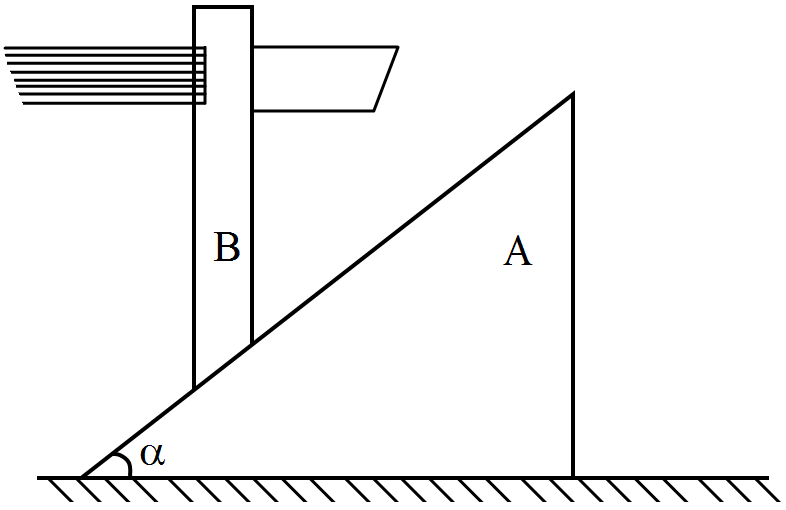
Find the acceleration of rod B and wedge A in the arrangement shown in figure, if the ratio of the mass of wedge to that of rod equals n and there is no friction between any contact surfaces.
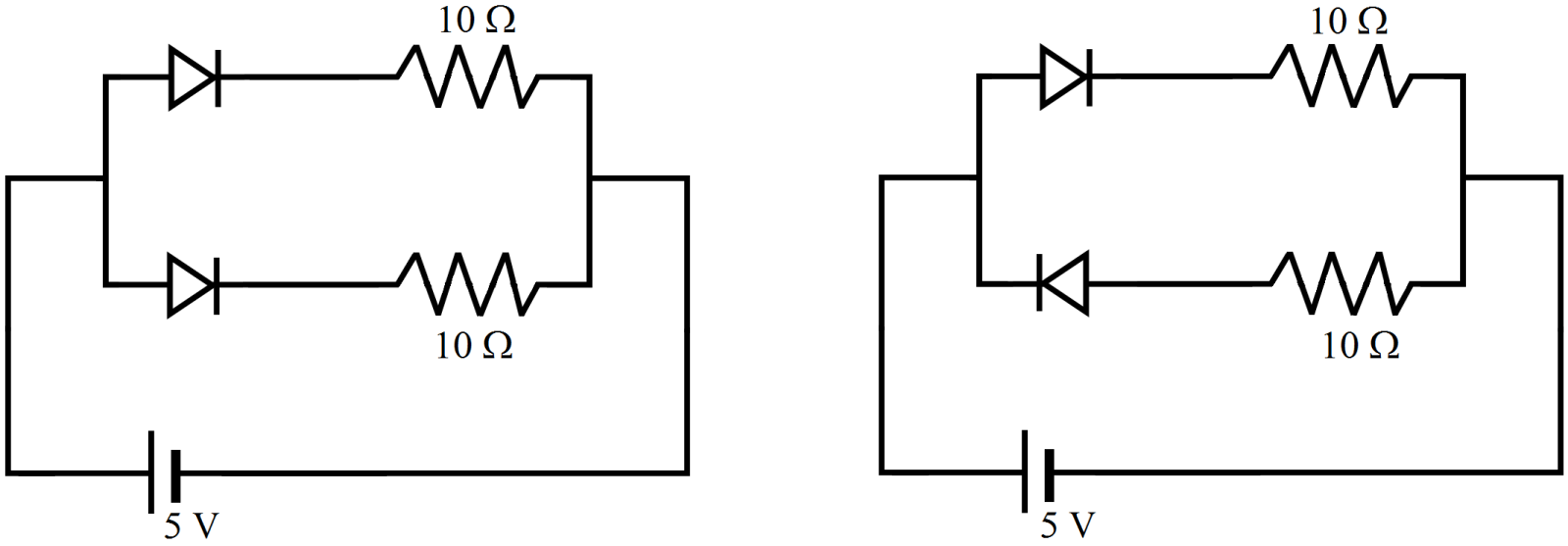
Find the current through the battery circuits shown in figure.