Question
In a single slit diffraction experiment, light of wavelength $\lambda$ illuminates the slit of width ‘a’ and the diffraction pattern is observed on a screen.
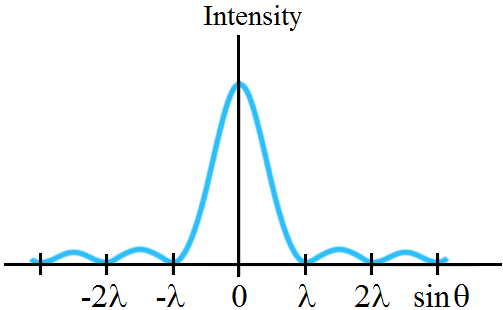
  1. Show the intensity distribution in the pattern with the angular position $\theta.$
  2. How are the intensity and angular width of central maxima affected when,
  1. Width of slit is increased,
  2. Separation between slit and screen is decreased?
Answer

  1.  
  1.  
  1. Intensity increases, angular width decreases.
  2. Intensity increases, no effect on angular width.

Need a full question paper?

Generate a complete, print-ready paper with questions like this in minutes — across 16+ boards, with answer keys.

Start Generating Free

Similar questions

Draw a labelled diagram of a full wave rectifier circuit. State its working principle. Show the input-output waveforms.
Carbon $(Z = 6)$ with mass number $11$ decays to boron $(Z = 5)$.
  1. Is it a $\beta^+-$decay or a $\beta^--$decay?
  2. The half$-$life of the decay scheme is $20.3$ minutes. How much time will elapse before a mixture of $90\%$ carbon$-11$ and $10\%$ boron$-11\ ($by the number of atoms$)$ converts itself into a mixture of $10\%$ carbon$-11$ and $90\%$ boron$-11$?
State the underlying principle of a potentiometer. Write two factors by which current sensitivity of a potentiometer can be increased. Why is a potentiometer preferred over a voltmeter for measuring the emf of a cell?
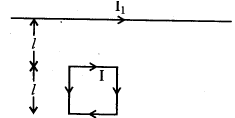
Write the expression for the magnetic moment $(\overrightarrow{\text{m}})$ due to a planar square loop of side $'l\ '$ carrying a steady current I in a vector form. In the given figure this loop is placed in a horizontal plane near a long straight conductor carrying a steady current $I_1$ at a distance l as shown. Give reasons to explain that the loop will experience a net force but no torque. Write the expression for this force acting on the loop.
Hydrogen atom in its ground state is excited by means of monochromatic radiation of wavelength $975 \stackrel{\circ}{A}$.
$i.$  How many different lines are possible in the resulting spectrum?
$ii.$ Calculate the longest wavelength amongst them. You may assume the ionization energy for hydrogen atom as $13.6 eV$ .
Two identical particles, each having a charge of $2.0 \times 10^{-4}C$ and mass of $10g,$ are kept at a separation of $10\ cm$ and then released. What would be the speeds of the particles when the separation becomes large?
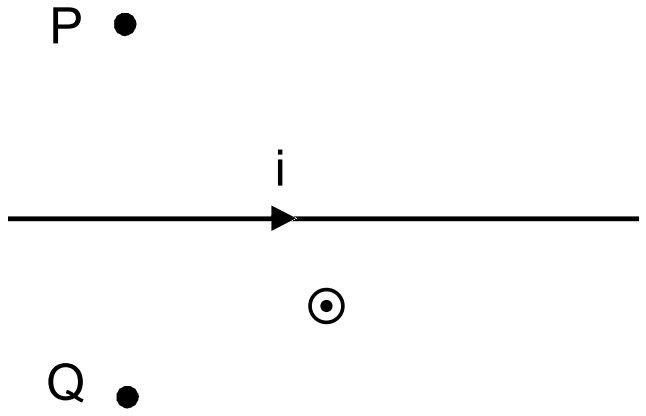
A long, straight wire carrying a current of $1.0A$ is placed horizontally in a uniform magnetic field $B = 1.0 \times 10^{-5}T$ pointing vertically upward figure. Find the magnitude of the resultant magnetic field at the points $P$ and $Q,$ both situated at a distance of $2.0\ cm$ from the wire in the same horizontal plane.
The nucleus $^{235}_{92}\text{Y},$ initially at rest, decays into $^{231}_{90}\text{X}$ by emitting an $\alpha-$particle
$^{235}_{92}\text{Y}\xrightarrow{ \ \ \ \ \ \ \ \ } \ ^{231}_{90}\text{X}+ \ ^4_2\text{He}+\text{energy}.$
The binding energies per nucleon of the parent nucleus, the daughter nucleus and $\alpha-$particle are $7.8\ MeV, 7.835\ MeV$ and $7.07\ MeV,$ respectively. Assuming the daughter nucleus to be formed in the unexcited state and neglecting its share in the energy of the reaction, find the speed of the emitted $\alpha-$particle. $($Mass of $\alpha-$ particle $= 6.68 \times 10^{–27}kg).$
You have learnt that plane and convex mirrors produce virtual images of objects. Can they produce real images under some circumstances? Explain.
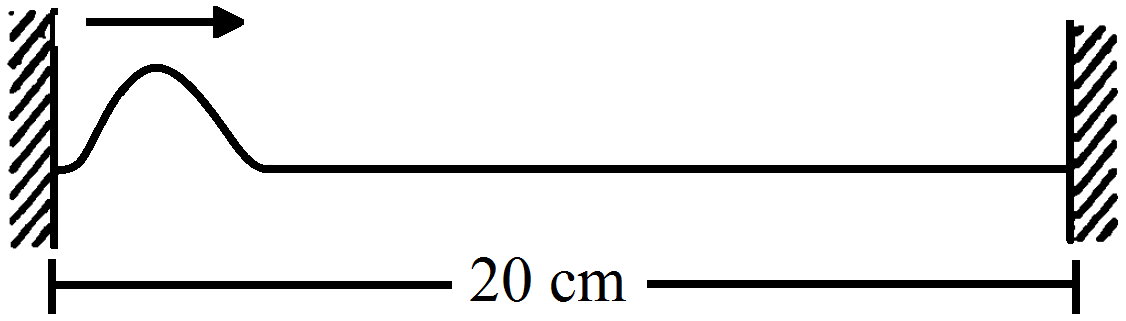
A string of length 20cm and linear mass density 0.40g/cm is fixed at both ends and is kept under a tension of 16N. A wave pulse is produced at t = 0 near an end as shown in figure, which travels towards the other end.
  1. When will the string have the shape shown in the figureagain
  2. Sketch the shape of the string at a time half of that found in part (a).