Question
State the underlying principle of a potentiometer. Write two factors by which current sensitivity of a potentiometer can be increased. Why is a potentiometer preferred over a voltmeter for measuring the emf of a cell?

Answer

Principle: The potential drop, across a part of a length l of a uniform wire of length L (L>l), is proportional to the length l.
Two factors:
  1. Increasing the length L of the wire.
  2. Connecting a suitable resistance, R, in series with the potentiometer wire.
Reason: At the balance position, there is no net current drawn, from the cell and the cell is effectively in an open circuit condition. This is not so for a voltmeter.

Need a full question paper?

Generate a complete, print-ready paper with questions like this in minutes — across 16+ boards, with answer keys.
Start Generating Free

Similar questions

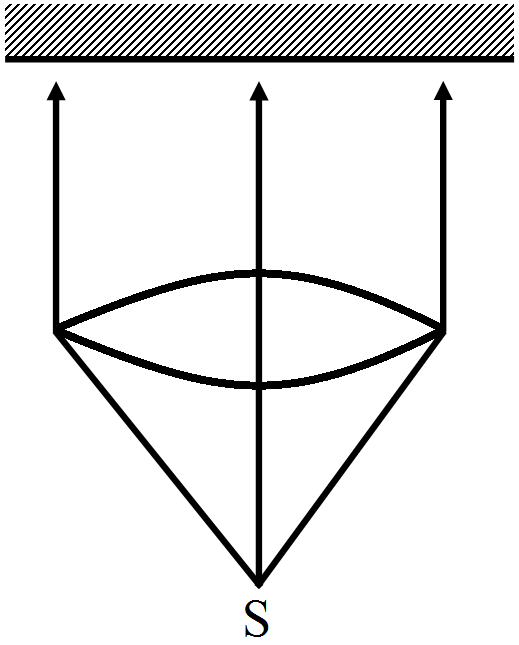
A totally reflecting, small plane mirror placed horizontally faces a parallel beam of light, as shown in the figure. The mass of the mirror is $20g.$ Assume that there is no absorption in the lens and that $30\%$ of the light emitted by the source goes through the lens. Find the power of the source needed to support the weight of the mirror. Take $g = 10\ m/s^2.$
In a $p-n$ junction, the depletion region is $400\ nm$ wide and an electric field of $5 \times 10^5\ V/m$ exists in it.
  1. Find the height of the potential barrier.
  2. What should be the minimum kinetic energy of a conduction electron which can diffuse from the $n-$side to the $p-$side?
A light ray falling at an angle of $45^\circ$ with the surface of a clean slab of ice of thickness $1m$ is refracted into it at an angle of $30^\circ$ . Calculate the time taken by the light rays, to cross the slab. Speed of light in vacuum $= 3 \times 10^8m/s$
  1. In a metre bridge [Fig. 3.27], the balance point is found to be at 39.5 cm from the end A, when the resistor Y is of $12.5\ \Omega.$ Determine the resistance of X. Why are the connections between resistors in a Wheatstone or meter bridge made of thick copper strips?
  2. Determine the balance point of the bridge above if X and Y are interchanged.
  3. What happens if the galvanometer and cell are interchanged at the balance point of the bridge? Would the galvanometer show any current?
Draw a graph showing the variation of decay rate with number of active nuclei.
Write nuclear reaction equations for
  1. $\alpha\text{-decay of }\ ^{226}_{88}\text{Ra}$
  2. $\alpha-\text{decay of }\ ^{226}_{94}\text{Pu}$
  3. $\beta\text{-decay of }\ ^{32}_{15}\text{P}$
  4. $\beta\text{-decay of }\ ^{210}_{83}\text{Bi}$
  5. $\beta\text{-decay of }\ ^{11}_{6}\text{C}$
  6. $\beta^+\text{-decay of }\ ^{97}_{43}\text{Tc}$
  7. $\text{Electron capture of }\ ^{120}_{54}\text{Xe}$
What is interference of light? Give one example of interference in our daily life.
The weight of an object is more at the poles than at the equator. Is it benificial to purchase goods at equator and sell them at the pole? Does it matter whether a spring balance is used or an equal-beam balance is used?
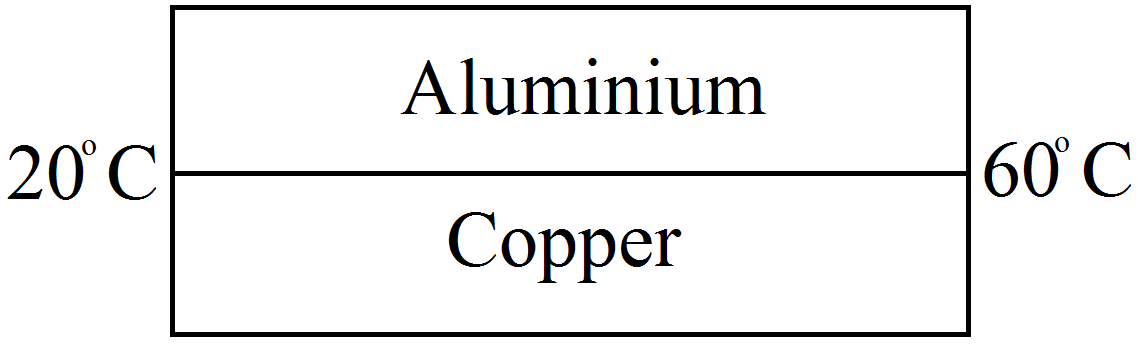
An aluminium rod and a copper rod of equal length $1.0m$ and cross$-$sectional area $1\ cm^2$ are welded together as shown in figure. One end is kept at a temperature of $20^\circ C$ and the other at $60^\circ C.$ Calculate the amount of heat taken out per second from the hot end. Thermal conductivity of aluminium $= 200\ Wm^{-1^\circ }C^{-1}$ and of copper $= 390\ Wm^{-1^\circ }C^{-1}.$
When a capacitor is connected in series $LR$ circuit, the alternating current flowing in the circuit increases. Explain why.