- Increase.
- Decrease.
- Remain the saint.
- May increase or decrease.
Explanation:

According to the first law of limiting friction,
$\text{f}=\mu\text{N}$
where f is the frictional force
N is the normal reaction force
$\mu$ is the coefficient of static friction
and
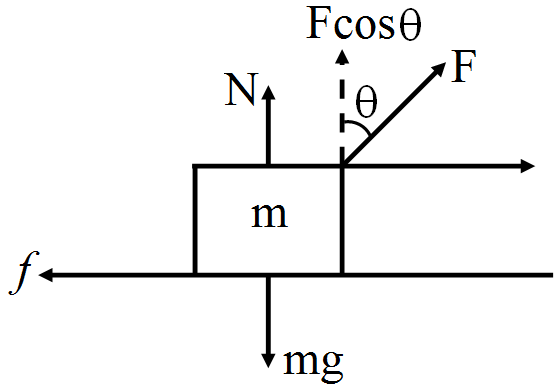
$\text{N = mg}-\text{F}\cos\theta$
where m is the mass of the body
F is the contact force acting on the body
If we decrease the angle between this contact force and the vertical, then $\text{F}\cos\theta$ increases and the normal reaction force (N) as well as the frictional force (f) decrease.
Generate a complete, print-ready paper with questions like this in minutes — across 16+ boards, with answer keys.
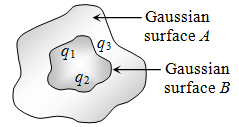
The electric flux for Gaussian surface A that enclose the charged particles in free space is (given q1 = –14 nC, q2 = 78.85 nC, q3 = – 56 nC)

|
(a) 103 Nm2 C–1 |
(b) 103 CN-1 m–2 |
(c) 6.32 × 10³ Nm2 C–1 |
(d) 6.32 × 10³ CN-1 m–2 |
The length of the optical path of two media in contact of length
and
of refractive indices
and
respectively, is
|
(a) |
(b) |
(c) |
(d) |
After 280 days, the activity of a radioactive sample is 6000 dps. The activity reduces to 3000 dps after another 140 days. The initial activity of the sample in dps is
| (a) 6000 | (b) 9000 | (c) 3000 | (d) 24000 |
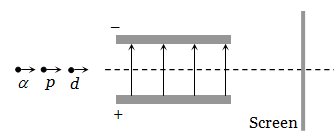
A proton, a deutron and an a-particle having the same momentum, enters a region of uniform electric field between the parallel plates of a capacitor. The electric field is perpendicular to the initial path of the particles. Then the ratio of deflections suffered by them is

|
(a) 1 : 2 : 8 |
(b) 1 : 2 : 4 |
(c) 1 : 1 : 2 |
(d) None of these |
Out of the following statements which is not correct
|
(a) When unpolarised light passes through a Nicol's prism, the emergent light is elliptically polarised |
|
(b) Nicol's prism works on the principle of double refraction and total internal reflection |
|
(c) Nicol's prism can be used to produce and analyse polarised light |
|
(d) Calcite and Quartz are both doubly refracting crystals |