MCQ
In a sonometer wire, the tension is maintained by suspending a $50.7 kg$ mass from the free end of the wire. The suspended mass has a volume of $ 0.0075 \, m^3$. The fundamental frequency of the wire is $260 Hz$. If the suspended mass is completely submerged in water, the fundamental frequency will become .... $Hz$ (take $g = 10 ms^{-2}$)
  • $240$
  • B
    $230$
  • C
    $220$
  • D
    $200$

Answer

Correct option: A.
$240$
a
$n = \frac{p}{{2l}}\sqrt {\frac{T}{m}}  \propto \sqrt T $

$\Rightarrow$$\frac{{{n_1}}}{{{n_2}}} = \sqrt {\frac{{{T_1}}}{{{T_2}}}} $

$\Rightarrow$$\frac{{260}}{{{n_2}}} = \sqrt {\frac{{50.7g}}{{(50.7 - 0.0075 \times {{10}^3})g}}} $

$\Rightarrow$${n_2} \approx 240$

Need a full question paper?

Generate a complete, print-ready paper with questions like this in minutes — across 16+ boards, with answer keys.

Start Generating Free

Similar questions

At critical temperature, the surface tension of a liquid
A buggy of mass $100\, kg$ is free to move on a frictionless horizontal track. Two men, each of mass $50\, kg$, are standing on the buggy, which is initially stationary. The men jump off the buggy with velocity $=10m/s$ relative to the buggy. In one situation, the men jump one after the other. In another situation, the men jump simultaneously. What is the ratio of the recoil velocities of the buggy in two cases?
The maximum velocity (in $ms^{-1}$) with which a car driver must traverse a flat curve of radius $150 \,m$ and coefficient of friction $0.6$ to avoid skidding is
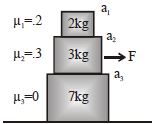
Find the acceleration of $a_1, a_2$ and $a_3$. If $10\,N$ force $F$ is applied on $3\,kg$ block :-
In case of a forced vibration, the resonance wave becomes very sharp when the
Two sirens situated one kilometer apart are producing sound of frequency $330 Hz$. An observer starts moving from one siren to the other with a speed of $2 m/s$. If the speed of sound be $330 m/s$, what will be the beat frequency heard by the observer
If the density of the material increases, the value of Young's modulus
A black coloured solid sphere of radius $R$ and mass $M$ is inside a cavity with vacuum inside. The walls of the cavity are maintained at temperature $T_0$. The initial temperature of the sphere is $3T_0$. If the specific heat of the material of the sphere varies as $\alpha T^3$ per unit mass with the temperature $T$ of the sphere, where $\alpha $ is a constant, then the time taken for the sphere to cool down to temperature $2T_0$ will be ( $\sigma $ is Stefan Boltzmann constant)
The time period of a satellite, revolving above earth's surface at a height equal to $R$ will be (Given $g =\pi^2 m / s ^2, R =$ radius of earth)
A vernier callipers used by student has $20$ divisions in $1\;cm$ on main scale. $10$ vernier divisions coincide with $9$ main scale divisions. When jaws are closed, zero of main scale is on left of zero of vernier scale and $6\ th$ division of vernier scale coincides with any of main scale divisions. He places a wooden cylinder in between the jaws and measures the length. The zero of vernier scale is on right of $3.20\;cm$ and $8\ th$ vernier division coincides with any main scale division. When he measures thickness of cylinder he finds that zero of vernier scale lies on right of $1.50\;cm$ mark of main scale and $6\ th$ division of vernier scale coincides with any main scale division. The correct values of measured length and diameter are respectively