In a steady state, the temperature at the end $A$ and $B$ of $20\,cm$ long rod $AB$ are $100\,^oC$ and $0\,^oC$ respectively. The temperature of a point $9\,cm$ from $A$ is....... $^oC$
Medium
Download our app for free and get started
$\mathrm{H}=\frac{100-0}{\mathrm{R}_{\mathrm{AH}}}=$ Heat current $=\frac{100}{\mathrm{R}_{\mathrm{AB}}}$
$100-\theta_{\mathrm{C}}=\mathrm{H} \cdot \mathrm{R}_{\mathrm{AC}}=\frac{100}{\mathrm{R}_{\mathrm{AB}}} \cdot \mathrm{R}_{\mathrm{AC}}$
$=\frac{100 \times 9}{20}=45$
$\therefore \quad \theta_{\mathrm{C}}=55^{\circ} \mathrm{C}$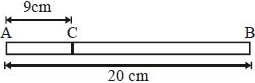

Download our appand get started for free
Experience the future of education. Simply download our apps or reach out to us for more information. Let's shape the future of learning together!No signup needed.*
Similar Questions
- 1A bowl filled with very hot soup cools from $98^{\circ}\,C$ to $86^{\circ}\,C$ in $2$ minutes when the room temperature is $22^{\circ}\,C$. $..........\,minutes$ long it will take to cool from $75^{\circ}\,C$ to $69^{\circ}\,C$ ?View Solution
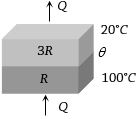
- 2In the following figure, two insulating sheets with thermal resistances $R$ and $3R$ as shown in figure. The temperature $\theta$ is ...... $^oC$View Solution
- 3A black body is at a temperature of $500 \;K$, it emits energy at a rate which is proportional toView Solution
- 4If the temperature of the sun were to be increased from $T$ to $2T$ and its radius from $R$ to $2R$ , then the ratio of the radiant energy received on the earth to what it was previously will beView Solution
- 5A hollow sphere of inner radius $R$ and outer radius $2R$ is made of a material of thermal conductivity $K$. It is surrounded by another hollow sphere of inner radius $2R$ and outer radius $3R$ made of same material of thermal conductivity $K$. The inside of smaller sphere is maintained at $0^o C$ and the outside of bigger sphere at $100^o C$. The system is in steady state. The temperature of the interface will be ........ $^oC$View Solution
- 6The energy emitted per second by a black body at ${27^o}C$ is $10\;J$. If the temperature of the black body is increased to ${327^o}C$, the energy emitted per second will be ......... $J$View Solution
- 7Two sphere of radius $R_1$ and $R_2$ have densities ${\rho _1}$ and ${\rho _2}$ and specific heat $S_1$ and $S_2$ if they are heated to the same temperature the ratio of their rates of falling temperature will beView Solution
- 8Consider two rods of same length and different specific heats $\left(S_{1}, S_{2}\right)$, conductivities $\left(K_{1}, K_{2}\right)$ and area of cross-sections $\left(A_{1}, A_{2}\right)$ and both having temperatures $T_{1}$ and $T_{2}$ at their ends. If rate of loss of heat due to conduction is equal, thenView Solution
- 9It takes $10$ minutes to cool a liquid from $61^oC$ to $59^oC$. If room temperature is $30^oC$ then time taken in cooling from $51^oC$ to $49^oC$ is ....... $\min$View Solution
- 10The coefficients of thermal conductivity of copper, mercury and glass are respectively $Kc, Km$ and $Kg$ such that $Kc > Km > Kg$ . If the same quantity of heat is to flow per second per unit area of each and corresponding temperature gradients are $Xc, Xm$ and $Xg$ , thenView Solution