MCQ
In a system of particles, internal forces can change (for the system)
  • A
    The linear momentum but not the kinetic energy
  • The kinetic energy but not the linear momentum
  • C
    Linear momentum as well as kinetic energy
  • D
    Neither the linear mometum nor the kinetic energy
Answer

Correct option: B.
The kinetic energy but not the linear momentum
b
Due to the work done by internal for os kinetic energy of system of particles can change but both action and reaction of internal forces are there within the system so no change in momentum take place.

Need a full question paper?

Generate a complete, print-ready paper with questions like this in minutes — across 16+ boards, with answer keys.

Start Generating Free

Similar questions

Electron of mass $m$ and charge $q$ is travelling with a speed along a circular path of radius $r$ at right angles to a uniform magnetic field of intensity $B$. If the speed of the electron is doubled and the magnetic field is halved the resulting path would have a radius
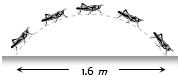
A grasshopper can jump maximum distance $1.6\; m$. It negligible time of the ground. How far can it go in $10 \;s$?
The $(x, y)$ coordinates of the corners of a square plate are $(0, 0), (L, 0), (L, L)$ and $(0, L).$ The edges of the plate are clamped and transverse standing waves are set up in it. If $u(x, y)$ denotes the displacement of the plate at the point $(x, y)$ at some instant of time, the possible expression(s) for $u$ is(are) ($a =$ positive constant)
A silicon speciman is made into a $P-$type semi-conductor by dopping, on an average, one Indium atom per $5 \times {10^7}$silicon atoms. If the number density of atoms in the silicon specimen is $5 \times {10^{28}}{\rm{atoms}}/{m^3}$ then the number of acceptor atoms in silicon per cubic centimetre will be
An unpolarised light beam strikes a glass surface at Brewster's angle. Then
A cubic block of mass $m$ is sliding down on an inclined plane at $60^{\circ}$ with an acceleration of $\frac{\mathrm{g}}{2}$, the value of coefficient of kinetic friction is
The amount of radiation emitted by a perfectly black body is proportional to
Near and far points of a human eye are
If the total energy transferred to a surface in time t is $6.48 \times 10^5 J$, then the magnitude of the total momentum delivered to this surface for complete absorption will be :
Radiation $p$ with wavelength $6561\;\mathring A$ falls on a metal surface to produce photoelectrons. The electrons are made to enter a uniform magnetic field of $3 \times 10^{-4}\; T$. If the radius of the largest circular path followed by the electrons is $10 \;\mathrm{mm},$ the work function of the metal is close to ............... $eV$