MCQ
In a tonga, horse pulls a wagon. Which is the correct analysis of the situation?
  • A
    The tonga moves forward because the horse pulls forward slightly harder on the wagon than the wagon pulls backward on the horse.
  • B
    Because action always equals reaction, the horse cannot pull the wagon. The wagon pull backward just as hard as the horse pulls forward, there is no motion.
  • The horse's force on the wagon is as strong as the force of the wagon on the horse.
  • D
    The horse can pull the wagon forward only if it weighs more than the wagon.

Answer

Correct option: C.
The horse's force on the wagon is as strong as the force of the wagon on the horse.
c

Need a full question paper?

Generate a complete, print-ready paper with questions like this in minutes — across 16+ boards, with answer keys.

Start Generating Free

Similar questions

A body of mass ${m_1}$ moving with a velocity$ 3 ms^{-1}$ collides with another body at rest of mass ${m_2}.$After collision the velocities of the two bodies are $2 ms^{-1} \,and \, 5ms^{-1}$ respectively along the direction of motion of ${m_1}$ The ratio $ \frac{m_1}{m_2}= $ 
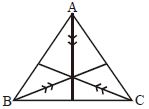
Three particles $A, B$ & $C$ of equal mass move with speed $V$ as shown to strike at  centroid of equilateral triangle after collision. $A$ comes to rest & $B$ retraces its path  with speed $V$. speed of $C$ after collision is :-
A body thrown vertically up with a velocity 'u' reaches the maximum height 'h' after 'T' second. The correct statement among the following is:
A body of mass 5kg is thrown vertically up with a kinetic energy of 490J. The height at which the kinetic energy of the body becomes half of the original value is:
Triple point of water is
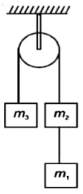
Three blocks of masses $m_1=4 \,kg , m_2=2 \,kg , m_3=4 \,kg$ are connected with ideal strings passing over a smooth. massless pulley as shown in figure. The acceleration of blocks will be ......... $m / s ^2$ $\left(g=10 \,m / s ^2\right)$
The angle of projection for a projectile to have same horizontal range and maximum height is :
Which of the following quantities is zero, when a uniform object is being supported at its centre of gravity?
The surface tension of a liquid is $70\,dyne/cm$. In $MKS$ system its value is 
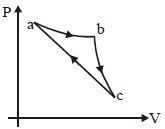
In the $P-V$ diagram shown, the gas does $5\, J$ of work in isothermal process $ab$ and $4\,J$ in adiabatic process $bc$.   .... $J$ will be the change in internal energy of the gas in straight path $c$ to $a$ ?