Question
In a transistor

Answer

Transitor : Structure and action

Need a full question paper?

Generate a complete, print-ready paper with questions like this in minutes — across 16+ boards, with answer keys.
Start Generating Free

Similar questions

If atmospheric electric field is approximately $150 \,volt / m$ and radius of the earth is $6400 \,km$, then the total charge on the earth's surface is .......... coulomb
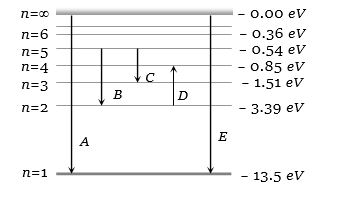
The energy levels of the hydrogen spectrum is shown in figure. There are some transitions $A, B, C, D$ and $E.$ Transition $A, B$ and $C$ respectively represent
When a source of sound crosses a stationary observer then the change in apparent frequency of sound observed by the observer, when $V_{ s } < < V$, will be -
Two lenses of power $ 6D$ and $-2D$ are combined to form a single lens. The focal length of this lens will be
An object moving in a circular path at constant speed has constant
In electromagnetic theory, the electric and magnetic phenomena are related to each other. Therefore, the dimensions of electric and magnetic quantities must also be related to each other. In the questions below, $[E]$ and $[B]$ stand for dimensions of electric and magnetic fields respectively, while $\left[\varepsilon_0\right]$ and $\left[\mu_0\right]$ stand for dimensions of the permittivity and permeability of free space respectively. $[L]$ and $[T]$ are dimensions of length and time respectively. All the quantities are given in $SI$ units.

($1$) The relation between $[E]$ and $[B]$ is

$(A)$ $[ E ]=[ B ][ L ][ T ]$  $(B)$ $[ E ]=[ B ][ L ]^{-1}[ T ]$  $(C)$ $[ E ]=[ B ][ L ][ T ]^{-1}$  $(D)$ $[ E ]=[ B ][ L ]^{-1}[ T ]^{-1}$

($2$) The relation between $\left[\varepsilon_0\right]$ and $\left[\mu_0\right]$ is

$(A)$ $\left[\mu_0\right]=\left[\varepsilon_0\right][ L ]^2[ T ]^{-2}$  $(B)$ $\left[\mu_0\right]=\left[\varepsilon_0\right][ L ]^{-2}[ T ]^2$   $(C)$ $\left[\mu_0\right]=\left[\varepsilon_0\right]^{-1}[ L ]^2[ T ]^{-2}$  $(D)$ $\left[\mu_0\right]=\left[\varepsilon_0\right]^{-1}[ L ]^{-2}[ T ]^2$

Give the answer or quetion ($1$) and ($2$)

According to Bohr's theory the moment of momentum of an electron revolving in second orbit of hydrogen atom will be
In the musical octave ‘Sa’, ‘Re’, ‘Ga’
For a gas the difference between the two specific heats is $4150\, J/kg\, K.$ What is the specific heats at constant volume of gas if the ratio of specific heat is $1.4$
The focal length of a combination of lenses formed with lenses having powers of $+ 2.50 D$ and $-3.75 D$ will be....$cm$