MCQ
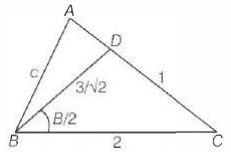
In a $\triangle A B C$, the angle bisector $B D$ of $\angle B$ intersects $A C$ in $D$. Suppose $B C=2, C D=1$ and $B D=\frac{3}{\sqrt{2}}$. The perimeter of the $\triangle A B C$ is
  • A
    $\frac{17}{2}$
  • $\frac{15}{2}$
  • C
    $\frac{17}{4}$
  • D
    $\frac{15}{4}$

Answer

Correct option: B.
$\frac{15}{2}$
b
(b)

We have, $\cos \frac{B}{2}=\frac{\frac{9}{2}+4-1}{6 \sqrt{2}}=\frac{5}{4 \sqrt{2}}$

$\therefore$ Length of angle bisector,

$B D=\frac{2 a c}{a+c} \cos \frac{B}{2}$

$\frac{3}{\sqrt{2}} =\left(\frac{4 c}{e+2}\right) \cdot \frac{5}{4 \sqrt{2}}$

$c =3$

We know that, $\frac{A B}{B C}=\frac{A D}{C D}$

$A D=\frac{3}{2}$

$\therefore$ Perimeter of $\triangle A B C=1+\frac{3}{2}+3+2=\frac{15}{2}$

Need a full question paper?

Generate a complete, print-ready paper with questions like this in minutes — across 16+ boards, with answer keys.

Start Generating Free

Similar questions

Suppose $\theta \in\left[0, \frac{\pi}{4}\right]$ is a solution of $4 \cos \theta-3 \sin \theta=1$ Then $\cos \theta$ is equal to :
The mean and variance of $7$ observations are $8$ and $16,$ respectively. If five observations are $2, 4, 10,12,14,$ then the absolute difference of the remaining two observations is 
Let $Z$ be the set of all integers,

$\mathrm{A}=\left\{(\mathrm{x}, \mathrm{y}) \in \mathbb{Z} \times \mathbb{Z}:(\mathrm{x}-2)^{2}+\mathrm{y}^{2} \leq 4\right\}$

$\mathrm{B}=\left\{(\mathrm{x}, \mathrm{y}) \in \mathbb{Z} \times \mathbb{Z}: \mathrm{x}^{2}+\mathrm{y}^{2} \leq 4\right\} \text { and }$

$\mathrm{C}=\left\{(\mathrm{x}, \mathrm{y}) \in \mathbb{Z} \times \mathbb{Z}:(\mathrm{x}-2)^{2}+(\mathrm{y}-2)^{2} \leq 4\right\}$

If the total number of relation from $\mathrm{A} \cap \mathrm{B}$ to $\mathrm{A} \cap \mathrm{C}$ is $2^{\mathrm{p}}$, then the value of $\mathrm{p}$ is :

If $12a + 5b = 9$, where $a, b$ $\in$ $R$, then minimum value of $a^2 + b^2$ is -
Let $S=\left\{x \in[-6,3]-\{-2,2\}: \frac{|x+3|-1}{|x|-2} \geq 0\right\}$ and $T =\left\{ x \in Z: x ^{2}-7| x |+9 \leq 0\right\}$. Then the number of elements in $S \cap T$ is $....$
$\mathop {\lim }\limits_{x \to 0} \frac{{{{(1 + x)}^{1/2}} - {{(1 - x)}^{1/2}}}}{x} = $
If $\text{y}=\frac{\sin(\text{x}+9)}{\cos\text{x}},$ then $\frac{\text{dy}}{\text{dx}}$ at x = 0 is:
The value of ${a^{{{\log }_b}x}}$, where $a = 0.2,\;b = \sqrt 5 ,\;x = \frac{1}{4} + \frac{1}{8} + \frac{1}{{16}} + .........$to $\infty $ is
The symmetric difference of A = {1, 2, 3} and B = {3, 4, 5} is:
  1. {1, 2}
  2. {1, 2, 4, 5}
  3. {4, 3}
  4. {2, 5, 1, 4, 3}.
If $\left(\frac{3^{6}}{4^{4}}\right) \mathrm{k}$ is the term, independent of $\mathrm{x}$, in the binomial expansion of $\left(\frac{\mathrm{x}}{4}-\frac{12}{\mathrm{x}^{2}}\right)^{12}$, then $\mathrm{k}$ is equal to ...... .