Question
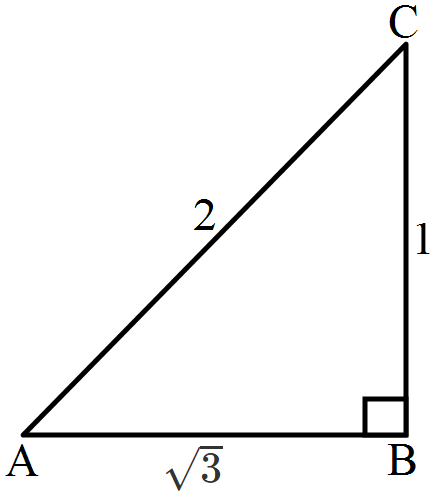
In a $\triangle\text{ABC},\angle\text{B}=90^\circ$ and $\tan\text{A}=\frac{1}{\sqrt{3}}.$ Prove that:
  1. $\sin\text{A}\cdot\cos\text{C}+\cos\text{A}\cdot\sin\text{C}=1$
  2. $\cos\text{A}\cdot\cos\text{C}-\sin\text{A}\cdot\sin\text{C}=0$
Answer


$\tan\text{A}=\frac{1}{\sqrt{3}}$
Consider $\triangle\text{ABC},$ where $\angle\text{B}=90^\circ$
Then, $\tan\text{A}=\frac{\text{Perpendicular}}{\text{Base}}=\frac{\text{BC}}{\text{AB}}=\frac{1}{\sqrt{3}}$
Let BC = 1 and $\text{AB}=\sqrt{3}$
Then, by Pythagoras theoram,
$\text{AC}^2=\text{AB}^2+\text{BC}^2$
$=\big(\sqrt{3}\big)^2+1^2=3+1=4$
$\Rightarrow\text{AC}=2$
Now,
$\sin\text{A}=\frac{\text{Perpendicular}}{\text{Hypotenuse}}=\frac{\text{BC}}{\text{AC}}=\frac12$ and $\cos\text{A}=\frac{\text{Base}}{\text{Hypotenuse}}=\frac{\text{AB}}{\text{AC}}=\frac{\sqrt{3}}{2}$
$\sin\text{C}=\frac{\text{Perpendicular}}{\text{Hypotenuse}}=\frac{\text{AB}}{\text{AC}}=\frac{\sqrt{3}}{2}$ and $\cos\text{C}=\frac{\text{Base}}{\text{Hypotenuse}}=\frac{\text{AB}}{\text{AC}}=\frac{1}{2}$
  1. $\text{L.H.S.}=\sin\text{A}\cos\text{C}+\cos\text{A}\sin\text{C}$
$=\frac12\times\frac12+\frac{\sqrt{3}}{2}\times\frac{\sqrt{3}}{2}$

$=\frac14+\frac{3}{4}$

$=\frac44$

$=1$

$=\text{R.H.S.}$
  1. $\text{L.H.S.}=\cos\text{A}\cos\text{C}-\sin\text{A}\sin\text{C}$
$=\frac{\sqrt{3}}{2}\times\frac12-\frac12\times\frac{\sqrt{3}}{2}$

$=\frac{\sqrt{3}}{4}-\frac{\sqrt{3}}{4}$

$=0$

$=\text{R.H.S.}$

Need a full question paper?

Generate a complete, print-ready paper with questions like this in minutes — across 16+ boards, with answer keys.

Start Generating Free

Similar questions

If $(\sec\theta+\tan\theta)=\text{m}$ and $(\sec\theta-\tan\theta)=\text{n},$ show that mn = 1.
Show that every positive odd integer is of the form (4q + 1) or (4q + 3) for some integer q.
Show graphically that each of the following given systems of equations has infinitely many solutions:
x - 2y = 5, 3x - 6y = 15
Solve for $x$ and $y$:
$\frac{\text{bx}}{\text{a}}+\frac{\text{ay}}{\text{b}}=\text{a}^2+\text{b}^2,$
$\text{x}+\text{y}=\text{2ab}$
Solve the following quadratic equation:
$\frac{\text{1}}{\text{x}+1}+\frac{\text{3}}{\text{5x}+1}=\frac{5}{\text{x}+4},$ $\text{x}\neq-1,-\frac{1}{5},-4$
The daily expenditure of 100 families are given below. Calculate $f_1$ and $f_2$ if the mean daily expenditure is ₹188.
Expenditure (in Rs.)
$140-160$
$160-180$
$180-200$
$200-220$
$220-240$
Number of families
$5$
$25$
$f_1​​​​​​​$
$f_2​​​​​​​$
$5$
If 18, a, (b - 3) are in AP, then find the value of (2a - b).
Draw two concentric circles of radii 4cm and 6cm. Contruct a tangent to the smaller circle from a point on the larger circle. Measure the length of this tangent.
Find the roots of the following equation, if they exist, by applying the quadratic formula:
$a^2b^2x^2 - (4b^4 - 3a^4)x - 12a^2b^2 = 0$, $ \text{a}\neq0$ and $\text{b}\neq0$
A man arranges to pay off a debt of $₹ 36000$ by $40$ monthly instalments which form an arithmetic series. When $30$ of the instalments are paid, he dies leaving one-third of the debt unpaid. Find the value of the first instalment.