Questions

5 Marks Question

Take a timed test

10 questions · self-marked practice — reveal the answer and mark yourself.

Question 15 Marks
If $\tan\theta=\frac{\text{a}}{\text{b}},$ show that $\frac{(\text{a}\sin\theta-\text{b}\cos\theta)}{(\text{a}\sin\theta+\text{b}\cos\theta)}=\frac{\big(\text{a}^2-\text{b}^2\big)}{\big(\text{a}^2 +\text{b}^2\big)}.$
Answer
Given:
$\tan\theta=\frac{\text{a}}{\text{b}}=\frac{\text{ak}}{\text{bk}}=\frac{\text{BC}}{\text{AB}}$
Let us draw a $\triangle\text{ABC}$ in which $\angle\text{B}=90^\circ$ and $\angle\text{A}=\theta$
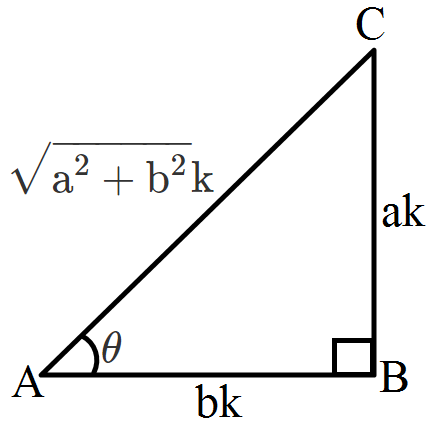
By pythagoras theoram, we have
$\text{AC}^2=\text{AB}^2+\text{BC}^2=\text{b}^2\text{k}^2+\text{a}^2\text{k}^2$
$\therefore\text{AC}=\sqrt{\text{a}^2+\text{b}^2}\text{k}$
$\sin\theta=\frac{\text{BC}}{\text{AC}}=\frac{\text{ak}}{\sqrt{\text{a}^2+\text{b}^2}\text{k}}=\frac{\text{a}}{\sqrt{\text{a}^2+\text{b}^2}}$
$\cos\theta=\frac{\text{AB}}{\text{AC}}=\frac{\text{bk}}{\sqrt{\text{a}^2+\text{b}^2}\text{k}}=\frac{\text{b}}{\sqrt{\text{a}^2+\text{b}^2}}$
$\text{L.H.S.}=\frac{\text{a}\sin\theta-\text{b}\cos\theta}{\text{a}\sin\theta+\text{b}\cos\theta}$
$=\frac{\text{a}\frac{\text{a}}{\sqrt{\text{a}^2+\text{b}^2}}-\text{b}.\frac{\text{b}}{\sqrt{\text{a}^2+\text{b}^2}}}{\text{a}\frac{\text{a}}{\sqrt{\text{a}^2+\text{b}^2}}+\text{b}.\frac{\text{b}}{\sqrt{\text{a}^2+\text{b}^2}}}=\frac{\frac{\text{a}^2-\text{b}^2}{\sqrt{\text{a}^2+\text{b}^2}}}{\frac{\text{a}^2+\text{b}^2}{\sqrt{\text{a}^2+\text{b}^2}}}=\frac{\text{a}^2-\text{b}^2}{\text{a}^2+\text{b}^2}$
$=\text{R.H.S.}$
View full question & answer
Question 25 Marks
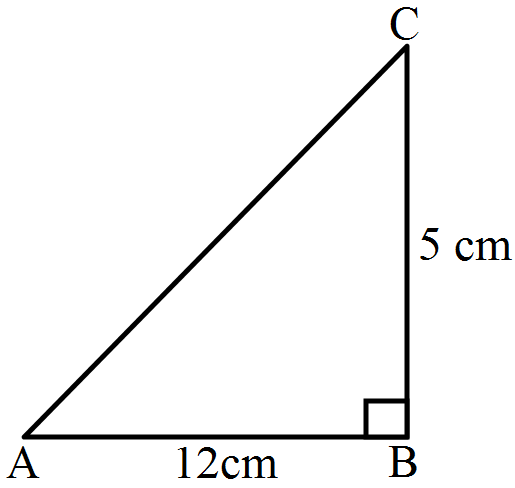
In a $\triangle\text{ABC},\angle\text{B}=90^\circ,\angle\text{AB}=12\text{cm}$ and BC = 5cm.
Find:
  1. $\cos\text{A}$
  2. $\text{cosec}\text{A}$
  3. $\cos\text{C}$
  4. $\text{cosec}\text{C}.$
Answer

In $\triangle\text{ABC},\angle\text{B}=90^\circ$
AB = 12cm and BC = 5cm
By Pythagoras theorem, we have
$\text{AC}^2=\text{AB}^2+\text{BC}^2$
$=12^2+5^2=144+25=169$
$\Rightarrow\text{AC}=13\text{cm}$
  1. $\cos\text{A}=\frac{\text{Base}}{\text{Hypotenuse}}=\frac{\text{AB}}{\text{AC}}=\frac{12}{13}$
  2. $\text{cosec}\text{A}=\frac{\text{Hypotenuse}}{\text{Perpendicular}}=\frac{\text{AC}}{\text{BC}}=\frac{13}{5}$
  3. $\cos\text{C}=\frac{\text{Base}}{\text{Hypotenuse}}=\frac{\text{BC}}{\text{AC}}=\frac{5}{13}$
  4. $\text{cosec}\text{C}=\frac{\text{Hypotenuse}}{\text{Perpendicular}}=\frac{\text{AC}}{\text{AB}}=\frac{13}{12}$
View full question & answer
Question 35 Marks
If $\text{x}=\text{cosec}\text{A}+\cos\text{A}$ and $\text{y}=\text{cosec}\text{A}-\cos\text{A}$ then Prove that $\Big(\frac{2}{\text{x}+\text{y}}\Big)^2+\Big(\frac{\text{x}-\text{y}}{2}\Big)^2-1=0.$
Answer
$\text{x}=\text{cosec}\text{A}+\cos\text{A}$ and $\text{y}=\text{cosec A}-\cos\text{A}$
Thus, we have
$\text{x}+\text{y}=(\text{cosec A}+\cos\text{A})\\+(\text{cosec A}-\cos\text{A})=2\text{cosec A}$
$\text{x}-\text{y}=(\text{cosec A}+\cos\text{A})\\-(\text{cosec A}-\cos\text{A})=2\cos\text{A}$
$\text{L.H.S.}=\Big(\frac{2}{\text{x}+\text{y}}\Big)^2+\Big(\frac{\text{x}-\text{y}}{2}\Big)^2-1$
$=\Big(\frac{2}{2\text{cosec A}}\Big)^2+\Big(\frac{2\cos\text{A}}{2}\Big)^2-1$
$=\Big(\frac{1}{\text{cosec A}}\Big)^2+(\cos\text{A})^2-1$
$=(\sin\text{A})^2+(\cos\text{A})^2-1$
$=\sin^2\text{A}+\cos^2\text{A}-1$
$=1-1$
$=0$
$=\text{R.H.S}$
View full question & answer
Question 45 Marks
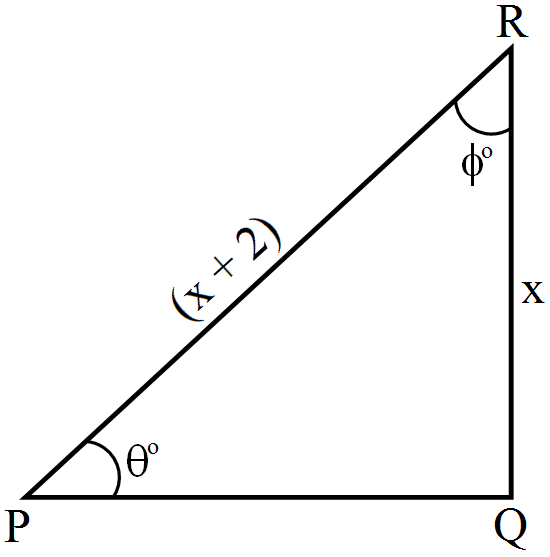
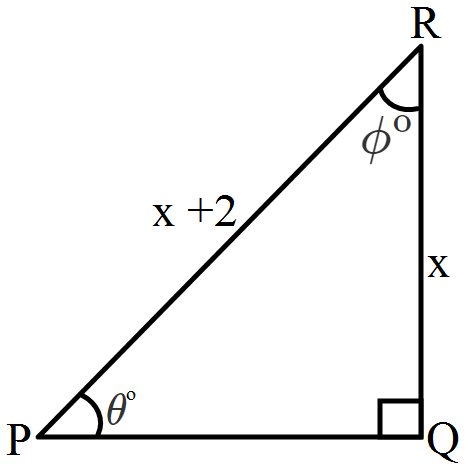
In the figure of $\triangle\text{PQR},\angle\text{P}=\theta^\circ$and $\angle\text{R}=\phi^\circ.$
Find:
  1. $\big(\sqrt{\text{x}+1}\big)\cot\phi$
  2. $\big(\sqrt{\text{x}^3+\text{x}^2}\big)\tan\theta$
  3. $\cos\theta$
Answer

In $\triangle\text{PQR},\angle\text{Q}=90^\circ,\angle\text{P}=\theta^\circ$ and $\angle\text{R}=\phi^\circ$
By Pythagoras theorem, we have
$\text{PQ}^2=\text{PR}^2-\text{QR}^2$
$=\big(\text{x}+2\big)^2-\text{x}^2=\text{x}^2+4\text{x}+4-\text{x}^2=4(\text{x}+1)$
$\Rightarrow\text{PQ}=2\sqrt{\text{x}+1}$
Now, $\cot\phi=\frac{\text{QR}}{\text{PQ}}=\frac{\text{x}}{2\sqrt{\text{x}+1}}$ and $\tan\theta=\frac{\text{QR}}{\text{PQ}}=\frac{\text{x}}{2\sqrt{\text{x}+1}}$
$\big(\sqrt{\text{x}+1}\big)\cot\phi=\big(\sqrt{\text{x}+1}\big)\times\frac{\text{x}}{2\sqrt{\text{x}+1}}=\frac{\text{x}}{2}$
$\big(\sqrt{\text{x}^3+\text{x}^2}\big)\tan\theta=\big(\sqrt{\text{x}^2(\text{x}+1)}\big)\\\tan\theta=\text{x}\big(\sqrt{\text{x}+1}\big)\times\frac{\text{x}}{2\sqrt{\text{x}+1}}=\frac{\text{x}^2}{2}$
$\cos\theta=\frac{\text{PQ}}{\text{PR}}=\frac{2\sqrt{\text{x}+1}}{\text{x}+2}$
View full question & answer
Question 55 Marks
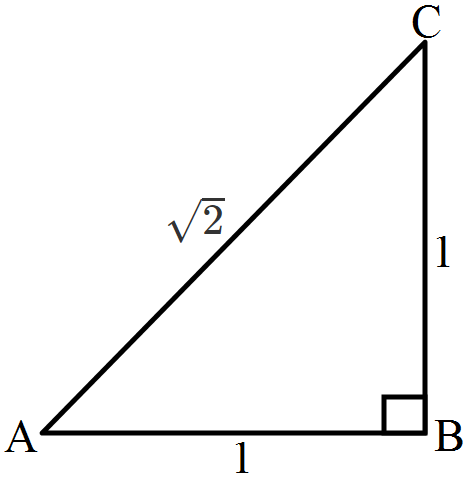
In a right $\triangle\text{ABC},$ right-angled at B, if $\tan\text{A}=1$ then verify that $2\sin\text{A}\cdot\cos\text{A}=1.$
Answer
$\tan\text{A}=1$
Consider $\triangle\text{ABC},$ where $\angle\text{B}=90^\circ$
Then, $\tan\text{A}=\frac{\text{Perpendicular}}{\text{Base}}=\frac{\text{BC}}{\text{AB}}=\frac11$
Let BC = 1 and AB = 1
Then, by Pythagoras theoram,
$\text{AC}^2=\text{AB}^2+\text{BC}^2$
$=2^2+1^2=1=2$
$\Rightarrow\text{AC}=\sqrt{2}$
Now,
$\sin\text{A}=\frac{\text{Perpendicular}}{\text{Hypotenuse}}=\frac{\text{BC}}{\text{AC}}=\frac{1}{\sqrt{2}}$
$\cos\text{A}=\frac{\text{Base}}{\text{Hypotenuse}}=\frac{\text{AB}}{\text{AC}}=\frac{1}{\sqrt{2}}$
$\therefore\text{L.H.S.}=2\sin\text{A}\cdot\cos\text{A}$
$=2\times\frac{1}{\sqrt{2}}\times\frac{1}{\sqrt{2}}$
$=\frac22$
$=1$
$=\text{R.H.S.}$
View full question & answer
Question 65 Marks
If $\cot\theta=\frac{3}{4},$ show that $\sqrt{\frac{\sec\theta-\text{cosec}\theta}{\sec\theta+\text{cosec}\theta}}=\frac{1}{\sqrt{7}}.$
Answer

$\cot\theta=\frac34$
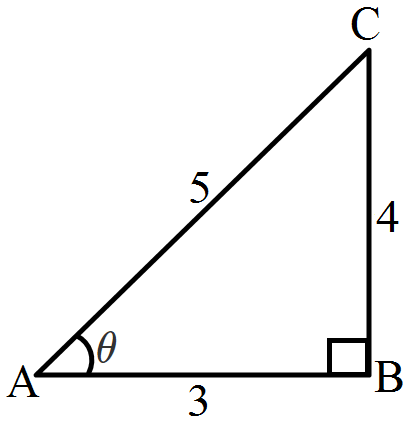
Consider $\triangle\text{ABC},$ where $\angle\text{B}=90^\circ$ and $\angle\text{A}=\theta$
Then, $\cot\theta=\frac{\text{Base}}{\text{Hypotenuse}}=\frac{\text{AB}}{\text{AC}}=\frac34$
Let $AB = 3$ and $BC = 4$
Then, by pythagoras theorem,
$AC^2 = AB^2 + BC^2$
$\Rightarrow 3^2 + 4^2$
$= 9 + 16 = 25$
$\Rightarrow AC = 5$
Now,
$\sec\theta=\frac{\text{Hypotenuse}}{\text{Base}}=\frac{\text{AC}}{\text{AB}}=\frac53$
$\text{cosec}\theta=\frac{\text{Hypotenuse}}{\text{Perpendicular}}=\frac{\text{AC}}{\text{BC}}=\frac54$
$\therefore\text{L.H.S.}=\sqrt{\frac{\sec\theta-\text{cosec}\theta}{\sec\theta-\text{cosec}\theta}}$
$=\sqrt{\frac{\frac{5}{3}-\frac{5}{4}}{\frac{5}{4}+\frac{5}{4}}}$
$=\sqrt{\frac{\frac{20-15}{12}}{\frac{20+15}{12}}}$
$=\sqrt{\frac{5}{35}}$
$=\sqrt{\frac{1}{7}}$
$=\frac{1}{\sqrt{7}}$
$=\text{R.H.S.}$
View full question & answer
Question 75 Marks
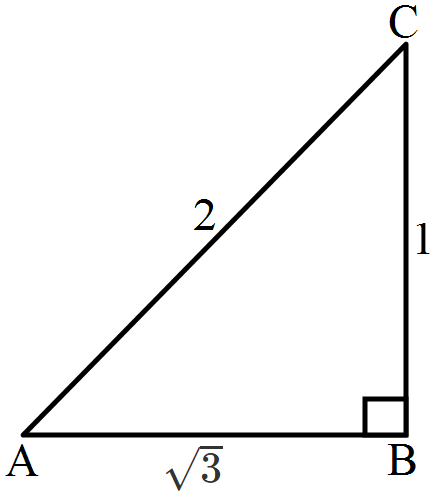
In a $\triangle\text{ABC},\angle\text{B}=90^\circ$ and $\tan\text{A}=\frac{1}{\sqrt{3}}.$ Prove that:
  1. $\sin\text{A}\cdot\cos\text{C}+\cos\text{A}\cdot\sin\text{C}=1$
  2. $\cos\text{A}\cdot\cos\text{C}-\sin\text{A}\cdot\sin\text{C}=0$
Answer

$\tan\text{A}=\frac{1}{\sqrt{3}}$
Consider $\triangle\text{ABC},$ where $\angle\text{B}=90^\circ$
Then, $\tan\text{A}=\frac{\text{Perpendicular}}{\text{Base}}=\frac{\text{BC}}{\text{AB}}=\frac{1}{\sqrt{3}}$
Let BC = 1 and $\text{AB}=\sqrt{3}$
Then, by Pythagoras theoram,
$\text{AC}^2=\text{AB}^2+\text{BC}^2$
$=\big(\sqrt{3}\big)^2+1^2=3+1=4$
$\Rightarrow\text{AC}=2$
Now,
$\sin\text{A}=\frac{\text{Perpendicular}}{\text{Hypotenuse}}=\frac{\text{BC}}{\text{AC}}=\frac12$ and $\cos\text{A}=\frac{\text{Base}}{\text{Hypotenuse}}=\frac{\text{AB}}{\text{AC}}=\frac{\sqrt{3}}{2}$
$\sin\text{C}=\frac{\text{Perpendicular}}{\text{Hypotenuse}}=\frac{\text{AB}}{\text{AC}}=\frac{\sqrt{3}}{2}$ and $\cos\text{C}=\frac{\text{Base}}{\text{Hypotenuse}}=\frac{\text{AB}}{\text{AC}}=\frac{1}{2}$
  1. $\text{L.H.S.}=\sin\text{A}\cos\text{C}+\cos\text{A}\sin\text{C}$
$=\frac12\times\frac12+\frac{\sqrt{3}}{2}\times\frac{\sqrt{3}}{2}$

$=\frac14+\frac{3}{4}$

$=\frac44$

$=1$

$=\text{R.H.S.}$
  1. $\text{L.H.S.}=\cos\text{A}\cos\text{C}-\sin\text{A}\sin\text{C}$
$=\frac{\sqrt{3}}{2}\times\frac12-\frac12\times\frac{\sqrt{3}}{2}$

$=\frac{\sqrt{3}}{4}-\frac{\sqrt{3}}{4}$

$=0$

$=\text{R.H.S.}$
View full question & answer
Question 85 Marks
If $\sec\theta=\frac{5}{4},$ show that $\frac{\big(\sin\theta-2\cos\theta\big)}{\big(\tan\theta-\cot\theta\big)}=\frac{12}{7}.$
Answer

$\sec\theta=\frac54\Rightarrow\cos\theta=\frac45$
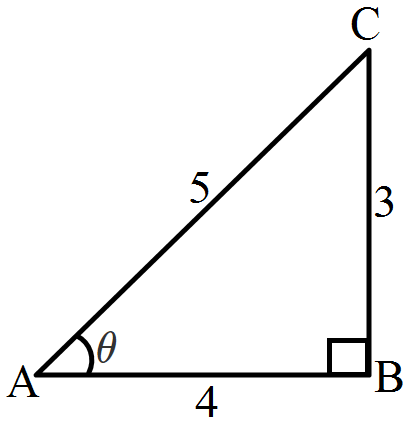
Consider $\triangle\text{ABC},$ where $\angle\text{B}=90^\circ$ and $\angle\text{A}=\theta$
Then, $\cos\theta=\frac{\text{Base}}{\text{Hypotenuse}}=\frac{\text{AB}}{\text{AC}}=\frac45$
Let $AB = 4$ and $AC = 5$
Then, by pythagoras theorem,
$AC^2 = AB^2 + BC^2$
$\Rightarrow BC^2 = AC^2 - AB^2$
$= 5^2 - 4^2 = 25 - 16 = 9$
$\Rightarrow BC = 3$
Now,
$\sin\theta=\frac{\text{Perpendicular}}{\text{Hypotenuse}}=\frac{\text{BC}}{\text{AC}}=\frac35$
$\tan\theta=\frac{\text{Perpendicular}}{\text{Base}}=\frac{\text{BC}}{\text{AB}}=\frac34$
$\cot\theta=\frac{1}{\tan\theta}=\frac43$
$\therefore\text{L.H.S.}=\frac{(\sin\theta-2\cos\theta)}{(\tan\theta-\cot\theta)}$
$=\frac{\frac35-2\times\frac45}{\frac{3}{4}-\frac43}$
$=\frac{\frac{3-8}{5}}{\frac{9-16}{12}}$
$=\frac{\frac{-5}{5}}{\frac{-7}{12}}$
$=\frac{-1}{\frac{-7}{12}}$
$=\frac{12}{7}$
$=\text{R.H.S.}$
View full question & answer
Question 95 Marks
If $\angle\text{A}$ and $\angle\text{B}$ are acute angles such that $\sin\text{A}=\sin\text{B}$ then prove that $\angle\text{A}=\angle\text{B}.$
Answer
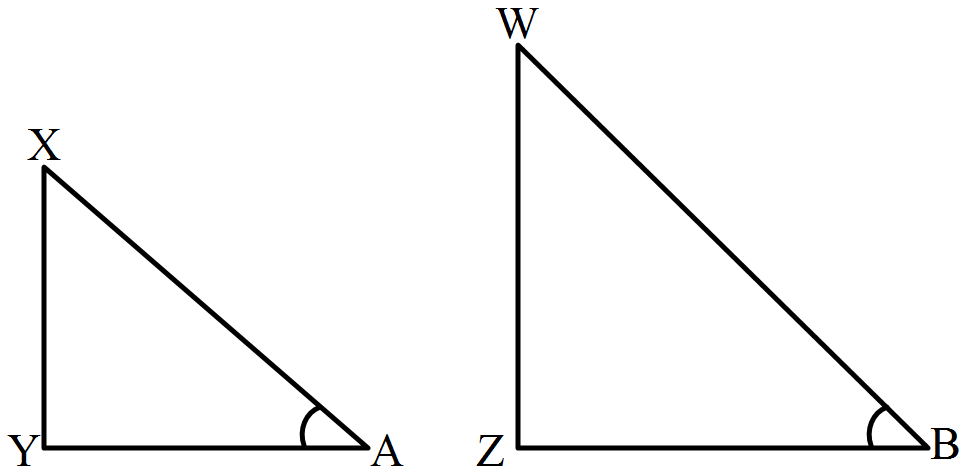
Consider two right $\triangle\text{XAY}$ and WBZ such that $\sin\text{A}=\sin\text{B}$

We have,
$\sin\text{A}=\frac{\text{XY}}{\text{XA}}$ and $\sin\text{B}=\frac{\text{WZ}}{\text{WB}}$
Since $\sin\text{A}=\sin\text{B}$
$\Rightarrow\frac{\text{XY}}{\text{XA}}=\frac{\text{WZ}}{\text{WB}}$
$\Rightarrow\frac{\text{XY}}{\text{WZ}}=\frac{\text{XA}}{\text{WB}}=\text{k}(\text{say})\dots(\text{i})$
$\Rightarrow\text{XY}=\text{k}\times\text{WZ}$ and $\text{XA}=\text{k}\times\text{WB}\dots(\text{ii})$
Using Pythagoras theoram in $\triangle\text{XAY}$ and WBZ, we have
$\text{XA}^2=\text{XY}^2+\text{AY}^2$ and $\text{WB}^2=\text{WZ}^2+\text{BZ}^2$
$\Rightarrow\text{AY}=\sqrt{\text{XA}^2-\text{XY}^2}$ and $\text{BZ}=\sqrt{\text{WB}^2-\text{WZ}^2}$
$\Rightarrow\frac{\text{AY}}{\text{BZ}}=\frac{\sqrt{\text{XA}^2-\text{XY}^2}}{\sqrt{\text{WB}^2-\text{WZ}^2}}=\frac{\sqrt{\text{k}^2\text{WB}^2-\text{k}^2\text{WZ}^2}}{\sqrt{\text{WB}^2-\text{WZ}^2}}$
$\Rightarrow\frac{\text{AY}}{\text{BZ}}=\text{k}\dots(\text{iii})$
From (i), (ii) and (iii), we get
$\frac{\text{XY}}{\text{WZ}}=\frac{\text{XA}}{\text{WB}}=\frac{\text{AY}}{\text{BZ}}$
$\Rightarrow\triangle\text{XYA}\sim\triangle\text{WZB}$
$\Rightarrow\angle\text{A}=\angle\text{B}$
View full question & answer
Question 105 Marks
If $\angle\text{A}$ and $\angle\text{B}$ are acute angles such that $\tan\text{A}=\tan\text{B}$ then prove that $\angle\text{A}=\angle\text{B}.$
Answer
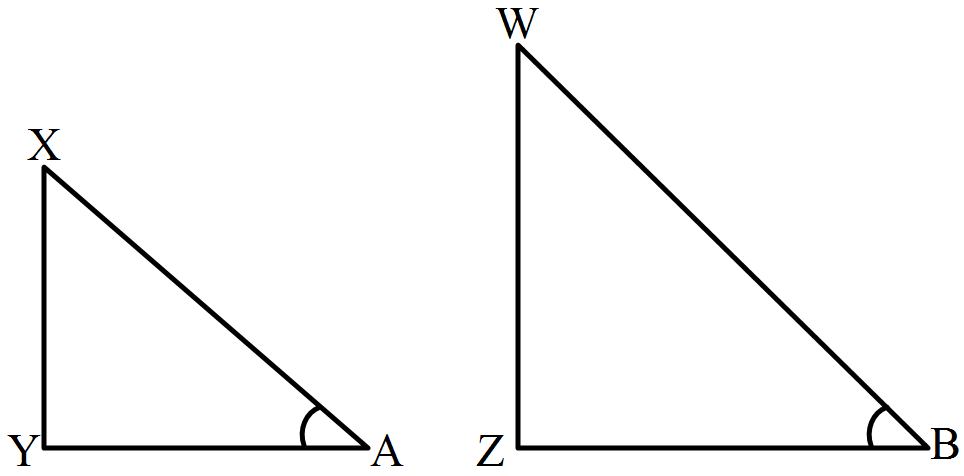
Consider two right $\triangle\text{XAY}$ and WBZ such that $\tan\text{A}=\tan\text{B}$

We have,
$\tan\text{A}=\frac{\text{XY}}{\text{XA}}$ and $\tan\text{B}=\frac{\text{WZ}}{\text{WB}}$
Since $\tan\text{A}=\tan\text{B}$
$\Rightarrow\frac{\text{XY}}{\text{AY}}=\frac{\text{WZ}}{\text{BZ}}$
$\Rightarrow\frac{\text{XY}}{\text{WZ}}=\frac{\text{AY}}{\text{BZ}}=\text{k}(\text{say})\dots(\text{i})$
$\Rightarrow\text{XY}=\text{k}\times\text{WZ}$ and $\text{AY}=\text{k}\times\text{BZ}\dots(\text{ii})$
Using Pythagoras theoram in $\triangle\text{XAY}$ and WBZ, we have
$\text{XA}^2=\text{XY}^2+\text{AY}^2$ and $\text{WB}^2=\text{WZ}^2+\text{BZ}^2$
$\Rightarrow\text{XA}^2={\text{k}^2\text{WZ}^2+\text{k}^2\text{BZ}^2}$ and $\text{WB}^2={\text{WZ}^2+\text{BZ}^2}$
$\Rightarrow\text{XA}^2={\text{k}^2\big(\text{WZ}^2+\text{BZ}^2}\big)$ and $\text{WB}^2={\text{WZ}^2+\text{BZ}^2}$
$\Rightarrow\frac{\text{XA}^2}{\text{WB}^2}=\frac{\text{k}^2\big({\text{WZ}^2+\text{BZ}^2\big)}}{\big({\text{WZ}^2+\text{BZ}^2\big)}}=\text{k}^2$
$\Rightarrow\frac{\text{XA}}{\text{WB}}=\text{k}\dots(\text{iii})$
From (i), (ii) and (iii), we get
$\frac{\text{XY}}{\text{WZ}}=\frac{\text{AY}}{\text{BZ}}=\frac{\text{XA}}{\text{WB}}$
$\Rightarrow\triangle\text{AYX}\sim\triangle\text{BZW}$
$\Rightarrow\angle\text{A}=\angle\text{B}$
View full question & answer