Question
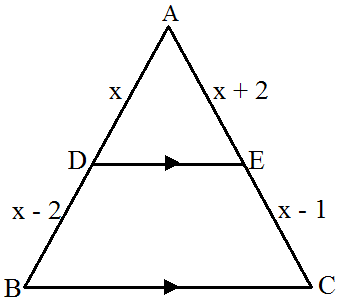
In a $\triangle ABC , D$ and E are points on the sides AB and $A C$ respectively such that $D E \| B C$.If $A D=x, D B=x-2, A E=x$ +2 and $E C=x-1$, find the value of $x$.
Answer

In the figure, $AD = x, DB = x - 2, AE = x + 2$ and $EC = x - 1$

$\because$ DE || BC
$\therefore\frac{\text{AD}}{\text{DB}}=\frac{\text{AE}}{\text{EC}}$
$\Rightarrow\frac{\text{x}}{\text{x}-2}=\frac{\text{x}+2}{\text{x}-1}$
$\Rightarrow x(x - 1) = (x + 2)(x - 2)$
$\Rightarrow x^2 - x = x^2 - 4$
$\Rightarrow x^2 - x - x^2 = -4$
$\Rightarrow -x = -4$
$​​​​​​​\Rightarrow x = 4$
$\therefore$ $x = 4$

Need a full question paper?

Generate a complete, print-ready paper with questions like this in minutes — across 16+ boards, with answer keys.
Start Generating Free

Similar questions

Find the sum of two middle terms of the $\text{A.P.:}-\frac{4}{3},-1,\frac{-2}{3},-\frac{1}{3}, .....\ ,4\frac{1}{3}.$
A horse is placed for grazing inside a reangular field 70m by 2m. It is tethered to one comer by a rope 21m long. On how much area an it graze? How much area is left ungrazed? $\Big[\text{Use }\pi=\frac{22}{7}\Big]$
A train travels a distance of 480 km at a uniform speed. If the speed had been $8 km / hr$ less, then it would have taken 3 hours more to cover the same distance. Find the usual speed of the train.
Solve the following quadratic equation by factorization:
$a^2b^2x^2 + b^2x - a^2x - 1 = 0$
The HCF of two numbers is 27 and their LCM is 162. If one of the number is 81, find the other.
Is this $–10, –6, –2, 2, ....$ an $AP$? If it forms an $AP$, find the common difference d and write three more terms.
A mason has to fit a bathroom with square marble tiles of the largest possible size. The size of the bathroom is 10 ft. by 8 ft. What would be the size in inches of the tile required that has to be cut and how many such tiles are required?
Prove that: $(1+\cos \theta-\operatorname{cosec} \theta) \cdot(1+\tan \theta+\sec \theta)=2$
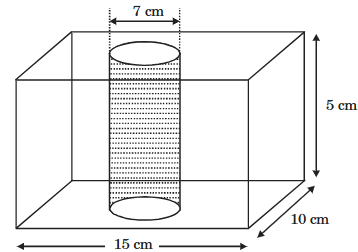
In the figure below, from a cuboidal solid metallic block, of dimensions $15 cm \times 10 cm \times 5 cm$, a cylindrical hole of diameter 7 cm is drilled out. Find the surface area of the remaining block.$\left[\right.$ Use $\left.\pi=\frac{22}{7}\right]$
Image
The difference between the outer and inner radii of a hollow right circular cylinder of length $14 \ cm$ is $1 \ cm$ . If the volume of the metal used in making the cylinder is $176 \ cm^3$, find the outer and inner radii of the cylinder.