MCQ
In a triode valve
  • A
    If the grid voltage is zero then plate current will be zero
  • B
    If the temperature of filament is doubled, then the thermionic current will also be doubled
  • If the temperature of filament is doubled, then the thermionic current will nearly be four times
  • D
    At a definite grid voltage the plate current varies with plate voltage according to Ohm’s law
Answer

Correct option: C.
If the temperature of filament is doubled, then the thermionic current will nearly be four times
c
(c)

Need a full question paper?

Generate a complete, print-ready paper with questions like this in minutes — across 16+ boards, with answer keys.

Start Generating Free

Similar questions

Experimentally it is found that $12.8\,eV$ energy is required to separate a hydrogen atom into a proton and an electron. So the orbital radius of the electron in a hydrogen atom is $\frac{9}{ x } \times 10^{-10}\,m$. The value of the $x$ is $\left(1\,eV =1.6 \times 10^{-19}\,J , \frac{1}{4 \pi \in_0}=9 \times 10^9\,Nm ^2 / C ^2\right.$ and electronic charge $=1.6 \times 10^{-19}\,J\,C$ )
The magnetic field of a plane electromagnetic wave is given by $\overrightarrow{ B }=3 \times 10^{-8} \cos \left(1.6 \times 10^3 x +48 \times 10^{10} t \right) \hat{ j }$, then the associated electric field will be :
Consider two hot bodies ${B_1}$ and ${B_2}$ which have temperatures ${100^o}C$ and ${80^o}C$ respectively at $t = 0$. The temperature of the surroundings is ${40^o}C$. The ratio of the respective rates of cooling ${R_1}$ and ${R_2}$ of these two bodies at $t = 0$ will be
The dispersion for a medium of wavelength $\lambda$ is $D$, then the dispersion for the wavelength $2 \lambda$ will be
The expression for magnetic induction inside a solenoid of length $L$ carrying a current $I$ and having $N$ number of turns is
For ordinary terrestrial experiments, which of the following observers below are inertial.
Samples of two radioactive nuclides, $X$ and $Y$, each have equal activity $A_0$ at time $t = 0$ . $X$ has a half life of $24$ years and $Y$ a half life of $16$ years. The samples  are mixed together.What will be the total activity of the mixture at $t = 48$ years ?
The velocities of $A$ and $B$ are $\vec{v}_A=2 \hat{i}+4 \hat{j}$ and $\vec{v}_B=3 \hat{i}-7 \hat{j}$ Velocity of $B$ as observed by $A$ is ..........
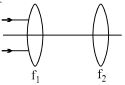
Parallel beam of light is incident on a system of two convex lenses of focal lengths $f_1 = 20\, cm$ and $f_2 = 10\, cm$. What should be the distance between the two lenses so that rays after refraction from both the lenses pass undeviated :........$cm$
A thin rod having a length of $1\; m$ and area of cross-section $3 \times 10^{-6}\,m ^2$ is suspended vertically from one end. The rod is cooled from $210^{\circ}\,C$ to $160^{\circ}\,C$. After cooling, a mass $M$ is attached at the lower end of the rod such that the length of rod again becomes $1\,m$. Young's modulus and coefficient of linear expansion of the rod are $2 \times 10^{11} Nm ^{-2}$ and $2 \times 10^{-5} K ^{-1}$, respectively. The value of $M$ is $.......kg .\left(\right.$ Take $\left.g=10\,m s ^{-2}\right)$