In a turbulent flow, the velocity of the liquid molecules in contact with the walls of the tube is
Easy
Download our app for free and get started
(d) Turbulent flow is a fluid motion with particle trajectories varying randomly in time, in which irregular fluctuations of velocity, pressure and other parameters arise. since turbulence is a property of the flow rather than a physical characteristic of the liquid, an energy source for maintaining turbulence is required in each case, where such flow is realized. Turbulence may be generated by the work either of shear stresses (friction) in the main (mean) flow, i.e., in the presence of mean velocity gradients (a shear flow), or of mass (buoyant, magnetic) forces.
In near$-$wall flows (i.e., boundary layer, as well as tube and channel flows), turbulence generates in the region of the greatest near$-$wall velocity gradients throughout the flow extent. The turbulent flow is much more capable for transfering momentum, heat and suspended particles, and for propagation of chemical reactions than is laminar flow.
Hence, in a turbulent flow, the velocity of the liquid molecules in contact with the walls of the tube is may have any value.

Download our appand get started for free
Experience the future of education. Simply download our apps or reach out to us for more information. Let's shape the future of learning together!No signup needed.*
Similar Questions
- 1The two thigh bones (femures), each of cross-sectional area $10 \,cm ^2$ support the upper part of a person of mass $50 \,kg$. The average pressure sustained by the femures is ............. $N / m ^2$View Solution
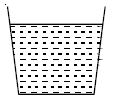
- 2A liquid of mass $1$ $kg$ is filled in a flask as shown in figure. The force exerted by the flask on the liquid is $(g = 10\ m/s^2)$[Neglect atmospheric pressure]:View Solution
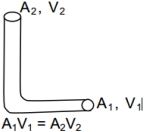
- 3A liquid enter at point $A_{1}$ with speed $3.5 m / s$ and leaves at point $A _{2} .$ Then find out the height attained by the liquid above point $A _{2}$ (in $cm$)View Solution
- 4A Newtonian fluid fills the clearance between a shaft and a sleeve. When a force of $800$ $N$ is applied to the shaft, parallel to the sleeve, the shaft attains a speed of $1.5$ $cm/sec$. If a force of $2.4$ $kN$ is applied instead, the shaft would move with a speed of ......... $ cm/sec$View Solution
- 5A liquid of density $750\,kgm ^{-3}$ flows smoothly through a horizontal pipe that tapers in crosssectional area from $A _{1}=1.2 \times 10^{-2}\,m ^{2}$ to $A_{2}=\frac{A_{1}}{2}$. The pressure difference between the wide and narrow sections of the pipe is $4500\,Pa$. The rate of flow of liquid is________$\times 10^{-3}\,m ^{3} s ^{-1}$View Solution
- 6$Assertion :$ Falling raindrops acquire a terminal velocity.View Solution
$Reason :$ A constant force in the direction of motion and a velocity dependent force opposite to the direction of motion, always result in the acquisition of terminal velocity. - 7A capillary tube is attached horizontally to a constant head arrangement. If the radius of the capillary tube is increased by $10\%$ then the rate of flow of liquid will change nearly by ......... $\%$View Solution
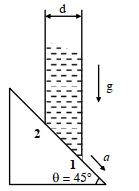
- 8A cylindrical tube, with its base as shown in the figure, is filled with water. It is moving down with a constant acceleration $a$ along a fixed inclined plane with angle $\theta=45^{\circ} . P_1$ and $P_2$ are pressures at points 1 and 2 , respectively, located at the base of the tube. Let $\beta=\left(P_1-P_2\right) /(\rho g d)$, where $\rho$ is density of water, $d$ is the inner diameter of the tube and $g$ is the acceleration due to gravity. Which of the following statement($s$) is(are) correct?View Solution
$(A)$ $\beta=0$ when $a= g / \sqrt{2}$
$(B)$ $\beta>0$ when $a= g / \sqrt{2}$
$(C)$ $\beta=\frac{\sqrt{2}-1}{\sqrt{2}}$ when $a= g / 2$
$(D)$ $\beta=\frac{1}{\sqrt{2}}$ when $a= g / 2$
- 9A container of height $10\, cm$ is filled with water. There is a hole at bottom. Find the pressure difference between points at top and bottom.View Solution
- 10A piece of gold weighs $10 \,g$ in air and $9 \,g$ in water. What is the volume of cavity is ...... $cc$ (Density of gold $=19.3 \,g cm ^{-3}$ )View Solution