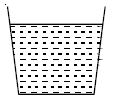
A liquid of mass $1$ $kg$ is filled in a flask as shown in figure. The force exerted by the flask on the liquid is $(g = 10\ m/s^2)$[Neglect atmospheric pressure]:
Medium


Download our appand get started for free
Experience the future of education. Simply download our apps or reach out to us for more information. Let's shape the future of learning together!No signup needed.*
Similar Questions
- 1An air bubble of radius $r$ rises steadily through a liquid of density $\rho $ with velocity $v$ . The coefficient of viscosity of liquid isView Solution
- 2Ajet of water having velocity $=$ $10 $ $m/s$ and stream cross-section $=$ $2$ $cm^2$ hits a flat plate perpendicularly, with the water splashing out parallel to plate. The plate experiences a force of ....... $N$View Solution
- 3Equal masses of water and a liquid of density $ 2$ are mixed together, then the mixture has a density of ........ $ g / cm^3$View Solution
- 4A liquid is kept in a cylindrical vessel which rotated along its axis. The liquid rises at the sides. If the radius of the vessel is $0.05\,m$ and the speed of rotation is $2\,rev/s$ , The difference in the height of the liquid at the centre of the vessel and its sides will be .............. $\mathrm{cm}$ $(\pi ^2 = 10)$View Solution
- 5View SolutionAs the temperature of water increases, its viscosity
- 6A hydraulic press can lift $100\, kg$ when a mass $'m'$ is placed on the smaller piston. It can lift ......... $kg$ when the diameter of the larger piston is increased by $4$ times and that of the smaller piston is decreased by $4$ times keeping the same mass $'m'$ on the smaller piston.View Solution
- 7Water flows in a streamlined manner through a capillary tube of radius $a$, the pressure difference being $P$ and the rate of flow $Q$. If the radius is reduced to $a/2$ and the pressure increased to $ 2P, $ the rate of flow becomesView Solution
- 8A ball whose density is $0.4 × 10^3 kg/m^3$ falls into water from a height of $9 cm$ . To what depth does the ball sink........ $cm$View Solution
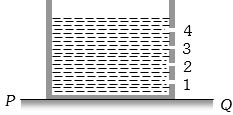
- 9A cylindrical vessel of $90 cm$ height is kept filled upto the brim. It has four holes $ 1, 2, 3, 4$ which are respectively at heights of $20 cm, 30 cm, 45 cm $ and $50 cm$ from the horizontal floor $PQ.$ The water falling at the maximum horizontal distance from the vessel comes fromView Solution
- 10The two thigh bones (femures), each of cross-sectional area $10 \,cm ^2$ support the upper part of a person of mass $50 \,kg$. The average pressure sustained by the femures is ........... $N / m ^2$View Solution