MCQ
In a vernier callipers, each $cm$ on the main scale is divided into $20$ equal parts. If tenth vernier scale division coincides with nineth main scale division. Then the value of vernier constant will be $\dots \; \times 10^{-2} \;mm$
  • A
    $3$
  • $5$
  • C
    $7$
  • D
    $9$

Answer

Correct option: B.
$5$
b
$20 \; MSD =1 \; cm$

$1 \; MSD =\frac{1}{20} \; cm$

$10 \; VSD =9 \; MSD$

$1 \; VSD =\frac{9}{10} \; MSD$

$=\frac{9}{10} \times \frac{1}{20} \; cm$

$1 VSD =\frac{9}{200} \; cm$

VC $=1 MSD -1 \; VSD$

$=\frac{1}{20} \; cm -\frac{9}{200} \; cm$

$=\frac{1}{200} \times 10 \; mm$

VC $=5 \times 10^{-2} \; mm$

Ans. $5$

Need a full question paper?

Generate a complete, print-ready paper with questions like this in minutes — across 16+ boards, with answer keys.

Start Generating Free

Similar questions

One mole of an ideal gas at an initial temperature of $T\, K$ does $6 R$ joules of work adiabatically. If the ratio of specific heats of this gas at constant pressure and at constant volume is $5/3$, the final temperature of gas will be
Acceleration due to gravity is$ ‘g’ $on the surface of the earth. The value of acceleration due to gravity at a height of $32\, km$ above earth’s surface is ........ $g$. (Radius of the earth$ = 6400 \,km$)
The Young's modulus of a steel wire of length $6\,m$ and cross-sectional area $3\,mm ^2$, is $2 \times 11^{11}\,N / m ^2$. The wire is suspended from its support on a given planet. A block of mass $4\,kg$ is attached to the free end of the wire. The acceleration due to gravity on the planet is $\frac{1}{4}$ of its value on the earth. The elongation of wire is  (Take $g$ on the earth $=10$ $\left.m / s ^2\right):$
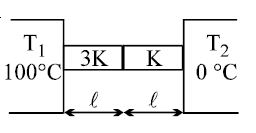
Two sheets of thickness $d$ and $3d$, are touching each other. The temperature just outside the thinner sheet side is $A$, and on the side of the thicker sheet is $C$. The interface temperature is $B. A, B$ and $C$ are in arithmetic progressing, the ratio of thermal conductivity of thinner sheet and thicker sheet is
Which of the two have same dimensions
Match List $I$ with List $II$

List $I$ List $II$
$A$ Torque  $I$ ${\left[\mathrm{M}^1 \mathrm{~L}^1 \mathrm{~T}^{-2} \mathrm{~A}^{-2}\right]}$
$B$ Magnetic fileld  $II$ $\left[\mathrm{L}^2 \mathrm{~A}^1\right]$
$C$ Magneti moment $III$ ${\left[\mathrm{M}^1 \mathrm{~T}^{-2} \mathrm{~A}^{-1}\right]}$
$D$ permeability of free  space $IV$ $\left[\mathrm{M}^1 \mathrm{~L}^2 \mathrm{~T}^{-2}\right]$

Choose the correct answer from the options given below :

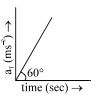
Tangential acceleration of a particle moving in a circle of radius $1$ $m$ varies with time $t$ as (initial velocity of particle is zero). Time after which total acceleration of particle makes and angle of $30^o$ with radial acceleration is
If $| A + B |=| A |+| B |$ the angle between $\overrightarrow A $and $\overrightarrow B $ is ....... $^o$
An electric dipole is placed in a uniform electric field. The net electric force on the dipole.
In which of the following cases the centre of mass of a rod is certainly not at its centre?