MCQ
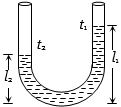
In a vertical $U-$tube containing a liquid, the two arms are maintained at different temperatures ${t_1}$ and ${t_2}$. The liquid columns in the two arms have heights ${l_1}$ and ${l_2}$ respectively. The coefficient of volume expansion of the liquid is equal to
  • $\frac{{{l_1} - {l_2}}}{{{l_2}{t_1} - {l_1}{t_2}}}$
  • B
    $\frac{{{l_1} - {l_2}}}{{{l_1}{t_1} - {l_2}{t_2}}}$
  • C
    $\frac{{{l_1} + {l_2}}}{{{l_2}{t_1} + {l_1}{t_2}}}$
  • D
    $\frac{{{l_1} + {l_2}}}{{{l_1}{t_1} + {l_2}{t_2}}}$
Answer

Correct option: A.
$\frac{{{l_1} - {l_2}}}{{{l_2}{t_1} - {l_1}{t_2}}}$
a
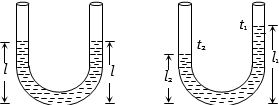
(a) Suppose, height of liquid in each arm before rising the temperature is $l.$

With temperature rise height of liquid in each arm increases i.e. $l_1 > l$ and $l_2 > l$

Also $l = \frac{{{l_1}}}{{1 + \gamma \,{t_1}}} = \frac{{{l_2}}}{{1 + \gamma \,{t_2}}}$

==> ${l_1} + \gamma \,{l_1}{t_2} = {l_2} + \gamma \,{l_2}{t_1}$ ==> $\gamma = \frac{{{l_1} - {l_2}}}{{{l_2}{t_1} - {l_1}{t_2}}}$

Need a full question paper?

Generate a complete, print-ready paper with questions like this in minutes — across 16+ boards, with answer keys.

Start Generating Free

Similar questions

In the Young's double slit experiment using a monochromatic light of wavelength $\lambda$, the path difference (in terms of an integer $n$ ) corresponding to any point having half the peak intensity is :
Coefficient of real expansion of mercury is $ 0.18 \times 10^{-3}{°C^{-1}}$. If the density of mercury at $0°C$ is $13.6\, gm/cc$. its density at $473K$ is
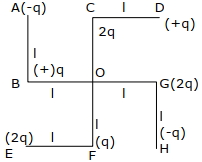
What will be the magnitude of electric field at point $O$ as shown in figure ? Each side of the figure is $I$ and perpendicular to each other.
Work done by a system under isothermal change from a volume ${V_1}$ to ${V_2}$ for a gas which obeys Vander Waal's equation $(V - \beta n)\,\left( {P + \frac{{\alpha {n^2}}}{V}} \right) = nRT$
Atomic radius of fcc is
A particle experiences a variable force $\overrightarrow{ F }=\left(4 x \hat{ i }+3 y ^{2} \hat{ j }\right)$ in a horizontal $x - y$ plane. Assume distance in meters and force is newton. If the particle moves from point $(1,2)$ to point $(2,3)$ in the $x-y$ plane, the Kinetic Energy changes by............$j$
The force required just to move a body up an inclined plane is double the force required just to prevent the body sliding down. If the coefficient of friction is $0.25$, the angle of inclination of the plane is ...... $^o$
A mixture of two moles of hydrogen and one mole of argon gas is taken in a closed container at room temperature. Consider the following two statements

$(i)$  The average kinetic energy of each molecule of $H_2$ and $Ar$ are the same.

$(ii)$  The partial pressure due to argon gas is more than that due to hydrogen gas

A block is attached to a spring as shown and very-very gradually lowered so that finally  spring expands by $"d"$. If same block is attached to spring & released suddenly then maximum expansion in spring will be-
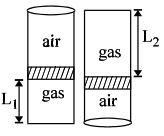
An ideal gas is trapped inside a test tube of cross-sectional area $20 \times 10^{-6} \,\,m^2$ as shown in the figure. The gas occupies a height $L_1$ at the bottom of the tube and is separated from air at atmospheric pressure by a mercury column of mass $0.002\,\, kg$. If the tube is quickly turned isothermally, upside down so that $L_2$ mercury column encloses the gas from below. The gas now occupies height $L_1$ in the tube. The ratio $L_1$ is [Take atmospheric pressure $= 10^5 Nm^{-2}]$