MCQ
In a wave, the path difference corresponding to a phase difference of $ \phi$  is
  • A
    $\frac{\pi }{{2\lambda }}\phi$
  • B
    $\frac{\pi }{\lambda }\phi $
  • $\frac{\lambda }{{2\pi }}\phi$
  • D
    $\frac{\lambda }{\pi }\phi$

Answer

Correct option: C.
$\frac{\lambda }{{2\pi }}\phi$
c
(c)For $2$ $\pi$  phase difference $\to$ Path difference is $\lambda$
 For $\phi $ phase difference $\to$ Path difference is $\frac{\lambda }{{2\pi }} \times \phi$

Need a full question paper?

Generate a complete, print-ready paper with questions like this in minutes — across 16+ boards, with answer keys.
Start Generating Free

Similar questions

The two ends of a uniform conductor are joined to a cell of e.m.f. E and some internal resistance. Starting from the midpoint P of the conductor, we move in the direction of current and return to P. The potential V at every point on the path is plotted against the distance covered (x). Which of the following graphs best represents the resulting curve
 
If a source of power $4\ kW$ produces $10^{20}$ photons/second , the radiation belongs to a part of the spectrum called
The bob of a simple pendulum is replaced by a magnet. The oscillations are set along the length of the magnet. A copper coil is added so that one pole of the magnet passes in and out of the coil. The coil is short-circuited. Then which one of the following happens
How is the potential within and on the surface of a conductor?
The light rays having photons of energy $1.8 eV$ are falling on a metal surface having a work function $1.2 eV$. What is the stopping potential to be applied to stop the emitting electrons .......... $eV$
Which of the following is most unstable
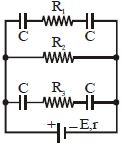
In the circuit diagram of figure, $E = 5\, volt, r = 1\, \Omega ,$$ R_2 = 4\, \Omega , R_1 = R_3 = 1 \Omega$ and $C = 3\, μF.$ Then the magnitude of the charge on each capacitor plate is......$\mu C$
A potential difference of $V$ is applied at the ends of a copper wire of length $l$ and diameter $d$. On doubling only $d$, drift velocity
An electron enters a magnetic field whose direction is perpendicular to the velocity of the electron. Then
A metal conductor of length $1\;m$ rotates vertically about one of its ends at angular velocity $5$ radians per second. If the horizontal component of earth's magnetic field is $0.2 \times {10^{ - 4}}\;T$, then the $e.m.f$. developed between the two ends of the conductor is