MCQ
In a wave, the path difference corresponding to a phase difference $\phi$ is
  • A
    $\frac{\pi}{2 \lambda} \phi$
  • B
    $\frac{\pi}{\lambda} \phi$
  • $\frac{\lambda}{2 \pi} \phi$
  • D
    $\frac{\lambda}{\pi} \phi$

Answer

Correct option: C.
$\frac{\lambda}{2 \pi} \phi$
For $2 \pi$ phase difference $\rightarrow$ Path difference is $\lambda$
$\therefore$ For $\phi$ phase difference $\rightarrow$ Path difference is $\frac{\lambda}{2 \pi} \times \phi$

Need a full question paper?

Generate a complete, print-ready paper with questions like this in minutes — across 16+ boards, with answer keys.

Start Generating Free

Similar questions

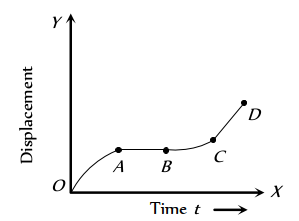
The graph between the displacement $x$ and time $t$ for a particle moving in a straight line is shown in figure. During the interval $O A, A B, B C$ and $C D$, the acceleration of the particle is
Image
Surface temperature of the sun is of the order of
Two springs of spring constants $1500 \mathrm{~N} / \mathrm{m}$ and $3000 \mathrm{~N} / \mathrm{m}$ respectively are stretched with the same force. They will have potential energy in the ratio
On a clear sunny day, an object at temperature $T$ is placed on the top of a high mountain. An identical object at the same temperature is placed at the foot of mountain. If both the objects are exposed to sun-rays for two hours in an identical manner, the object at the top of the mountain will register a temperature
If two metallic plates of equal thicknesses and thermal conductivities $K_1$ and $K_2$ are put together face to face and a common plate is constructed, then the equivalent thermal conductivity of this plate will be
Image
A body of mass $2 kg$ moving on a horizontal surface with an initial velocity of $4 m / sec$ comes to rest after $2 sec$. If one wants to keep this body moving on the same surface with a velocity of $4 m / sec$, the force required is
When wavelength of incident photon is decreased then
Two solid rubber balls $A$ and $B$ having masses 200 and $400 \mathrm{gm}$ respectively are moving in opposite directions with velocity of $A$ equal to $0.3 \mathrm{~m} / \mathrm{s}$. After collision the two balls come to rest, then the velocity of $B$ is
A square loop of side $2a$ and carrying current I is kept in $xz$ plane with its centre at origin. A long wire carrying the same current I is placed parallel to $z-$axis and passing through point $(0, b , 0),( b >> a ) .$ The magnitude of torque on the loop about $z-$ax is will be
A Galileo telescope has an objective of focal length $100 \mathrm{~cm}$ and magnifying power $50.$ The distance between the two lenses in normal adjustment will be