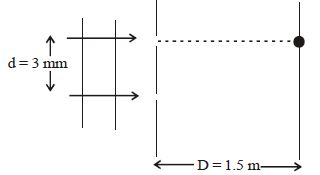
Given $D = \ 1.5\ m$
$d = 3\ mm$
$4500 \ Å < \lambda_1 , \lambda_2 < 7000\ Å$
then $n, m$ and $\lambda_1$ are
- A$3,4,4000\ \mathop A\limits^0$
- ✓$5,6,6000\ \mathop A\limits^0$
- C$2,3,5000\ \mathop A\limits^0$
- D$4,5,3000\ \mathop A\limits^0 $
Given $D = \ 1.5\ m$
$d = 3\ mm$
$4500 \ Å < \lambda_1 , \lambda_2 < 7000\ Å$
then $n, m$ and $\lambda_1$ are
${y_{{m^{th}}}} = \frac{{m{\lambda _2}D}}{{2d}};{\rm{m}} = 2,4,6,8 \ldots \ldots $
${y_{{n^{th}}}} = {y_{{m^{th}}}} = \frac{d}{2}$ from central fringe.
Generate a complete, print-ready paper with questions like this in minutes — across 16+ boards, with answer keys.

$A.$ Atoms of each element emit characterstics spectrum.
$B.$ According to Bohr's Postulate, an electron in a hydrogen atom, revolves in a certain stationary orbit.
$C.$ The density of nuclear matter depends on the size of the nucleus.
$D.$ A free neutron is stable but a free proton decay is possible.
$E.$ Radioactivity is an indication of the instability of nuclei.
Choose the correct answer from the options given below
$\left( {k = \frac{1}{{4\pi {\varepsilon _0}}}} \right)$