MCQ
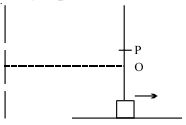
In a Young's Double slit experiment, first maxima is observed at a fixed point $P$ on the screen. Now the screen is continuously moved away from the plane of slits. The ratio of intensity at point $P$ to the intensity at point $O$ (centre of the screen)
  • A
    remains constant
  • B
    keeps on decreasing
  • first decreases and then increases
  • D
    First decreases and then becomes constant
Answer

Correct option: C.
first decreases and then increases
c
$I_{p}=\frac{I_{\max }}{2}[1+\cos \phi]=\frac{I_{\max }}{2}\left(1+\cos \frac{2 \pi y}{\beta}\right)$

where $\beta=D \lambda / d$.

First maxima is observed at $P$, i.e., cos. $\frac{2 \pi y}{\beta}$ should be negative. Hence, the ratio

$I_{P} / I_{\max }$ starts decreasing but starts increasing again as cos. $\frac{2 \pi y}{\beta}$ again starts becoming positive.

Need a full question paper?

Generate a complete, print-ready paper with questions like this in minutes — across 16+ boards, with answer keys.

Start Generating Free

Similar questions

Resolving power of a telescope increases with:
A point charge $q_1=4 q_0$ is placed at origin. Another point charge $q_2=-q_0$ is placed at $x =12\,cm$. Charge of proton is $q_0$. The proton is placed on $x$-axis so that the electrostatic force on the proton in zero. In this situation, the position of the proton from the origin is $..........cm$.
The first line of Balmer series has wavelength $6563 Å.$ What will be the wavelength of the first member of Lyman series.....$\mathop A\limits^o $
The focal length of a convex lens is 10 cm and its refractive index is 1.5. If the radius of curvature of one surface is 7.5 cm, the radius of curvature of the second surface will be
Three thin prisms are combined as shown in figure. The refractive indices of the crown glass for red, yellow and violet rays are ${\mu _r},{\mu _y}$ and ${\mu _v}$ respectively and those for the flint glass are ${\mu _r}',{\mu _y}',{\mu _v}'$ respectively, if there is no net deviation in the yellow ray then the ratio $A'/A$ will be
A circular current loop of radius a is placed in a radial field $B$ as shown. The net force acting on the loop is
Which of the following semi-conductor diodes is reverse biased
A point charge $q$ is held at the centre of a circle of radius $r . B, C$ are two points on the circumference of the circle and $A$ is a point outside the circle. If $W_{A B}$ represents work done by electric field in taking a charge $q_0$ from $A$ to $B$ and $W_{A C}$ represents the workdone from $A$ to $C$, then
Two electrolytic cells containing CuSO$_4$ and AgNO$_3$ respectively are connected in series and a current is passed through them until 1 mg of copper is deposited in the first cell. The amount of silver deposited in the second cell during this time is approximately [Atomic weights of copper and silver are respectively 63.57 and 107.88]
The surface that we choose for application of Gauss’s law is called as: