MCQ
In a Young's double slit experiment if there is no initial phase difference between the light from the two slits, a point on the screen corresponding to the fifth minimum has path difference
  • A
     $5 \frac{\lambda}{2}$
  • B
     $10 \frac{\lambda}{2}$
  •  $9 \frac{\lambda}{2}$
  • D
    $11 \frac{\lambda}{2}$

Answer

Correct option: C.
 $9 \frac{\lambda}{2}$
c
Path difference for $n^{\text {th }}$ minima $=(2 n-1) \frac{\lambda}{2}$

For fifth minima $(n=5)=\frac{9 \lambda}{2}$

Need a full question paper?

Generate a complete, print-ready paper with questions like this in minutes — across 16+ boards, with answer keys.

Start Generating Free

Similar questions

A polaroid is placed at  $45^{o}$  to an incoming light of intensity ${I_0}$. Now the intensity of light passing through polaroid after polarisation would be
A steel wire having a radius of $2.0\, mm$, carrying a load of $4\, kg$, is hanging from a ceiling. Given that $g = 3.1\pi \,m{s^{ - 2}}$ , what will be the tensile stress that would be developed in the wire?
The electric intensity due to an infinite cylinder of radius $R$ and having charge $q$ per unit length at a distance $r(r > R)$ from its axis is
List-IList-II
(A) Coefficient of viscosity(I) $\left[ ML ^0 T^{-3}\right]$
(B) Intensity of wave(II) $\left[ ML ^{-2} T^{-2}\right]$
(C) Pressure gradient(III) $\left[ M ^{-1} LT ^2\right]$
(D) Compressibility(IV) $\left[ ML ^{-1} T^{-1}\right]$

Choose the correct answer from the options given below:
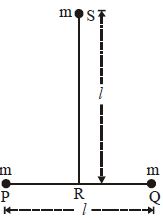
Two particles each of mass $m$ are placed at points $P$ and $Q$ as shown in the figure. $R$ is the mid-point of $PQ = l$. The gravitational force on the third particle of mass $m$ placed at point $S$ on the perpendicular bisector of $PQ$ is
A car is moving along a straight line, say $OP$ in given figure. It moves from $O$ to $P$ in $18\; s$ and returns from $P$ to $\mathrm{Q}$ in $6.0\; s$. What are the average velocity and average speed of the car in going from $O$ to $P$?
A binary star system consists of two stars one of which has double the mass of the other. The stars rotate about their common centre of mass :-
A body initially at rest, breaks up into two pieces of masses $2 M$ and $3 M$ respectively, together having a total kinetic energy $E$. The piece of mass $2 M$, after breaking up, has a kinetic energy
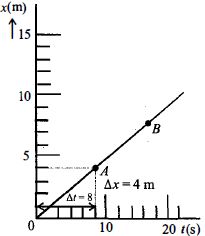
The graph of an object's motion (along the $x-$ axis) is shown in the figure. The instantaneous velocity of the object at points $A$ and $B$ are $v_A$ and $v_B$ respectively. Then
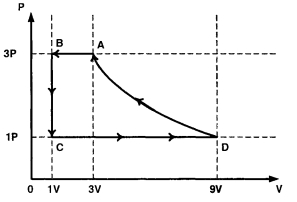
One mole of a monatomic ideal gas is taken through a cycle $ABCDA$ as shown in the $P-V$ diagram. Column $II$ gives the characteristics involved in the cycle. Match them with each of the processes qiven in Column $I$
Column $I$ Column $II$
$(A)$ Process $A \rightarrow B$ $(p)$ Internal energy decreases.
$(B)$ Process $B \rightarrow C$ $(q)$ Internal energy increases.
$(C)$ Process $C \rightarrow D$ $(r)$ Heat is lost.
$(D)$ Process $D \rightarrow A$ $(s)$ Heat is gained.
  $(t)$ Work is done on the gas.