A steel wire having a radius of $2.0\, mm$, carrying a load of $4\, kg$, is hanging from a ceiling. Given that $g = 3.1\pi \,m{s^{ - 2}}$ , what will be the tensile stress that would be developed in the wire?
JEE MAIN 2019, Medium


Download our appand get started for free
Experience the future of education. Simply download our apps or reach out to us for more information. Let's shape the future of learning together!No signup needed.*
Similar Questions
- 1A copper wire $(Y = 1 \times 10^{11}\, N/m^2)$ of length $6\, m$ and a steel wire $(Y = 2 \times 10^{11}\, N/m^2)$ of length $4\, m$ each of cross section $10^{-5}\, m^2$ are fastened end to end and stretched by a tension of $100\, N$. The elongation produced in the copper wire is ......... $mm$View Solution
- 2A stone of mass $20\, {g}$ is projected from a rubber catapult of length $0.1\, {m}$ and area of cross section $10^{-6} \,{m}^{2}$ stretched by an amount $0.04\, {m}$. The velocity of the projected stone is $....\,m\,/s.$ (Young's modulus of rubber $=0.5 \times 10^{9}\, {N} / {m}^{2}$ )View Solution
- 3An elevator cable can have a maximum stress of $7 \times 10^7\,N/m^2$ for appropriate safety factors. Its maximum upward acceleration is $1.5\,m/s^2$ . If the cable has to support the total weight of $2000\,kg$ of a loaded elevator, the minimum area of crosssection of the cable should be ....... $cm^2$ $(g = 10\,m/s^2)$View Solution
- 4View SolutionMinimum and maximum values of Poisson’s ratio for a metal lies between
- 5View SolutionDue to addition of impurities, the modulus of elasticity
- 6A body of mass $\mathrm{m}=10\; \mathrm{kg}$ is attached to one end of a wire of length $0.3\; \mathrm{m} .$ The maximum angular speed (in $rad \;s^{-1}$ ) with which it can be rotated about its other end in space station is (Breaking stress of wire $=4.8 \times 10^{7} \;\mathrm{Nm}^{-2}$ and area of cross-section of the wire $=10^{-2}\; \mathrm{cm}^{2}$ ) isView Solution
- 7Find the depth of lake at which density of water is $1\%$ greater than at the surface. Given compressibility ........... $km$ . $K = 50\times10^{-6}/atm$ ?View Solution
- 8$A$ current of $(2.5 \pm 0.05)$ $A$ flows through a wire and develops a potential difference of $(10 \pm 0.1)$ $\mathrm{volt}.$ Resistance of the wire in $\mathrm{ohm},$ isView Solution
- 9A metal wire of length $L_1$ and area of cross section $A$ is attached to a rigid support. Another metal wire of length $L_2$ and of the same cross sectional area is attached to the free end of the first wire. A body of mass $M$ is then suspended from the free end of the second wire. If $Y_1$ and $Y_2$ are the Youngs moduli of the wires respectively, the effective force constant of the system of two wires is :View Solution
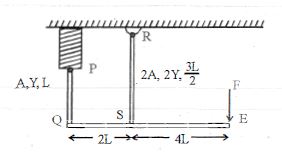
- 10A rigid massless rod of length $6\ L$ is suspended horizontally by means of two elasticrods $PQ$ and $RS$ as given figure. Their area of cross section, young's modulus and lengths are mentioned in figure. Find deflection of end $S$ in equilibrium state. Free end of rigid rod is pushed down by a constant force . $A$ is area of cross section, $Y$ is young's modulus of elasticityView Solution