Question
In a Young's double slit experiment using monochromatic light, the fringe pattern shifts by a certain distance on the screen when a mica sheet of refractive index 1.6 and thickness 1.964 micron (1 micron = 10-6m) is introduced in the path of one of the interfering waves. The mica sheet is then removed and the distance between the screen and the slits is doubled. It is found that the distance between the successive maxima now is the same as the observed fringe-shift upon the introduction of the mica sheet. Calculate the wavelength of the monochromatic light used in the experiment.
Answer

In the given Young’s double slit experiment,
$\mu=1.6,$ t = 1.964 micron = 1.964 × 10⁻⁶m
We know, number of fringes shifted $=\frac{(\mu-1)\text{t}}{\lambda}$
So, the corresponding shift = No.of fringes shifted × fringe width
$=\frac{(\mu-1)\text{t}}{\lambda}\times\frac{\lambda\text{D}}{\text{d}}=\frac{(\mu-1)\text{tD}}{\text{d}}\ ...(1)$
Again, when the distance between the screen and the slits is doubled,
Fringe width $=\frac{\lambda(2\text{D})}{\text{d}}\ ...(2)$
From (1) and (2), $\frac{(\mu-1)\text{tD}}{\text{d}}=\frac{\lambda(2\text{D})}{\text{d}}$
$\Rightarrow\lambda=\frac{(\mu-1)\text{t}}{\lambda}$
$=\frac{(1.6-1)\times(1.964)\times10^{-6}}{2}=589.2\times10^{-9}=589.2\text{nm}.$

Need a full question paper?

Generate a complete, print-ready paper with questions like this in minutes — across 16+ boards, with answer keys.

Start Generating Free

Similar questions

An electric current flows in a wire from north to south. What will be the direction of the magnetic field due to this wire at a point east of the wire? West of the wire? Vertically above the wire? Vertically below the wire?
A hydrogen atom moving at speed υ collides with another hydrogen atom kept at rest. Find the minimum value of υ for which one of the atoms may get ionized. The mass of a hydrogen atom = 1.67 × 10⁻²⁷kg.
A wire of resistance $15.0\Omega$ is bent to form a regular hexagon ABCDEFA. Find the equivalent resistance of the loop between the points (a) A and B (b) A and C and (c) A and D.
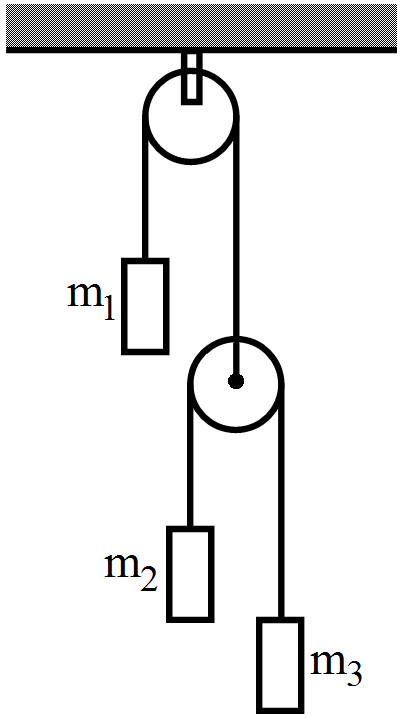
Let m1 = 1kg, m2 = 2kg and m3 = 3kg in figure. Find the accelerations of m1, m2 and m3. The string from the upper pulley to m1 is 20cm when the system is released from rest. How long will it take before m, strikes the pulley?

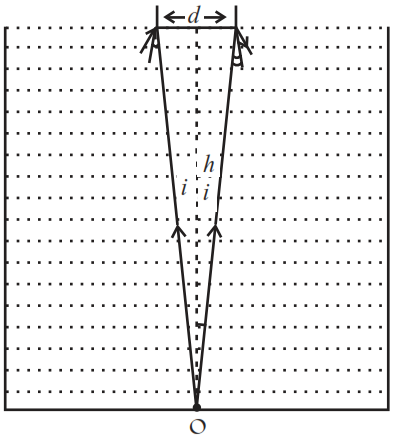
A jar of height h is filled with a transparent liquid of refractive index μ (Fig). At the centre of the jar on the bottom surface is a dot. Find the minimum diameter of a disc, such that when placed on the top surface symmetrically about the centre, the dot is invisible.

Suppose the $19\Omega$ resistor of the previous problem is disconnected. Find the current through P2Q2 in the two situations:
  1. Both the wires move towards right.
  2. If P1Q1 moves towards left but P2Q2 moves towards right.
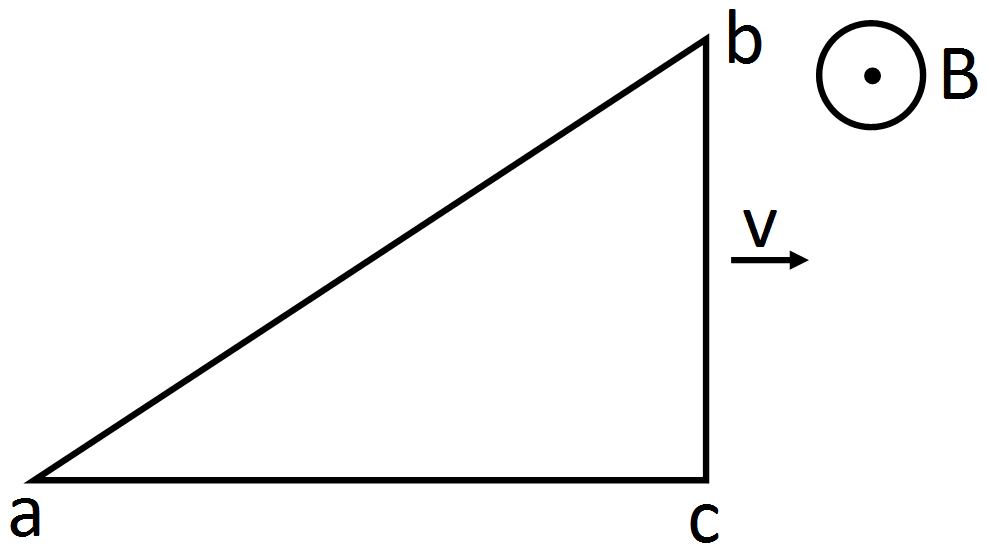
A right-angled triangle abc, made from a metallic wire, moves at a uniform speed v in its plane as shown in figure. A uniform magnetic field B exists in the perpendicular direction. Find the emf induced:
  1. In the loop abc.
  2. In the segment bc.
  3. In the segment ac.
  4. In the segment ab.

  1. Draw the circuit arrangement for studying the input and output characteristics of an n-p-n transistor in CE configuration. With the help of these characteristics define (i) input resistance, (ii) current amplification factor.
  2. Describe briefly with the help of a circuit diagram how an n-p-n transistor is used to produce self-sustained oscillations.
Find the charge required to flow through an electrolyte to liberate one atom of.
  1. A monovalent material.
  2. A divalent material.