Question
In a Young's double slit interference experiment the fringe pattern is observed on a screen placed at a distance D from the slits. The slits are separated by a distance d and are illuminated by monochromatic light of wavelength $\lambda$. Find the distance from the central point where the intensity falls to,
  1. Half the maximum.
  2. One fourth of the maximum.

Answer

  1. When intensity is half the maximum $\frac{\text{I}}{\text{I}_\text{max}}=\frac{1}{2}$
$\Rightarrow\frac{4\text{a}^2\cos^2\big(\frac{\phi}{2}\big)}{4\text{a}^2}=\frac{1}{2}$

$\Rightarrow\cos^2\Big(\frac{\phi}{2}\Big)=\frac{1}{2}\Rightarrow\cos\Big(\frac{\phi}{2}\Big)=\frac{1}{\sqrt{2}}$

$\Rightarrow\frac{\phi}{2}=\frac{\pi}{4}\Rightarrow\phi=\frac{\pi}{2}$

$\Rightarrow$ Path difference, $\text{x}=\frac{\lambda}{4}$

$\Rightarrow\text{y}=\frac{\text{xD}}{\text{d}}=\frac{\lambda\text{D}}{4\text{d}}$
  1. When intensity is $\frac{1}{4}\text{th}$ of the maximum $\frac{\text{I}}{\text{I}_\text{max}}=\frac{1}{4}$
$\Rightarrow\frac{4\text{a}^2\cos^2\Big(\frac{\phi}{2}\Big)}{4\text{a}^2}=\frac{1}{4}$

$\Rightarrow\cos^2\Big(\frac{\phi}{2}\Big)=\frac{1}{4}\Rightarrow\cos\Big(\frac{\phi}{2}\Big)=\frac{1}{2}$

$\Rightarrow\frac{\phi}{2}=\frac{\pi}{3}\Rightarrow\phi=\frac{2\pi}{3}$

$\Rightarrow$ Path difference, $\text{x}=\frac{\lambda}{3}$

$\Rightarrow\text{y}=\frac{\text{xD}}{\text{d}}=\frac{\lambda\text{D}}{3\text{d}}$

Need a full question paper?

Generate a complete, print-ready paper with questions like this in minutes — across 16+ boards, with answer keys.

Start Generating Free

Similar questions

$Fe^+$ ions are accelerated through a potential difference of 500V and are injected normally into a homogeneous magnetic field B of strength 20.0mT. Find the radius of the circular paths followed by the isotopes with mass numbers 57 and 58. Take the mass of an ion $= A (1.6 \times 10^{-27})kg,$ where A is the mass number.
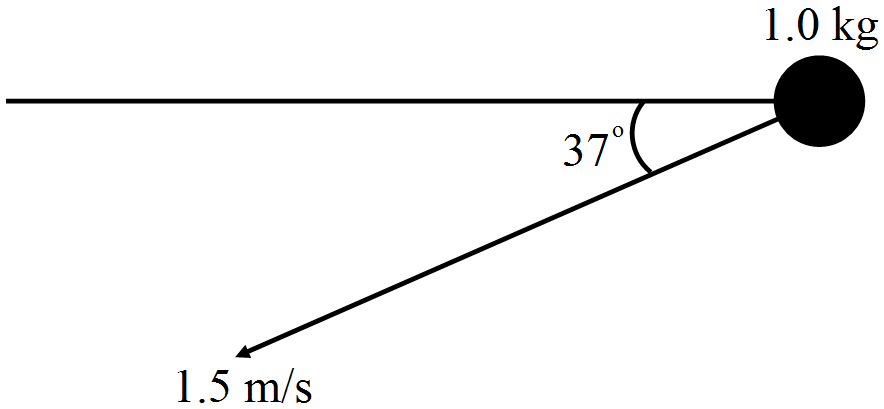
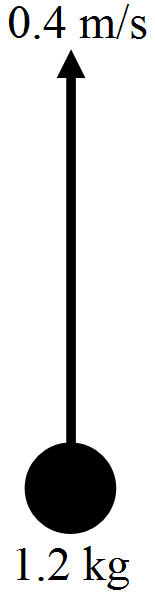
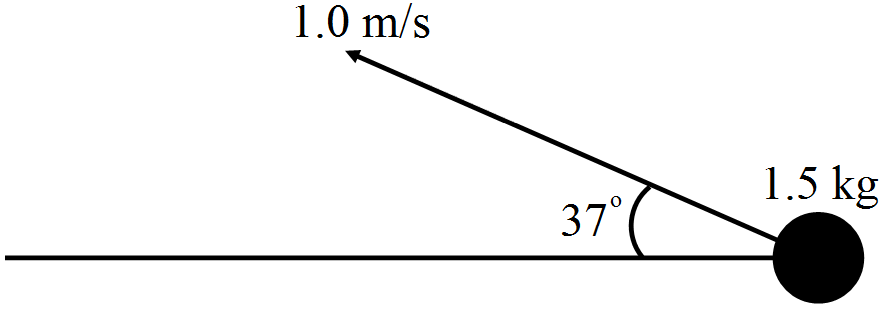
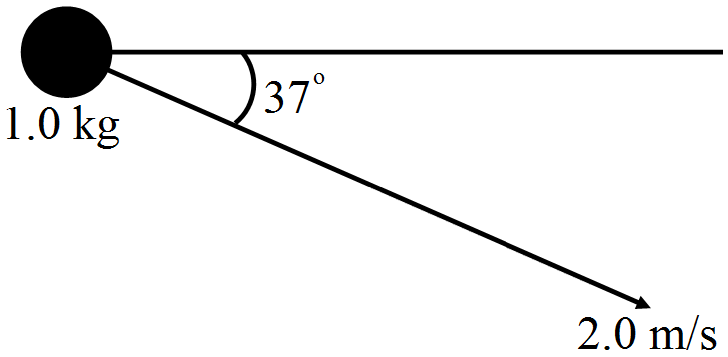
Calculate the velocity of the centre of mass of the system of particles shown in figure.


What is Gauss theorem? With its help, obtain an expression for the electric field intensity at any point near a uniformly charged linear conductor of infinite length.###Make the necessary diagram and with the help of Gauss law, calculate the electric field intensity at any point due to a charged wire of infinite length. Plot the change in intensity with distance.###Define Gauss' law. With its help, find the value of electric field intensity at a distance from a uniformly charged linear conductor of infinite extension. Make the necessary diagram and also make a graph of the change of electric field with distance.
A solenoid of length 20cm, area of cross-section $4.0cm^2$ and having 4000 turns is placed inside another solenoid of 2000 turns having a cross-sectional area $8.0cm^2$ and length 10cm. Find the mutual inductance between the solenoids.
In en experiment on photoelectric effect, light of wavelength 400 run is incident on a cesium plate at the rate of 5.0W. The potential of the collector plate is made sufficiently positive with respect to the emitter so that the current reaches its saturation value. Assuming that on the average one out of every 10° photons is able to eject a photoelectron, find the photocurrent in the circuit.
What is the minimum energy that must be given to a H atom in ground state so that it can emit an $\text{H}_\gamma$ line in Balmer series. If the angular momentum of the system is conserved, what would be the angular momentum of such $\text{H}_\gamma$ photon?
An X-OR gate has following truth table:
A B Y
0 0 0
0 1 1
1 0 1
1 1 0
It is represented by following logic relation $\text{Y}=\bar{\text{A}}.\text{B}+\text{A}.\bar{\text{B}}$ Build this gate using AND, OR and NOT gates.
  1. Using Ampere's circuital law, obtain the expression for the magnetic field due to a long solenoid at a point inside the solenoid on its axis.
  2. In what respect is a toroid different from a solenoid? Draw and compare the pattern of the magnetic field lines in the two cases.
  3. How is the magnetic field inside a given solenoid made strong?
A boy riding on a bicycle going at 12km/h towards a vertical wall whistles at his dog on the ground. If the frequency of the whistle is 1600Hz and the speed of sound in air is 330m/s, find
  1. The frequency of the whistle as received by the wall.
  2. The frequency of the reflected whistle as received by the boy.
The plates of a capacitor of capacitance $10\mu\text{F},$ charged to $60\mu\text{C},$ are joined together by a wire of resistance $10\Omega$ at t = 0. Find the charge on the capacitor in the circuit at (a) t = 0 (b) $\text{t}=30\mu\text{s}$ (c) $\text{t}=120\mu\text{s}$ and (d) t = 1.0ms.