Question
What is the minimum energy that must be given to a H atom in ground state so that it can emit an $\text{H}_\gamma$ line in Balmer series. If the angular momentum of the system is conserved, what would be the angular momentum of such $\text{H}_\gamma$ photon?
Answer

$\text{H}_\gamma$ in Balmer series corresponds to transition n = 5 to n = 2. So, the electron in ground state n = 1 must first be put in state n = 5.
Energy required $= E_1 - E_5 = 13.6 - 0.54 = 13.06eV$
If angular momentum is conserved, angular momentun of photon = change in angular momentum of electron $= L_5 - L_2 = 5h - 2h = 3 \times 1.06 \times 10^{-34} = 3.18 \times 10^{-34} = 3.18 \times 10^{-38}kh m^2/s.$

Need a full question paper?

Generate a complete, print-ready paper with questions like this in minutes — across 16+ boards, with answer keys.

Start Generating Free

Similar questions

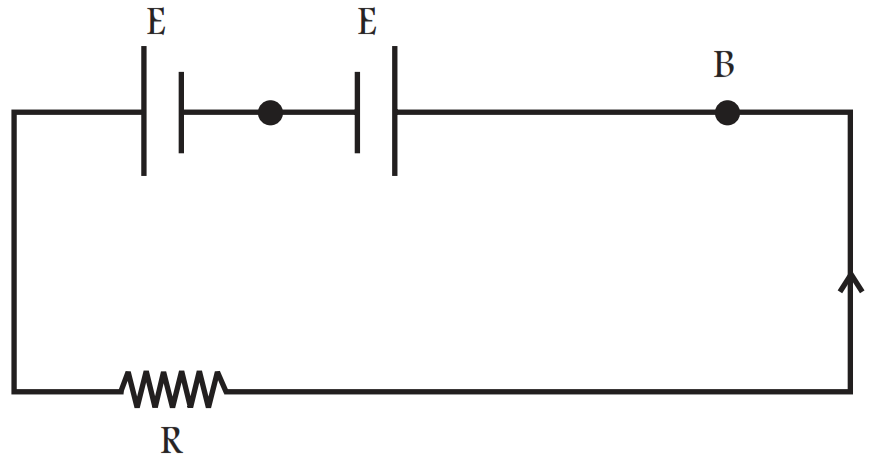
Two cells of same emf E but internal resistance $r_1$ and $r_2$ are connected in series to an external resistor R (Fig). What should be the value of R so that the potential difference across the terminals of the first cell becomes zero.
When an electron goes from the valence band to the conduction band in silicon, its energy is increased by 1.1eV. The average energy exchanged in a thermal collision is of the order of kT which is only 0.026eV at room temperature. How is a thermal collision able to take some of the electrons from the valence band to the conduction band?
Calculate the increase in the internal energy of 10 g of water when it is heated from $0^{\circ} \mathrm{C}$ to $100^{\circ} \mathrm{C}$ and converted into steam at 100 kPa . The density of steam $=0.6 \mathrm{~kg} / \mathrm{m}^{-3}$. Specific heat capacity of water $=4200 \mathrm{~J} / \mathrm{kg}^{-10} \mathrm{C}^{-1}$ and the Jatent heat of vaporization of water $=2.25 \times 10^6 \mathrm{~J} / \mathrm{kg}^{-1}$.
Obtain the amount of $^{60}_{27}\text{Co}$ necessary to provide a radioactive source of 8.0 mCi strength. The half-life of $^{60}_{27}\text{Co}$ is 5.3 years.
A ball of mass m moving at a speed v makes a head-on collision with an identical ball at rest. The kinetic energy of the balls after the collision is three fourths of the original. Find the coefficient of restitution.
(i) How will you show that Lenz's law is a conclusion of energy conservation law? Explain with suitable examples.

(ii) Using the expression for Lorentz force applied on charge carriers of any conductor, obtain an expression for that induced emf which is induced in a conductor of length $l$ moving with a velocity $v$, perpendicular to any magnetic field $B$.
A 5mm high pin is placed at a distance of 15cm from a convex lens of focal length 10cm. A second lens of focal length 5cm is placed 40cm from the first lens and 55cm from the pin. Find
  1. The position of the final image.
  2. Its nature.
  3. Its size.
A card sheet divided into squares each of size $1\ mm^2$ is being viewed at a distance of 9 cm through a magnifying glass (a converging lens of focal length 9 cm) held close to the eye.
  1. What is the magnification produced by the lens? How much is the area of each square in the virtual image?
  2. What is the angular magnification (magnifying power) of the lens?
  3. Is the magnification in (a) equal to the magnifying power in (b)? Explain.
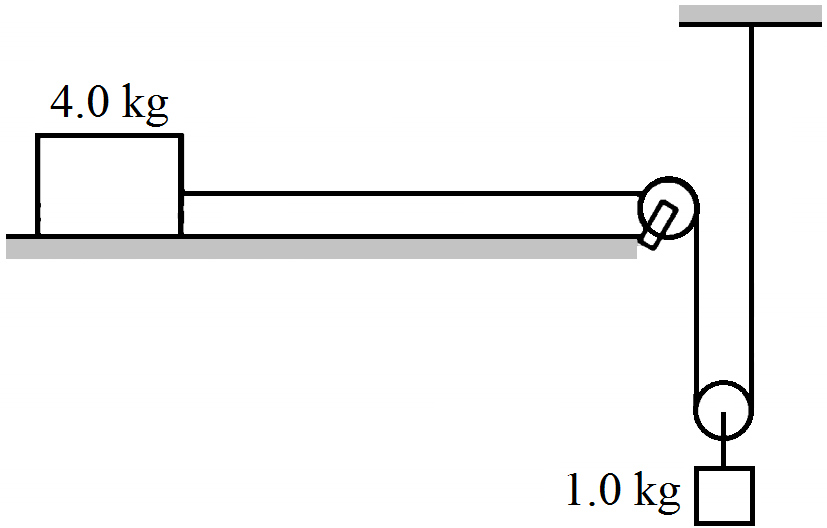
Consider the situation shown in figure. The system is released from rest and the block of mass 1.0kg is found to have a speed 0.3m/s after it has descended through a distance of 1m. Find the coefficient of kinetic friction between the block and the table.
The count rate of nuclear radiation coming from a radiation coming from a radioactive sample containing $^{128}I$ varies with time as follows.
Time t(minute): 0 25 50 75 100
Ctount rate $R(10^9s^{-1}):$ 30 16 8.0 3.8 2.0
  1. Plot In $\Big(\frac{\text{R}_0}{\text{R}}\Big)$ against t.
  2. From the slope of the best straight line through the points, find the decay constant $\lambda.$
  3. Calculate the half-life $\text{t}_{\frac{1}{2}}.$