Question
✓
Answer
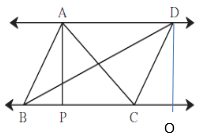
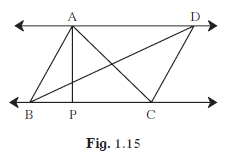
We can re-draw the fig.1.15(as shown above) where we add DO
which will be height of $\triangle B C D$.
Now, $\frac{ A (\triangle ABC )}{ A (\triangle BCD )}=\frac{ AP }{ DO }$
(PROPERTY: Areas of triangles with equal bases are proportional to their corresponding heights.)
$\begin{aligned}
\Rightarrow & \frac{A(\triangle A B C)}{A(\triangle B C D)}=\frac{A P}{D O} \\
\Rightarrow & \frac{A(\triangle A B C)}{A(\triangle B C D)}=\frac{1}{1}
\end{aligned}$
( $\because$ the distance between the two parallel lines is always equal $\Rightarrow A P=D O)$
$\Rightarrow \frac{ A (\triangle ABC )}{ A (\triangle BCD )}=1: 1$
Need a full question paper?
Generate a complete, print-ready paper with questions like this in minutes — across 16+ boards, with answer keys.
Explore more
Similar questions
A man goes $10\ m$ due south and then $24\ m$ due west. How far is he from the starting point?
→Solve the following quadratic equations by factorisation : x² = 3
The sum of the squares of two consecutive even numbers is $340$. Find the numbers.
→If A (-14, -10), B(6, -2) is given, find the coordinates of the points whichdivide segment AB into four equal parts.
Find the value of $k$, if $(5, k),(-3,1)$ and $(-7,-2)$ are collinear.
→If $\text{cosec }\theta=\frac{13}{12},$ find the value of $\frac{2\sin\theta-3\cos\theta}{4\sin\theta-9\cos\theta}$.
→Solve the following simultaneous equation graphically.
2x + 3y = 12; x – y = 1
2x + 3y = 12; x – y = 1
If a $\triangle\text{ABC},$ AD is the bisector of $\angle\text{A},$ Meeting side BC at D.
If AB = 5.6cm, AC = 6cm and DC = 3cm, find BC.
→If AB = 5.6cm, AC = 6cm and DC = 3cm, find BC.
How many multiples of $4$ lie between $10$ and $250$?
→Solve the following quadratic equations by factorization:
$\frac{\text{x}-1}{\text{x}-2}+\frac{\text{x}-3}{\text{x}-4}=3\frac{1}{3},$ $\text{x}\neq2, 4$
→$\frac{\text{x}-1}{\text{x}-2}+\frac{\text{x}-3}{\text{x}-4}=3\frac{1}{3},$ $\text{x}\neq2, 4$