MCQ
In alternating current.
  • A
    The direction of current is always positive
  • B
    The direction of current is always negative
  • The direction of current changes constantly
  • D
    The direction of current is either positive or negative

Answer

Correct option: C.
The direction of current changes constantly

Electric charge in alternating current $(AC)$ changes direction periodically. The voltage in $AC$ circuits also periodically reverses because the current changes direction.

Need a full question paper?

Generate a complete, print-ready paper with questions like this in minutes — across 16+ boards, with answer keys.
Start Generating Free

Similar questions

The insulation property of air breaks down at $E = 3 \times {10^6}$ $volt\,/\,metre$. The maximum charge that can be given to a sphere of diameter $5\,m$ is approximately (in coulombs)
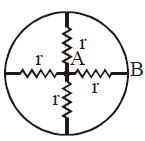
The equivalent resistance betweent point $A$ and $B$
The rays of different colours fail to converge at a point after going through a converging lens. This defect is called:
An electron in hydrogen atom first jumps from second excited state to first excited state and then, from first excited state to ground state. Let the ratio of wavelength, momentum and energy of photons in the two cases be $x, y$ and $z,$ then select the wrong answer/(s) :
The time period of rotation of the sun is 25 days and its radius is $7\times 10^8$ m. The Doppler shift for the light of wavelength 6000 Å emitted from the surface of the sun will be
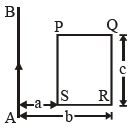
$AB$ is an infinitely long wire placed in the plane of rectangular coil of dimensions as shown in the figure. Calculate the mutual inductance of wire $AB$ and coil $PQRS$
In a $NPN$ transistor the collector current is $24\, mA$. If $80\%$ of electrons reach  collector its base current in $mA$ is
$12$ positive charges of magnitude $q$ are placed on a circle of radius $R$ in a manner that they are equally spaced. A charge $Q$ is placed at the centre, if one of the charges $q$ is removed, then the force on $Q$ is
According to Joule's law, if the potential difference across a conductor having a material of specific resistance remains constant, then the heat produced in the conductor is directly proportional to
There are two identical capacitors, the first one is uncharged and filled with a dielectric of constant $K$ while the other one is charged to potential $V$ having air between its plates. If two capacitors are joined end to end, the common potential will be