MCQ
In an $AC$ circuit, the impedance is $3$​ times the reactance, then the phase angle is.
  • A
    $60^\circ $
  • B
    $30^\circ$
  • C
    zero
  • none of these

Answer

Correct option: D.
none of these
$\sin\phi=\frac{\text{X}}{\text{Z}}=\frac{1}{\sqrt{3}}$
$\therefore\phi=\sin^{-1}\Big(\frac{1}{\sqrt{3}}\Big)$

Need a full question paper?

Generate a complete, print-ready paper with questions like this in minutes — across 16+ boards, with answer keys.

Start Generating Free

Similar questions

Space between two concentric conducting spheres of radii $a$ and $b (b > a)$ is filled with $a$ medium of resistivity $\rho $. The resistance between the two spheres will be
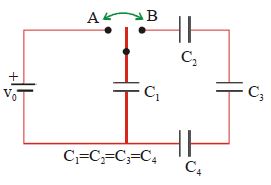
The four identical capacitors in the circuit shown below are initially uncharged. The switch is then thrown first to position $A$, and then to position $B$. After this is done: 

Note: $V_{1,2,3,4}$ are the potential differences across $C_{1,2,3,4}$ and $Q_{1,2,3,4}$ are the final charges stored in $C_{1,2,3,4}$ respectively.
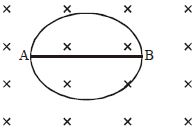
The radius of the circular conducting loop shown in figure is $R.$ Magnetic field is decreasing at a constant rate $\alpha$. Resistance per unit length of the loop is $r.$ Then current in wire $AB$ is ($AB$ is one of the diameters) :-
A transformer with turns ratio $\frac{ N _{1}}{ N _{2}}=\frac{50}{1}$ is connected to a $120$ volt $AC$ supply. If primary and secondary circuit resistances are $1.5\, k \Omega$ and $1\, \Omega$ respectively then find out power out put (in $W$)
Operational amplifier is a
According to classical physics, $10^{-15}\ m$ is distance of closest approach $(d_c)$ for fusion to occur between two protons. A more accurate and quantum approach says that ${d_c} = \frac{{{\lambda _p}}}{{\sqrt 2 }}$ where $'\lambda _p'$ is de-broglie's wavelength of proton when they were far apart. Using quantum approach, find equation of temperature at centre of star. [Given: $M_p$ is mass of proton, $k$ is boltzman constant]
An example of a diamagnetic substance is
Coulomb force and gravitational force follows the:
A convex lens forming a real image of magnification $m_1$ on a screen is moved through  a  distance $x$. $A$ new image of magnification $m_2$ is again formed on the screen. The focal  length of the lens is:
The S.I. unit of electric flux is: