MCQ
In an AC circuit, the impedance is 3 times the reactance, then the phase angle is.
- A60°
- B30°
- Czero
- Dnone of these
Explanation:
$\sin\phi=\frac{\text{X}}{\text{Z}}=\frac{1}{\sqrt{3}}$
$\therefore\phi=\sin^{-1}\Big(\frac{1}{\sqrt{3}}\Big)$
Generate a complete, print-ready paper with questions like this in minutes — across 16+ boards, with answer keys.
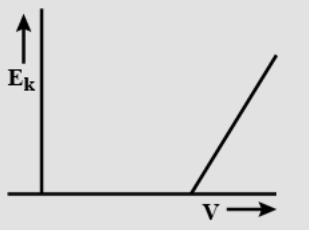
Sixty-four drops are jointed together to form a bigger drop. If each small drop has a capacitance C, a potential V, and a charge q, then the capacitance of the bigger drop will be
|
(a) C |
(b) 4C |
(c) 16C |
(d) 64C |
If convex lens of focal length 80cm and a concave lens of focal length 50 cm are combined together, what will be their resulting power
|
(a) + 6.5 D |
(b) – 6.5 D |
(c) + 7.5 D |
(d) – 0.75 D |
If half-life of a substance is 3.8 days and its quantity is 10.38 gm. Then substance quantity remaining left after 19 days will be
|
(a) 0.151 gm |
(b) 0.32 gm |
(c) 1.51 gm |
(d) 0.16 gm |
In Young’s experiment, the ratio of maximum to minimum intensities of the fringe system is 4 : 1. The amplitudes of the coherent sources are in the ratio
|
(a) 4 : 1 |
(b) 3 : 1 |
(c) 2 : 1 |
(d) 1 : 1 |