Questions · Page 1 of 4

M.C.Q [1M]

🎯

Test yourself on this topic

50 questions · timed · auto-graded

MCQ 11 Mark
In a transformer 220 ac voltage is increased to 2200 volts. If the number of turns in the secondary are 2000, then the number of turns in the primary will be
  • 200
  • B
    100
  • C
    50
  • D
    20
Answer
Correct option: A.
200
A
View full question & answer
MCQ 21 Mark
A current source sends a current $\text{I}-\text{i}_0\cos(\omega\text{t}).$ when connected across an unknown load, it gives a voltage output of $\text{v}=\text{v}_0\sin[\omega\text{t}+(\frac{\pi}{4})]$across that load. then the voltage across the current source may be brought in phase with the current through it by.
  • A
    Connecting an inductor in series with the load
  • B
    Connecting a capacitor in series with the load
  • C
    Connecting an inductor in parallel with the load
  • D
    Connecting a capacitor in parallel with the load
Answer
  1. Connecting an inductor in series with the load
View full question & answer
MCQ 31 Mark
In an ideal parallel LC circuit, the capacitor is charged by connecting it to a D.C. source which is then disconnected. The current in the circuit.
  • A
    Becomes zero instantaneously
  • B
    Grows monotonically
  • C
    Decays monotonically
  • D
    Oscillates instantaneously
Answer
  1. Oscillates instantaneously

Explanation:

In an LC circuit current oscillates between, maximum and minimum value. So, LC circuit needs oscillations (electrical). It occurs due to discharging and charging of capacitor and magnetisation and demagnetisation of inductor

View full question & answer
MCQ 41 Mark
What is the value of inductance L for which the current is a maximum in a series LCR circuit with $\text{C}=10\mu\text{F}$ and $\omega=1000_\text{s}^{-1}$?
  • A
    10mH
  • B
    100mH
  • C
    1mH
  • D
    cannot be calculated unless R is known
Answer
  1. 100mH
View full question & answer
MCQ 51 Mark
A light bulb is rated at 100W for a 220V supply. Find the peak voltage of the source:
  • A
    111V
  • B
    211V
  • C
    311V
  • D
    411V
Answer
  1. 311V

Explanation:

The rated voltage in bulb is rms voltage.

$\text{V}_\text{rms}=\frac{\text{V}_0}{\sqrt{2}}$

$\text{V}_0=\sqrt{2}\times220=311.08\text{V}$

View full question & answer
MCQ 61 Mark
Capacitance (C) of the capacitor is.
  • A
    $10\mu\text{F}$
  • B
    $15\mu\text{F}$
  • C
    $20\mu\text{F}$
  • D
    $\text{None of these}$
Answer
  1. $20\mu\text{F}$
View full question & answer
MCQ 71 Mark
In series L - C - R circuit voltage drop across resistance is 8V, across inductor is 6V and across capacitor is 12V. Then.
  • A
    Voltage of the source will be leading in the circuit.
  • B
    Voltage drop across each element will be less than the applied voltage.
  • C
    Power factor of the circuit will be $\frac{3}{4}$
  • D
    None of the above.
Answer
  1. None of the above.

Explanation:

$\text{V}=\sqrt{\text{V}_\text{R}^2+(\text{V}_\text{C}-\text{V}_\text{L})^2}=10\text{V}$

VC​ > VL​, hence current leads the voltage.

Power factor $=\cos\phi=\frac{8}{10}=0.8$

View full question & answer
MCQ 81 Mark
In an AC circuit containing only capacitance, the current:
  • A
    leads the voltage by 180
  • B
    lags the voltage by 90
  • C
    leads the voltage by 90
  • D
    remains in phase with the voltage
Answer
  1. leads the voltage by 90

Explanation:

Current leads by 90°.

View full question & answer
MCQ 91 Mark
Inductive reactance of a coil is expressed in.
  • A
    Amphere
  • B
    Ohm
  • C
    Volt
  • D
    Weber
Answer
  1. Ohm

Explanation:

Inductive reactance or capacitive reactance are the impedance of an AC circuit which has the units of ohms.

View full question & answer
MCQ 101 Mark
A mixer of $100\Omega$ resistance is connected to an A.C. source of 200V and 50 cycles/ sec. The value of average potential difference across the mixer will be:
  • A
    308 V
  • B
    264 V
  • C
    220 V
  • D
    zero
Answer
  1. zero

Explanation:

We need to find the average potential difference across the mixer. Here by average we mean average over a long period of time. As we know in one complete cycle, average voltage across the mixer is zero. (In one complete cycle current changes the direction and net voltage across a resistor is zero). 
So when in one complete cycle voltage drop across the resistor is zero, then the average voltage drop across the resistor (mixer) is zero.

View full question & answer
MCQ 111 Mark
The equation of an alternating voltage is E = 220 E = 220.Then the impedance of the circuit is:
  • A
    10 ohm
  • B
    22 ohm
  • C
    11 ohm
  • D
    17 ohm
Answer
  1. 22 ohm

Explanation:

Our experts are building a solution for this.

View full question & answer
MCQ 121 Mark
To convert mechanical energy into electrical energy, one can use:
  • A
    DC dynamo.
  • B
    AC dynamo.
  • C
    Motor.
  • D
    Transformer.
Answer
  1. DC dynamo.
  2. AC dynamo.

Explanation:

DC dynamo or AC dynamo use to convert mechnical energy into electrial energy.

View full question & answer
MCQ 131 Mark
In an alternating current circuit consisting of elements in series, the current increases on increasing the frequency of supply. Which of the following elements are likely to constitute the circuit?
  • A
    Only resistor.
  • B
    Resistor and an inductor.
  • C
    Resistor and a capacitor.
  • D
    Only a capacitor.
Answer
  1. Resistor and a capacitor.
  2. Only a capacitor.

Solution:

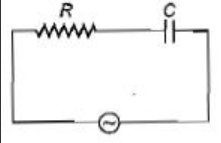
This is the similar problem as we discussed above. In this problem, the current increases on increasing the frequency of supply. Hence, the reactance of the circuit must be decreased as increase in frequency. So, one element that must be connected is capacitor. We can also connect a resistor in series.

For a capacitive circuit,

$\text{X}_\text{C}=\frac{1}{\omega\text{C}}=\frac{1}{2\pi\text{fC}}$

When frequency increases, XC decreases. Hence current in the circuit increases.

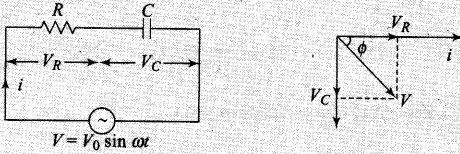
Importance point: Resistive, Capacitive Circuit (RC-Circuit)

VR = iR,

VC = iXC,

VR = iR

  1. Applied voltage: $\text{V}=\sqrt{\text{V}^2_\text{R}+\text{V}^2_\text{C}}$

  2. Impedance: $\text{Z}=\sqrt{\text{R}^2+\text{X}^2_\text{C}}=\sqrt{\text{R}^2+\Big(\frac{1}{\omega\text{C}}\Big)^2}$

  3. Current: $\text{i}=\text{i}_0\sin(\omega\text{t}+\phi)$

  4. Peak current: $\text{i}_0=\frac{\text{V}_0}{\text{Z}}=\frac{\text{V}_0}{\sqrt{\text{R}^2+\text{X}^2_\text{C}}}=\frac{\text{V}_0}{\sqrt{\text{R}^2+\frac{1}{4\pi^2\text{v}^2\text{C}^2}}}$

  5. Phase difference: $\phi=\tan^{-1}\frac{\text{X}_\text{C}}{\text{R}}=\tan^{-1}\frac{1}{\omega\text{CR}}$

  6. Power factor: $\cos\phi=\frac{\text{R}}{\sqrt{\text{R}^2+\text{X}^2_\text{C}}}$

  7. Leading quantity: Current.

View full question & answer
MCQ 141 Mark
The line that draws power supply to your house from street has:
  • A
    Zero average current.
  • B
    220V average voltage.
  • C
    Voltage and current out of phase by 90º.
  • D
    Voltage and current possibly differing in phase $\phi$ such that $\Big|\phi\Big|<\frac{\pi}{2}$.
Answer
  1. Zero average current.
  1. Voltage and current possibly differing in phase $\phi$ such that $\Big|\phi\Big|<\frac{\pi}{2}$.

Solution:

Alternation currents are used for household supplies, which are having zero average value over a cycle.

The line is having some resistance, so power factor $\cos\phi=\frac{\text{R}}{\text{Z}}\neq0$

So, $\phi\neq\frac{\pi}{2}\Rightarrow\ \phi<\frac{2}{\pi}$

i.e., phase lies between 0 and $\frac{\pi}{2}$.

Important point: The average value of alternating quantity for one complete cycle is zero.

The average value of ac over half cycle $\Big(\text{t}=0\text{ to }\frac{\text{T}}{2}\Big)$

$\text{i}_\text{av}=\frac{\int_0^{\frac{\text{T}}{2}}\text{idt}}{\int_0^{\frac{\text{T}}{2}}\text{dt}}=0.637\text{i}_0=63.7\% \ \text{of i}_0$

Similarly $\text{V}_\text{av}=\frac{2\text{V}_0}{\pi}=0.637\text{V}_0=63.7\%\ \text{of V}_0.$
View full question & answer
MCQ 151 Mark
In a series RLC circuit that is operating above the resonant frequency, the current.
  • A
    lags the applied voltage
  • B
    leads the applied voltage
  • C
    is in phase with the applied voltage
  • D
    is zero
Answer
  1. lags the applied voltage

Explanation:

Capacitive reactance is given by. $\text{X}_\text{C}=\frac{1}{\text{wC}}$

Inductive reactance is given by $\text{X}_\text{L}={\text{wL}}$

At resonance, $\text{X}_\text{L}={\text{X}_\text{C}}\Rightarrow \text{w}\text{L}=\frac{1}{\text{wC}}$

But a frequency higher than resonance frequency, XL​ > XC

So the circuit behaves as a inductive circuit at a frequency higher that resonant frequency and the current lags behind the voltage in an inductive circuit.

View full question & answer
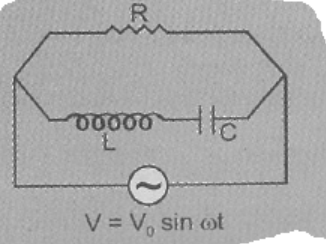
MCQ 161 Mark
The Current in resistance R at resonance is.
Image
  • A
    Zero
  • B
    Minimum but finite
  • C
    Maximum but finite
  • D
    Infinite
Answer
  1. Maximum but finite

Explanation:

At resonance XL​ = XC

⇒ R & current is maximum but finite, which is

$\text{I}_\text{max}=\frac{\text{E}}{\text{R}}$ where E is applied voltag.

View full question & answer
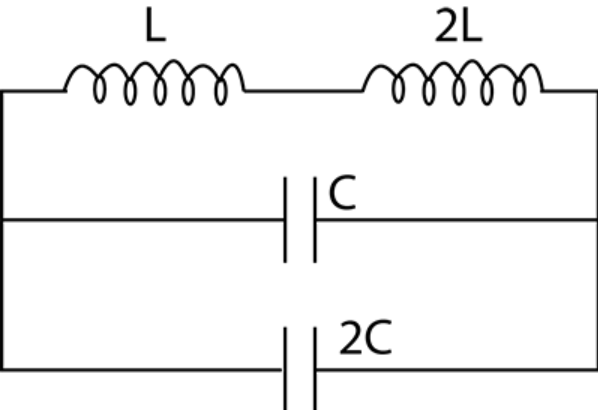
MCQ 171 Mark
The frequency of oscillation of current in the inductor is.
Image
  • A
    $\frac{1}{3\sqrt{\text{LC}}}$
  • B
    $\frac{1}{6\pi\sqrt{\text{LC}}}$
  • C
    $\frac{1}{\sqrt{\text{LC}}}$
  • D
    $\frac{1}{2\pi\sqrt{\text{LC}}}$
Answer
  1. $\frac{1}{6\pi\sqrt{\text{LC}}}$

Explanation:

Equivalent inductance Leq ​= L + 2L = 3L

Ceq ​= C + 2C = 3C

$\therefore$ Frequency of oscillation $\text{f}=\frac{1}{2\pi\sqrt{\text{L}_\text{eq}\text{C}_\text{eq}}}=\frac{1}{6\pi\sqrt{\text{LC}}}$

View full question & answer
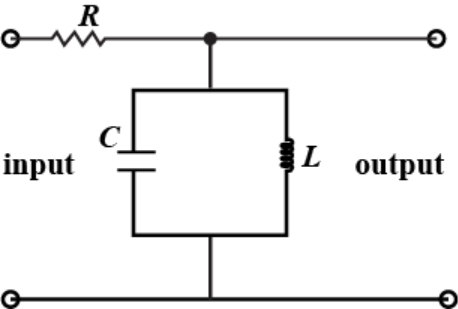
MCQ 181 Mark
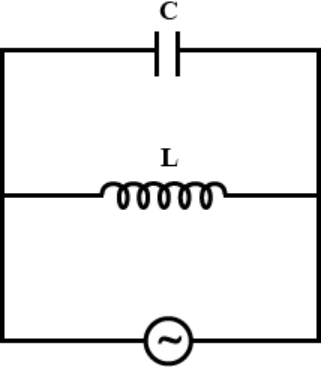
The circuit shown in Fig. acts as a.
Image
  • A
    tuned filter
  • B
    low pass filter
  • C
    high pass filter
  • D
    rectifier
Answer
  1. tuned filter

Explanation:

The circuit shown in figure has capacitor and inductor in parallel so their will be current flowing continuously with energy being transformed into electrical in capacitor and magnetic in inductor, hence it is a tuned filter.

View full question & answer
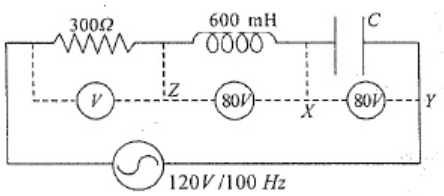
MCQ 191 Mark
In above circuit, what is the potential drop across ZY?
Image
  • A
    160 V
  • B
    $80\sqrt{80}$
  • C
    80 V
  • D
    zero
Answer
  1. zero

Explanation:

VZY ​= VC ​- VL ​= 0

View full question & answer
MCQ 201 Mark
In alternating current.
  • A
    The direction of current is always positive
  • B
    The direction of current is always negative
  • C
    The direction of current changes constantly
  • D
    The direction of current is either positive or negative
Answer
  1. The direction of current changes constantly

Explanation:

Electric charge in alternating current (AC) changes direction periodically. The voltage in AC circuits also periodically reverses because the current changes direction.

View full question & answer
MCQ 211 Mark
A capacitor has capacitance 0.5nF. A choke of $5\mu\text{H}$ is connected in series. An electromagnetic wave of wavelength $\lambda$ is found to resonate with it. Find $\lambda$ (in meter).
  • A
    $10\pi$
  • B
    $20\pi$
  • C
    $30\pi$
  • D
    $5\pi$
Answer
  1. $30\pi$
View full question & answer
MCQ 221 Mark
A capacitor acts as an infinite resistance for.
  • A
    DC
  • B
    AC
  • C
    DC as well as AC
  • D
    neither AC nor DC
Answer
  1. DC

Explanation:

Capacitors contain at least two electrical conductors separated by a dielectric/ insulator and is used to store energy electrostatically between the conductors. It acts like an open circuit and hence acts like an infinite resistance for DC currents.

View full question & answer
MCQ 231 Mark
The AC voltage across a resistance can be measured using:
  • A
    A potentiometer.
  • B
    A hot-wire voltmeter.
  • C
    A moving-coil galvanometer.
  • D
    A moving-magnet galvanometer.
Answer
  1. A hot-wire voltmeter.

Explanation:

The AC voltae across a resustance can be measured using a hot-wore volmeter.

View full question & answer
MCQ 241 Mark
The peak voltage in a 220V AC source is:
  • A
    220V.
  • B
    About 160V.
  • C
    About 310V.
  • D
    440V.
Answer
  1. About 310V.

Explanation:

$\text{V}_\text{rms}=220\text{V}$

$\text{V}_\text{p}=\sqrt{2}\times\text{V}_\text{rms}$

$=220\times1.414=311\text{volt}$

View full question & answer
MCQ 251 Mark
'Z' is not.
  • A
    Atomic number
  • B
    Impedance
  • C
    Zeta potential
  • D
    Partition function
Answer
  1. Partition function

Explanation:

Z- Atomic number we study in modern physics

Z- impedance we study in alternating current 

Z-zeta potential

View full question & answer
MCQ 261 Mark
A 50 Hz, 20 V AC source is connected across R series circuit as shown in Figure If the voltage across R is 12V then voltage across capacitor is.
Image
  • A
    8 V
  • B
    16 V
  • C
    10 V
  • D
    cannot be predicted as values of R and C are not given.
Answer
  1. 16 V

Explanation:

$\text{V}^2={\text{V}^2_\text{R}}+{\text{V}^2_\text{c}}$

$20^2=12^2+\text{V}^2_\text{c}$

$\text{V}_\text{c}=\sqrt{20^2-12^2}$

$\text{V}_\text{c}=16\text{ V}$

View full question & answer
MCQ 271 Mark
The AC produced in India changes its direction in every:
  • A
    $\frac{1}{100}\text{second}$
  • B
    100 second
  • C
    50 second
  • D
    None of these
Answer
  1. $\frac{1}{100}\text{second}$

Explanation:

In India, the frequency of AC voltage is 50 Hz.

It means 50 waves will be produced in 1 s.

In one wave, the direction is changed 2 times.

Thus, in 50 waves, the direction will be altered 50 × 2 = 100 times.

i.e. the direction is changed 100 times in 1 s.

Thus the direction is changed in every $\frac{1}{100}\text{second}$

View full question & answer
MCQ 281 Mark
To reduce the reasonant frequency in an LCR series circuit with a generator:
  • A
    The generator frequency should be reduced.
  • B
    Another capacitor should be added in parallel to the first.
  • C
    The iron core of the inductor should be removed.
  • D
    Dielectric in the capacitor should be removed.
Answer
  1. Another capacitor should be added in parallel to the first.

Solution:

Key Concept: Resonant frequency (Natural frequency)

At resonance $\text{X}_\text{L}=\text{X}_\text{C}\Rightarrow\ \omega_0\text{L}=\frac{1}{\omega_0\text{C}}$

$\Rightarrow\ \omega_0=\frac{1}{\sqrt{\text{LC}}}\frac{\text{red}}{\sec}$

$\Rightarrow\ \text{v}_0=\frac{1}{2\pi\sqrt{\text{LC}}}\text{Hz}$

Resonant frequency in an L-C-R circuit is given by

$\text{v}_0=\frac{1}{2\pi\sqrt{\text{LC}}}$

If L or C increases, the resonant frequency will reduce.

To increase capacitance, we must connect another capacitor parallel to the first.

View full question & answer
MCQ 291 Mark
The values of XL​, XC​ and R in series with an A.C. circuit are $8\Omega,6\Omega$ and $10\Omega$ respectively. The
total impedance of the circuit will be ________$\Omega$
  • A
    10.2
  • B
    12.2
  • C
    10
  • D
    24.4
Answer
  1. 10.2

Explanation:

$\text{Z}=\sqrt{\text{R}^2+(\text{X}_\text{L}-\text{X}_\text{C})^2}$

$=\sqrt{(10)^2+(8-6)^2}$

$=\sqrt{10^2+2^2}$

$=\sqrt{100+4}$

$=10.2\Omega$

View full question & answer
MCQ 301 Mark
Of the following about capacitive reactance which is correct?
  • A
    The reactance of the capacitor is directly proportional to its ability to store charge
  • B
    Capacitive reactance is inversely proportional to the frequency of the current
  • C
    Capacitive reactance is measured in farad
  • D
    The reactance of a capacitor in an AC circuit is similar to the resistance of a capacitor in a DC circuit
Answer
  1. Capacitive reactance is inversely proportional to the frequency of the current

Explanation:

Capacitative reactance is an opposition to the change of voltage across an element.

It is denoted by XC​ and is inversely proportional to the signal frequency (f) and the capacitance C

$\text{X}_\text{c}=\frac{1}{2\pi\text{fc}}$

View full question & answer
MCQ 311 Mark
A series LCR circuit is tuned to resonance. If the angular frequency of the applied AC voltage at resonance is $\omega$ the impedance of the circuit then is:
  • A
    $\text{R}+\omega\text{L}+(\frac{1}{\omega\text{C}})$
  • B
    $\text{R}$
  • C
    $\sqrt{\text{R}^2+\omega\text{L}+(\frac{1}{\omega\text{C}})^2}$
  • D
    $\sqrt{\text{R}^2+(\omega\text{L}-\frac{1}{\omega\text{C}})^2}$
Answer
  1. $\text{R}$

Explanation:

At resonance $\frac{1}{\omega\text{C}}=\omega\text{L}$

$\therefore$ impedance = R

View full question & answer
MCQ 321 Mark
If the inductance and capacitance are both doubled in L - C - R circuit, the resonant frequency of the circuit will:
  • A
    Decrease to one-half of the original value
  • B
    Decrease to one-fourth of the original value
  • C
    Increase to twice the original value
  • D
    Decrease to twice the original value
Answer
  1. Decrease to one-half of the original value

Explanation:

Resonant frequency in series LCR circuit: $\omega=\sqrt{\frac{1}{\text{LC}}}$

Resonant frequency in series LCR circuit, $\omega=\sqrt{\frac{1}{\text{LC}}}=\sqrt{\frac{1}{\text{2L}\times\text{2C}}}=\frac{\omega}{2}$

View full question & answer
MCQ 331 Mark
A series R-C circuit is connected to an alternating voltage source. Consider two situation:
(a) When capacitor is filled
(b) When capacitor is mica filled
Current through resister is i and voltage across capacitor is V then:
  • A
    Va​ = Vb
  • B
    Va​ < Vb
  • C
    Va​ > Vb​
  • D
    ia​ = ib​
Answer
  1. Va​ > Vb​

Explanation:

For series C - R circuit, the impedance $\text{Z}=\sqrt{\text{R}^2+\text{X}^2_\text{C}}$ where $\text{X}_\text{C}=\frac{\text{i}}{\omega\text{C}}$ and current $\text{I}=\frac{\text{V}}{\text{Z}}$

When the capacitor is filled by mica, the capacitance will be increased. If C increases, XC​ decreases, so the current will increase and 

hence voltage across resistance increases and voltage across capacitor decreases. thus, Va​ > Vb​

View full question & answer
MCQ 341 Mark
When an AC voltage of 220V is applied to the capacitor C:
  • A
    The maximum voltage between plates is 220V.
  • B
    The current is in phase with the applied voltage.
  • C
    The charge on the plates is in phase with the applied voltage.
  • D
    Power delivered to the capacitor is zero.
Answer
  1. The charge on the plates is in phase with the applied voltage.
  2. Power delivered to the capacitor is zero.

Solution:

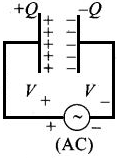
If the alternating voltage is applied to the capacitor, the plate connected to the positive terminal of the source will be at higher potential and the plate connected to the negative terminal of source will be at lower potential. So the plates capacitor is charged.

If $\text{V}=\text{V}_0\sin\omega\text{t},\text{Q}=\text{C V}_0\sin\omega\text{t}$ or we can say that Q and emf are in pahse.

As $\text{P}=\text{V}_\text{rms}\text{I}_\text{rms}\cos\phi$ and in case of a capacitor, $\phi=\frac{\pi}{2}\text{P} = 0,$ or we can say that power delivered to the capacitor is zero.

⇒ Pav = power delivered = 0.

View full question & answer
MCQ 351 Mark
The resultant reactance in an L - C - R circuit is.
  • A
    XL ​+ XC
  • B
    XL​ - XC
  • C
    $\sqrt{\text{X}^2_\text{L}+\text{X}^2_\text{C}}$
  • D
    $\sqrt{\text{X}^2_\text{L}-\text{X}^2_\text{C}}$
Answer
  1. XL​ - XC

Explanation:

Reactance is the nonresistive component of impedance in an AC circuit, arising from the effect of inductance or capacitance or both and causing the current to be out of phase with the electromotive force causing it.

Therefore, reactance of the L - C - R circuit is XL​ - XC​.

View full question & answer
MCQ 361 Mark
Statement A: With an increase in the frequency of AC supply inductive reactance increases.
Statement B: With an increase in the frequency of AC supply capacitive reactance increase.
  • A
    A is true but B is false
  • B
    Both A and B are true
  • C
    A is false but B is true
  • D
    Both A and B are false
Answer
  1. A is true but B is false

Explanation:

$\text{Z}_\text{L}=\text{WL}\ \ \ \text{Z}_\text{C}=\frac{1}{\text{WC}}$

$\text{w}\uparrow,\text{Z}_\text{L}\uparrow\text{Z}_\text{c}\downarrow$

View full question & answer
MCQ 371 Mark
If the phase difference between Alternating Voltage and Alternating Current is $\frac{\pi}{6}$​ and the resistance in the circuit is $\sqrt{300}\Omega,$ then the impedance of the circuit will be.
  • A
    $25\Omega$
  • B
    $50\Omega$
  • C
    $20\Omega$
  • D
    $100\Omega$
Answer
  1. $20\Omega$

Explanation:

$\text{impedance}×\cos\theta = \text{resistance}$

$\text{impedance} = \frac{\text{resistance}}{\cos\theta}$

$=\frac{\sqrt{300}}{\frac{\cos\pi}{6}}$

$20\Omega$

View full question & answer
MCQ 381 Mark
The phase angle between current and voltage in a purely inductive circuit is:
  • A
    $\text{zero}$
  • B
    $\pi$
  • C
    $\frac{\pi}{4}$
  • D
    $\frac{\pi}{2}$
Answer
  1. $\frac{\pi}{2}$

Explanation:

In the above image waveform of current and voltage in puerly inductive circuit with time is shown.

It is clear from the image that current lags voltage by 90°.

Hence phase angle between current and voltage in purely inductive circuit is $\frac{\pi}{2}$

View full question & answer
MCQ 391 Mark
An inductor of reactance 1Ω and a resistor of 2Ω are connected in series to the terminals of a 6V (rms) a.c. source. The power dissipated in the circuit is:
  • A
    8W.
  • B
    12W.
  • C
    14.4W.
  • D
    18W.
Answer
  1. 14.4W.

Solution:

According to the problem, XL = 1Ω, R = 2Ω,

Erms = 6V, Pav = ?

Average power dissipated in the circuit

$\text{P}_\text{av}=\text{E}_\text{rms}\text{I}_\text{rms}\cos\phi \ .....(\text{i})$

$\text{I}_\text{rms}=\frac{\text{E}_\text{rms}}{\text{Z}}$

$\text{Z}=\sqrt{\text{R}^2+\text{X}^2_\text{L}}$

$=\sqrt{4+1}=\sqrt{5}$

$\text{I}_\text{rms}=\frac{6}{\sqrt{5}}\text{A}$

$\cos\phi=\frac{\text{R}}{\text{Z}}=\frac{2}{\sqrt{5}}$

$\text{P}_\text{av}=6\times\frac{6}{\sqrt{5}}\times\frac{2}{\sqrt{5}}\ \ [\text{from Eq. (i)]}$

$=\frac{72}{\sqrt{5}\sqrt{5}}=\frac{72}{5}=14.4\text{W}$​​​​​​​

View full question & answer
MCQ 401 Mark
A capacitor is connected to an A.C. circuit, then the phase difference between current and the voltage is:
  • A
    $\pi$
  • B
    $\frac{\pi}{2}$
  • C
    $\frac{-\pi}{2}$
  • D
    $\text{Zero}$
Answer
  1. $\frac{\pi}{2}$

Explanation:

Current leads voltage by $\frac{\pi}{2}$

$\therefore$ phase difference is $=\frac{\pi}{2}$

View full question & answer
MCQ 411 Mark
In an LCR circuit the potential difference between the terminal of the inductance is 60V, between the terminals of the capacitor is 30V and that between the terminals of the resistance is 40V. The supply voltage will be equal to:
  • A
    130V
  • B
    10V
  • C
    50V
  • D
    70V
Answer
  1. 50V

Explanation:

Supply voltage of an LCR circuit

$\text{V}=\sqrt{\text{V}^2_\text{R}+(\text{V}_\text{L}-\text{V}_\text{C})^2}$

since inductor and capacitor potentials are out of phase with each other

$=\sqrt{40^2+(60-30)^2\text{V}}$

$=50\text{V}$

View full question & answer
MCQ 421 Mark
A 220V main supply is connected to a resistance of $100\text{k}\Omega$ The effective current is?
  • A
    $2.2\text{mA}$
  • B
    $2.2\sqrt{2\text{mA}}$
  • C
    $\frac{2.2}{\sqrt{2}}\text{mA}$
  • D
    $\text{None of these}$
Answer
  1. $2.2\text{mA}$

Explanation:

Effective current is the rms value. Here, 220V is the labelled value of AC which is also the rms value. Hence,

$\text{I}_\text{rms}=\frac{\text{E}_\text{rms}}{\text{R}}$

$\text{I}_\text{rms}=\frac{220}{100\times10^3}$

$\text{I}_\text{rms}=2.2{\text{mA}}$

View full question & answer
MCQ 431 Mark
An AC source is rated 220V, 50Hz. The average voltage is calculated in a time interval of 0.01s, It:
  • A
    Must be zero.
  • B
    May be zero.
  • C
    Is never zero.
  • D
    Is $\Big(\frac{200}{\sqrt{2}}\Big)\text{V}.$
Answer
  1. May be zero.

Explanation:

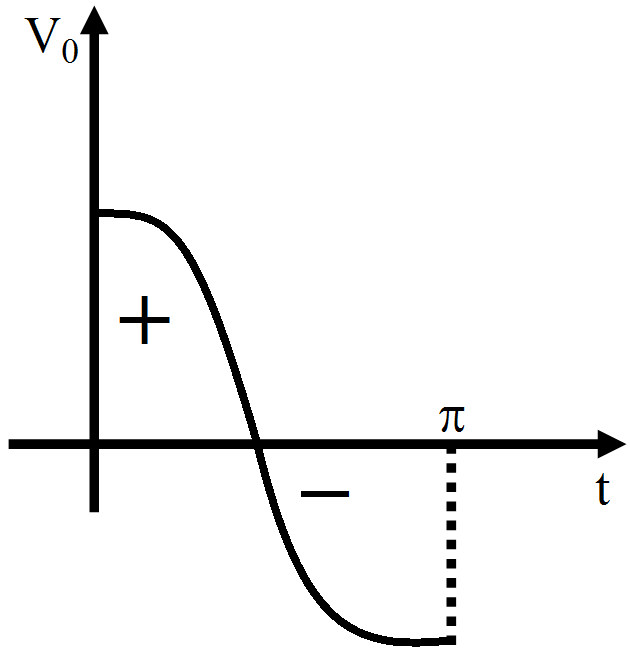
  1. $\text{V}=\text{V}_0\sin\omega\text{t}$

$\omega=2\pi\text{f}=2\times3.14\times50$

$\omega=314$

$\text{V}_\text{avg}=\frac{\int\limits_0^{0.01}\text{V}\text{dt}}{\int\limits_0^{0.01}\text{dt}}$

$=\text{V}_0\Big(\frac{1\cos\omega\text{t}}{\omega}\Big)_0^{0.01}$

$=\frac{\text{V}_0}{\omega\times0.01}\big(1-\cos\omega(0.1)\big)$

$=\frac{\text{V}_0}{314\times0.01}\big(1-\cos(314\times0.01)\big)$

$=\frac{\text{V}_0}{3.14}\big(1-\cos(314)\big)$

$=\frac{\text{V}_0}{3.14}\big(1-\cos\pi\big)$

$=\frac{2\text{V}_0}{\pi}=140.127\text{volt}$

  1.  

if $\text{V}=\text{V}_0\cos\omega\text{t}$

$\text{V}_\text{avg}=\frac{\int\text{V d}\rho}{\int\text{dt}}=0$

View full question & answer
MCQ 441 Mark
In the AC network shown in figure, the rms current flowing through the inductor and capacitor are 0.6A and 0.8A respectively. Then the current coming out of the source is
Image
  • A
    1.0A
  • B
    1.4A
  • C
    0.2A
  • D
    None of the above
Answer
  1. 0.2A

Explanation:

IC​ is 90° ahead of the applied voltage and IL​ lags behind the applied voltage by 90°. So, there is a phase difference of 180° between IL​ and IC​

$\therefore$ I = IC​ - IL ​= 0.2A

View full question & answer
MCQ 451 Mark
The instantaneous voltage through a device of impedence $20\Omega$ is $\text{e}=80\sin100\pi\text{t}.$The effective value of the current is.
  • A
    3A
  • B
    2.828A
  • C
    1.732A
  • D
    4A
Answer
  1. 2.828A

Explantion:

Given equation, $\text{e}=80\sin100\pi\text{t}.(\text{i})$

Standard equation of instantaneous voltage given by E =

$\text{e}_\text{m}\sin(\omega\text{t})......(\text{i})$

Compare (i) and (ii), we get em​ = 80V

where em​ is the voltage amplitude.

Current amplitude $\text{I}_\text{m}=\frac{\text{e}_\text{m}}{\text{Z}}$ where Z = impedence

$=\frac{80}{20}=4\text{A}$

$\text{I}_\text{r.m.s}=\frac{4}{\sqrt{2}}=\frac{4\sqrt{2}}{2}=2\sqrt{2}=2.828\text{A}$

View full question & answer
MCQ 461 Mark
In a circuit L, C and R are connected in series with an alternating voltage source of frequency f. The current leads the voltage by 45°. The value of C is.
  • A
    $\frac{1}{2\pi\text{f}(2\pi\text{fL - R})}$
  • B
    $\frac{1}{2\pi\text{f}(2\pi\text{fL + R})}$
  • C
    $\frac{1}{\pi\text{f}(2\pi\text{fL - R})}$
  • D
    $\frac{1}{\pi\text{f}(2\pi\text{fL + R})}$
Answer
  1. $\frac{1}{2\pi\text{f}(2\pi\text{fL + R})}$

Explanation:

Here XC​ - XL ​= R

$\Rightarrow\frac{1}{2\pi\text{f}}=(\text{R}+2\pi\text{fL})$

$\Rightarrow\text{C}=\frac{1}{2\pi\text{f}(2\pi\text{fL + R})}$

View full question & answer
MCQ 471 Mark
The impedance of a series L - C - R circuit in an AC circuit is.
  • A
    $\sqrt{\text{R}+(\text{X}_\text{L}-\text{X}_\text{C})}$
  • B
    $\sqrt{\text{R}^2+(\text{X}_\text{L}^2-\text{X}_\text{C}^2)}$
  • C
    $\text{R}$
  • D
    $\text{None of these}$
Answer
  1. $\text{None of these}$

Explanation:

$\text{Z}=\sqrt{\text{R}^2+(\text{X}_\text{L}-\text{X}_\text{C})^2}$

View full question & answer
MCQ 481 Mark
A steady potential difference of 100V produces heat at a constant rate in a resistor. The alternating voltage which will produce half the heating effect in the same resister will be.
  • A
    100V
  • B
    50V
  • C
    70.7V
  • D
    141.4V
Answer
  1. 100V

Explanation:

The power supplied to the resistor by DC source $=\frac{\text{V}^2_\text{dc}}{\text{R}}$

Energy given by AC source $\int_{0}^{\text{T}}=\frac{\text{V}^2_0}{\text{R}}\text{dt}$

Hence, $\int_{0}^{\text{T}}=\frac{\text{V}^2_0\sin^2\omega\text{t}}{\text{R}}\text{dt}=\frac{1}{2}\times\frac{\text{V}^2_\text{dc}\text{T}}{\text{R}}$

$\Rightarrow\text{V}_0=\text{V}_\text{dc}=100\text{V}$

View full question & answer
MCQ 491 Mark
An inductance and resistance are connected in series with an A.C circuit. In this circuit.
  • A
    the current and P.d. across the resistance lead P.d across the inductance by $\frac{\pi}{2}$
  • B
    the current and P.d across the resistance lags behind the P.d. across the inductance by angle $\frac{\pi}{2}$
  • C
    The current across resistance leads and the P.d across resistance lags behind the P.d across the inductance by $\frac{\pi}{2}$
  • D
    the current across resistance lags behind and the P.d across the resistance leads the P.d across the inductance by $\frac{\pi}{2}$
Answer
  1. the current and P.d across the resistance lags behind the P.d. across the inductance by angle $\frac{\pi}{2}$

Explanation:

This is very fundamental. If we apply separate voltages across resistance and inductor, then in resistance, current and voltage both are in same phase whereas in inductor, current across it lags p.d across it by $\frac{\pi}{2}.$
Now, when we apply voltage across inductor and resistance connencted in series then current through both of them will be same because of KCL. therefore voltage across resistor will be in same phase with current whereas voltage across inductor will lead the current across it by $\frac{\pi}{2}.$ therefore current and voltage across resistor lags voltage across inductor by $\frac{\pi}{2}$

View full question & answer
MCQ 501 Mark
A constant current of 2.8A exists in a resistor. The rms current is:
  • A
    2.8A.
  • B
    About 2A.
  • C
    1.4A.
  • D
    Undefined for a direct current.
Answer
  1. 2.8A.

Explanation:

A constant current exists in a resistor is rms current it is equal to 2.8Amp.

View full question & answer