MCQ
In an electric circuit containing a battery, the charge (assumed positive) inside the battery:
  • A
    Always goes from the positive terminal to the negative terminal.
  • May go from the positive terminal to the negative terminal.
  • C
    Always goes from the negative terminal to the positive terminal
  • D
    Does not move.

Answer

Correct option: B.
May go from the positive terminal to the negative terminal.
The charge (Positive) inside the bottery my go from the positive terminal to the negative terminal.

Need a full question paper?

Generate a complete, print-ready paper with questions like this in minutes — across 16+ boards, with answer keys.

Start Generating Free

Similar questions

Consider a planet in some solar system which has a mass double the mass of earth and density equal to the average density of earth. If the weight of an object on earth is ${W}$, then weight of the same object on that planet will be
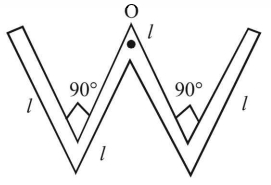
A thin rod of length $41$ and mass $4\,m$ is bent at the points as shown in figure. What is the moment of inertia of the rod about the axis passes through point $O$ and perpendicular to the plane of paper?
A tuning fork of frequency $340\, Hz$ is sounded above an organ pipe of length $120\, cm$. Water is now slowly poured in it. The minimum height of water column required for resonance is .... $cm$ (speed of sound in air $= 340 \,m/s$)
​​​​50% of the X-rays coming from a Coolidge tube are able to pass through a 0.1mm thick aluminium foil. If the potential difference between the target and the filament is increased, the fraction of the X-rays passing through the same foil will be:
If $g$ is the acceleration due to gravity on the earth's surface, the gain in the potential energy of an object of mass $m$ raised from the earth's surface to a height equal to the radius $R$ of the earth, is:
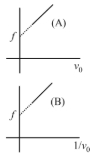
A source of sound emits sound waves at frequency $f_0$. It is moving towards an observer with fixed speed $v_s$ ($v_s < v$, where $v$ is the speed of sound in air). If the observer were to move towards the source with speed $v_0$, one of the following two graphs ($A$ and $B$) will given the correct variation of the frequency $f$ heard by the observer as $v_0$ is changed The variation of $f$ with $v_0$ is given correctly by
At a given place where acceleration due to gravity is $‘g’$ $m/{\sec ^2}$, a sphere of lead of density $‘d’$ $kg/{m^3}$ is gently released in a column of liquid of density $'\rho '\;kg/{m^3}$. If $d > \rho $, the sphere will
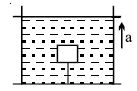
A body having volume $V$ and density $\rho$ is attached to the bottom of a container as shown. Density of the liquid is $d( > \rho )$. Container has a constant upward acceleration $a.$ Tension in the string is
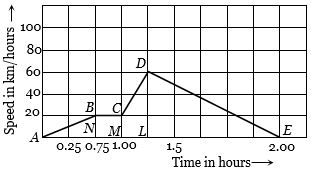
A train moves from one station to another in $2$ hours time. Its speed-time graph during this motion is shown in the figure. The maximum acceleration during the journey is.............$km\, h^{-2}$
$(a)$ Centre of gravity $(C.G.)$ of a body is the point at which the weight of the body acts.

$(b)$ Centre of mass coincides with the centre of gravity if the earth is assumed to have infinitely large radius

$(c)$ To evaluate the gravitational field intensity due to any body at an external point, the entire mass of the body can be considered to be concentrated at its $C.G.$

$(d)$ The radius of gyration of any body rotating about an axis is the length of the perpendicular dropped from the $C.G.$ of the body to the axis of rotation.

Which one of the following pairs of statements is correct ?