MCQ
In an electrolysis experiment, a current i passes through two different cells in series, one containing a solution of $\mathrm{CuSO}_4$ and the other a solution of $\mathrm{AgNO}_3.$ The rate of increase of the weight of the cathodes in the two cells will be
  • A
    In the ratio of the densities of $Cu$ and $Ag$
  • B
    In the ratio of the at. weights of $Cu$ and $Ag$
  • In the ratio of half the atomic weight of $Cu$ to the atomic weight of $Ag$
  • D
    In the ratio of half the atomic weight of $Cu$ to half the atomic weight of $Ag$
Answer

Correct option: C.
In the ratio of half the atomic weight of $Cu$ to the atomic weight of $Ag$

Need a full question paper?

Generate a complete, print-ready paper with questions like this in minutes — across 16+ boards, with answer keys.

Start Generating Free

Similar questions

In double slits experiment, for light of which colour the fringe width will be minimum(a) Violet  (b) Red(c) Green  (d) Yellow
       
An object is placed 12 cm to the left of a converging lens of focal length 8 cm. Another converging lens of 6 cm focal length is placed at a distance of 30 cm to the right of the first lens.  The second lens will produce(a) No image (b) A virtual enlarged image(c) A real enlarged image(d) A real smaller image
   
   
According to Mosley's law, the frequency of a spectral line in X-ray spectrum varies as(a) Atomic number of the element(b) Square of the atomic number of the element(c) Square root of the atomic number of the element(d) Fourth power of the atomic number of the element


Relation between current (i) and drift velocity $\left(v_d\right)$ is :
5 amperes of current is passed through a metallic conductor. The charge flowing in one minute in coulombs will be(a) 5 (b) 12(c) 1/12(d) 300
       
The process by which a heavy nucleus splits into light nuclei is known as(a) Fission(b) α- decay(c) Fusion(d) Chain reaction
       
If the frequency of light in a photoelectric experiment is doubled, the stopping potential will :
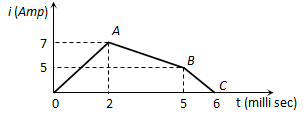
The current through a $4.6 H$ inductor is shown in the following graph. The induced emf during the time interval $t = 5\ \ce{milli-sec}$ to $6\ \ce{milli-sec}$ will be
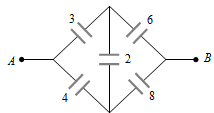
Effective capacitance between $A$ and $B$ in the figure shown is $($all capacitance are in $mF)$
A shell is fired from a cannon with a velocity V at an angle $\theta$ with the horizontal direction. At the highest point in its path, it explodes into two pieces of equal masses. One of the pieces retraces its path to the cannon. The speed of the other piece immediately after the explosion is:
  1. $\text{3V}\cos\theta$
  2. $2\text{V}\cos\theta$
  3. $\frac{3}{2}\text{V}\cos\theta$
  4. $\text{V}\cos\theta$