MCQ
Effective capacitance between $A$ and $B$ in the figure shown is $($all capacitance are in $mF)$
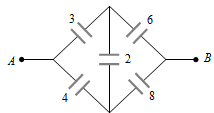
  • A
    $21\ mF$
  • B
    $23\ mF$
  • C
    $\frac{3}{14} \mu F$
  • $\frac{14}{3} \mu F$ 

Answer

Correct option: D.
$\frac{14}{3} \mu F$ 

Need a full question paper?

Generate a complete, print-ready paper with questions like this in minutes — across 16+ boards, with answer keys.

Start Generating Free

Similar questions

The wavelength 21 cm emitted by atomic hydrogen in interstellar space belongs to(a) Radio waves(b) Infrared waves(c) Microwaves(d) g-rays
       
At Curie temperature the ferromagnetic materials get converted into.
Two particles $X$ and $Y$ having equal charge, after being accelerated through the same potential difference enter a region of uniform magnetic field and describe circular paths of radii $R_1$ and $R_2$ respectively. The ratio of the mass of $X$ to that of $Y$ is:
A Solid sphare of radius $R$ has a charge $Q$ distributed in its Volume with a charge density $P = Kr^a$ Where $K$ and a are constants and r is the distance from its centre from its centre. if the electric filed at $\text{r}=\frac{\text{R}}{2}$ is $\frac{1}{8}$ times that at $r = R,$ the value of a is.
No bias is applied to a P-N junction, then the current(a) Is zero because the number of charge carriers flowing on both sides is same(b) Is zero because the charge carriers do not move(c) Is non-zero(d) None of these


The phenomenon of light passing through the object is called:
Two resistors whose value are in ratio 2 : 1 are connected in parallel with one cell.  Then ratio of power dissipated is(a) 2 : 1(b) 4 : 1(c) 1 : 2    (d) 1 : 1
       
Indirect method of charging is:
Which of the following particles will have minimum frequency of revolution when projected with the same velocity perpendicular to a magnetic field?
In the series combination of two or more than two resistances: