Question
In an electromagnetic wave the electric field vector and magnetic field vector are given as $\vec{E}=E_{0} \hat{i}$ and $\vec{B}=B_{0} \hat{k}$ respectively. The direction of propagation of electromagnetic wave is along.

Answer

Direct of propagation $=\vec{E} \times \vec{B}=\hat{i} \times \hat{k}=-\hat{j}$

Need a full question paper?

Generate a complete, print-ready paper with questions like this in minutes — across 16+ boards, with answer keys.
Start Generating Free

Similar questions

22 g of $CO _2$ at $27^{\circ} C$ is mixed 16 g of $O _2$ at $37^{\circ} C$. The temperature of mixture is
[Assume degree of freedom of $CO _2=7$ and degree of freedom of $O _2=5$ ]
If a black body is heated at a high temperature, it seems to be
Two wires have resistance of $2$ $\Omega$ and $4$ $\Omega$ connected to same voltage, ratio of heat dissipated at resistance is
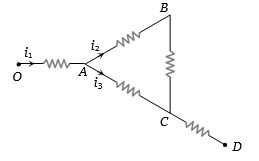
The current in the arm $CD$ of the circuit will be
A $50\, W$ bulb is in series with a room heater and the combination is connected across the mains. To get max. heater output the $50\, W$ bulb should be replaced by ......$W$
Two waves $y = 0.25\sin 316\,t$ and $y = 0.25\sin 310\,t$ are travelling in same direction. The number of beats produced per second will be
The period of oscillation of a simple pendulum is given by $T = 2\pi \sqrt {\frac{l}{g}} $ where $l$ is about $100 \,cm$ and is known to have $1\,mm$ accuracy. The period is about $2\,s$. The time of $100$ oscillations is measured by a stop watch of least count $0.1\, s$. The percentage error in $g$ is ......... $\%$
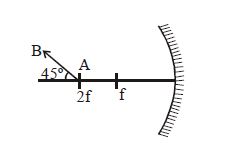
The shape of image formed of an object $AB$ due to the concave mirror shown in the figure is best represented by (assume point $A$ is at the centre of curvature of the mirror) :-
A projectile thrown with velocity $v$ making angle $\theta$ with vertical gains maximum height $H$ in the time for which the projectile remains in air, the time period is
$A$ wall is made up of two layers $A$ and $B$ . The thickness of the two layers is the same, but materials are different. The thermal conductivity of $A$ is double than that of $B$ . In thermal equilibrium the temperature difference between the two ends is ${36^o}C$. Then the difference of temperature at the two surfaces of $A$ will be ....... $^oC$