Question
In an elliptical orbit under gravitational force, in general

Answer

(d)

Need a full question paper?

Generate a complete, print-ready paper with questions like this in minutes — across 16+ boards, with answer keys.

Start Generating Free

Similar questions

In which one of the following cases will the liquid flow in a pipe be most streamlined
The position vectors of radius are $2\hat i + \hat j + \hat k$ and $2\hat i - 3\hat j + \hat k$ while those of linear momentum are $2\hat i + 3\hat j - \hat k.$ Then the angular momentum is
What is the shape of the graph between the speed and kinetic energy of a body
A convex lens of focal length $100 \,cm$ and a concave lens of focal length $10 \,cm$ are placed coaxially at a separation of $90 \,cm$. If a parallel beam of light is incident on convex lens, then after passing through the two lenses the beam
A mouse jumps off from the $15$ th floor of a high-rise building and lands $12 \,m$ from the building. Assume that, each floor is of $3 \,m$ height. The horizontal speed with which the mouse jumps is closest to ...............$km /h$
A physical quantity $p$ is described by the relation $p\, = a^{1/2}\, b^2\, c^3\, d^{-4}$

If the relative errors in the measurement of $a, b, c$ and $d$ respectively, are $2\% , 1\%, 3\%$ and $5\%$, then the relative error in $P$ will be ........... $\%$
There are a large number of cells available, each marked $(6 \,V , 0.5 \,\Omega)$ to be used to supply current to a device of resistance $0.75 \,\Omega$, requiring $24 \,A$ current. How should the cells be arranged, so that power is transmitted to the load using minimum number of cells?
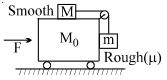
Imagine $a$ situation in which the horizontal surface of block $M_0$ is smooth and its vertical surface is rough with $a$ coefficient of friction $\mu$ In above problem, choose the correct value $(s)$ of F which the blocks $M$ and $m$ remain stationary with respect to $M_0$
To remove myopia (short sightedness) a lens of power $0.66 \,D$ is required. The distant point of the eye is approximately.......$cm$
An ideal gas in a cylinder is separated by a piston in such a way that the entropy of one part is $S_{1}$ and that of the other part is $S_{2}$. Given that $S _{1}> S _{2}$. If the piston is removed then the total entropy of the system will be :