There are a large number of cells available, each marked $(6 \,V , 0.5 \,\Omega)$ to be used to supply current to a device of resistance $0.75 \,\Omega$, requiring $24 \,A$ current. How should the cells be arranged, so that power is transmitted to the load using minimum number of cells?
Medium
Download our app for free and get started
(b)
$E=6 \,V$
$r=0.5 \,\Omega$
$R=0.75 \,\Omega$
$i=24 \,\Omega$
$S(0.5)=P(0.75)$
$2 \,s=3 p$
$i=\frac{P S E}{S r+P R}$
$24=\frac{P\left(\frac{3}{2} P\right) 6}{15 P}$
$P=4$ rows
$S=6$ cells

Download our appand get started for free
Experience the future of education. Simply download our apps or reach out to us for more information. Let's shape the future of learning together!No signup needed.*
Similar Questions
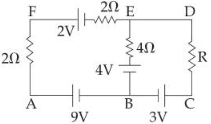
- 1In the electric network shown, when no current flows through the $4\, \Omega $ resistor in the arm $EB$, the potential difference between the points $A$ and $D$ will be ............... $V$View Solution
- 2In the following $'I'$ refers to current and other symbols have their usual meaning, Choose the option that corresponds to the dimensions of electrical conductivityView Solution
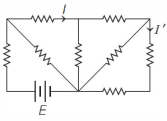
- 3Consider the following circuit shown below. All the resistors are identical. The ratio of $I / I^{\prime}$ isView Solution
- 4The $V-i$ graph for a conductor makes an angle $\theta $ with $V-$ axis. Here $ V$ denotes the voltage and $i$ denotes current. The resistance of conductor is given byView Solution
- 5View SolutionConstantan wire is used in making standard resistances because its
- 6Two electric bulbs whose resistances are in the ratio of $1 : 2$ are connected in series. The powers dissipated in them have the ratioView Solution
- 7A potentiometer is connected between $A$ and $B$ and the balance point is obtained at $203. 6\,cm$. When the end of the potentiometer connected to $B$ is shifted to $C$, then the balance point is obtained at $24.6\,cm$. If now the potentiometer be connected between $B$ and $C$, the balance point will be at ................. $cm$View Solution

- 8The resistance of a conductor is $5\, ohm$ at $50\,^oC$ and $6\, ohm$ at $100\,^oC$. Its resistance at $0\,^oC$ is ................ $ohm$View Solution
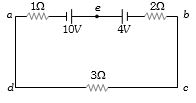
- 9View SolutionThe magnitude and direction of the current in the circuit shown will be
- 10A wire of length $L$ and $3$ identical cells of negligible internal resistances are connected in series. Due to current, the temperature of the wire is raised by $\Delta T$ in a time $t$. A number $N$ of similar cells is now connected in series with a wire of the same material and cross-section but of length $2\, L$. The temperature of the wire is raised by the same amount $\Delta T$ in the same time $t$. the value of $N$ isView Solution