Question
In an envelope there are some ₹5 notes and some ₹10 notes. Total amount of these notes together is ₹350. Number of ₹5 notes are less by 10 than twice the number of ₹10 notes. Then find the number of ₹5 and ₹10 notes.

Answer

Let the number of ₹5 notes be ‘x’ and the number of ₹10 notes be ‘y’
Total amount of x notes of ₹ 5 = ₹ 5x
Total amount ofy notes of ₹ 10 = ₹ 10y
∴ Total amount = 5x + 10y
According to the first condition,
total amount of the notes together is ₹350.
∴ 5x + 10y = 350 …(i)
According to the second condition,
Number of ₹ 5 notes are less by 10 than twice the number of ₹ 10 notes.
∴ x = 2y – 10
∴ x – 2y = -10 …..(ii)
Multiplying equation (ii) by 5,
5x – 10y = -50 …(iii)
Adding equations (i) and (iii),
5x + 10y =350
+ 5x – 10y = -50
10x =300
$\therefore x=\frac{300}{10}$
$\therefore x=30$
Substituting $x=30$ in equation (ii),
$x-2 y=-10$
$30-2 y=-10$
$\therefore 30+10=2 y$
$\therefore 40=2 y$
$\therefore y=\frac{40}{2}$
$\therefore y=20$
There are 30 notes of $₹ 5$ and 20 notes of $₹ 10$ in the envelope.

Need a full question paper?

Generate a complete, print-ready paper with questions like this in minutes — across 16+ boards, with answer keys.

Start Generating Free

Similar questions

Construct ∆XYZ such that XY = 6.7 cm, YZ = 5.8 cm, XZ = 6.9 cm. Construct its incircle.
If $(28 – x)$ is the mean proportional of $(23 – x)$ and $(19 – x),$ then find the value of $x.$
Find the distances with the help of the number line given below.

Image
i. d(B, E)
ii. d (J, J)
iii. d(P, C)
iv. d(J, H)
v. d(K, O)
vi. d(O, E)
vii. d(P, J)
viii. d(Q, B)
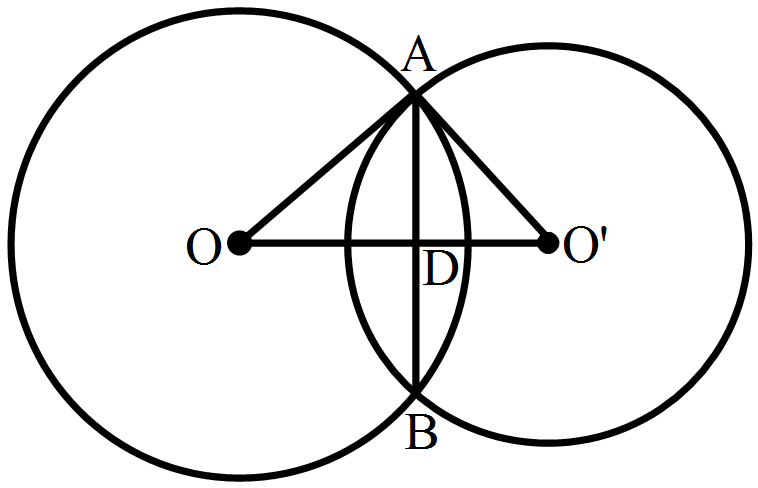
Two circles of radii $10\ cm$ and $8\cm$ intersect each other, and the length of the common chord is $12\ cm$.
Find the distance between their centres.
In □IJKL, side IJ || side KL, ∠I = 108° and ∠K = 53°, then find the measures of ∠J and ∠L.
For the above Question prepare Frequency Distribution Table.
Prove that in a triangle, other than an equilateral triangle, angle opposite the longest side is greater than $\frac{2}{3}$ of a right angle.
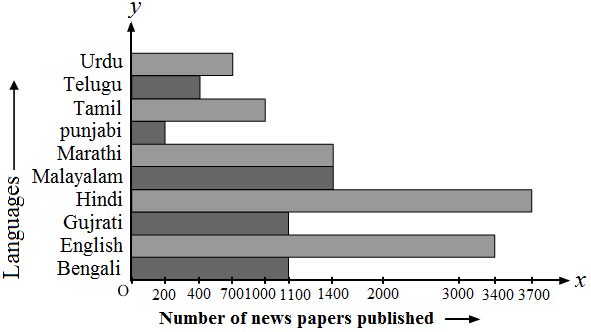
The bar graph shown in figure represents the circulation of newspapers in 10 languages.
Study the bar graph and answer the following questions:
  1. What is the total number of newspapers published in Hindi, English, Urdu, Punjabi, and Bengali?
  2. What percent is the number of newspapers published in Hindi of the total number of newspapers?
  3. Find the excess of the number of newspapers published in English over those published in Urdu.
  4. Name two pairs of languages which publish the same number of newspapers.
  5. State the language in which the smallest number of newspapers are published.
  6. State the language in which the largest number of newspapers are published.
  7. State the language in which the number of newspapers published is between 2500 and 3500.
  8. State whether true or false:
  1. The number of newspapers published in Malayalam and Marathi together is less than those published in English.
  2. The number of newspapers published in Telugu is more than those published in Tamil.
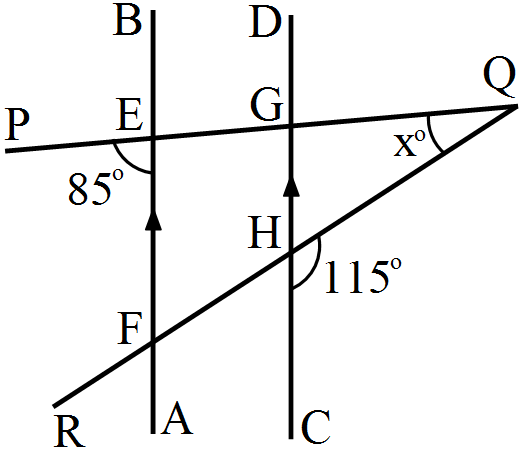
In the given figure, AB || CD. Find the value of x.
If $\frac{y+z}{a}=\frac{z+x}{b}=\frac{x+y}{c}$, then show that $\frac{x}{b+c-a}=\frac{y}{c+a-b}=\frac{z}{a+b-c}$.