Question
Prove that in a triangle, other than an equilateral triangle, angle opposite the longest side is greater than $\frac{2}{3}$ of a right angle.
Answer

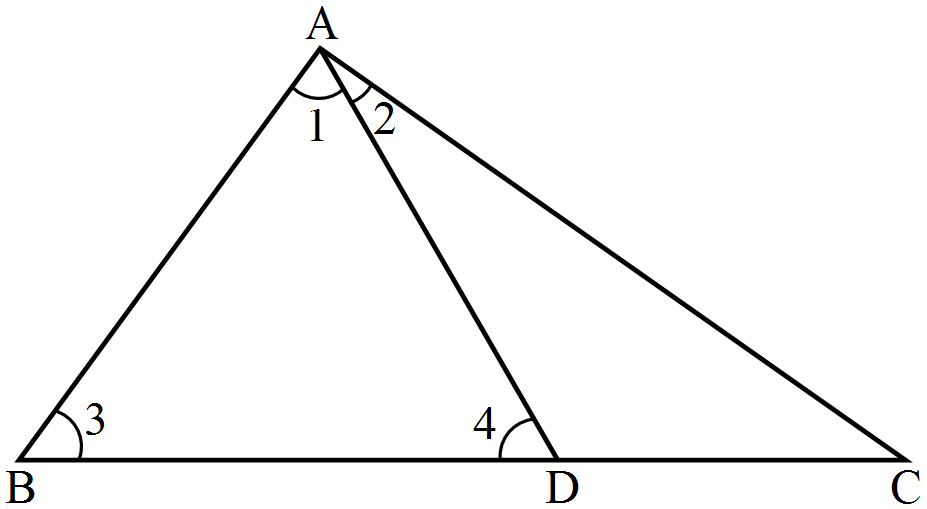
Given: In $\triangle\text{ABC, BC}$ is the longest side. To prove: $\angle\text{BAC}>\frac{2}{3}$ of a right angle, i.e., $\angle\text{BAC}>60^{\circ}$ Construct: Mark a point D on side AC such that AD = AB = BD. Proof: In $\triangle\text{ABD,}$$\because\text{AD = AB = BD}$ (By construction)
$\therefore\angle1=\angle3=\angle4=60^{\circ}$
Now,$\angle\text{BAC}=\angle1+\angle2=60^{\circ}+\angle2$
but $60^{\circ}=\frac{2}{3}$ of a right angle So, $\angle\text{BAC}=\frac{2}{3}$ of a right angle + $\angle2$ Hence, $\angle\text{BAC}>\frac{2}{3}$ of a right angle.

Need a full question paper?

Generate a complete, print-ready paper with questions like this in minutes — across 16+ boards, with answer keys.

Start Generating Free

Similar questions

Prove the following two theorems for two congruent circles : Chords of congruent circles which are equidistant from their respective centres are congruent.
Write ‘Given’. ‘To prove’ and the proofs of these theorems.
In figure, ABCD is a rectangle in which CD = 6cm, AD = 8cm. Find the area of parallelogram CDEF.
ABCD is a parallelogram. G is a point on AB such that AG = 2GB and E is point on DC such that CE = 2DE and F is the point of BC such that BF = 2FC. Prove that:
  1. $\text{ar}(\text{ADEG})=\text{ar}(\text{GBCE})$
  2. $\text{ar}{(\triangle\text{EGB}})=\frac{1}{6}\text{ar}(\text{ABCD})$
  3. $\text{ar}(\triangle\text{EFC})=\frac{1}{2}\text{ar}(\triangle\text{EBF})$
  4. $\text{ar}(\triangle\text{EBG})=\text{ar}(\triangle\text{EFC})$
  5. Find what portion of the parallelogram is the area of $\triangle\text{EFG}.$
In a triangle ABC, if L and M are points on AB and AC respectively such that LM || BC. Prove that:
  1. $\text{ar}(\triangle\text{LCM})=\text{ar}(\triangle\text{LBM})$
  2. $\text{ar}(\triangle\text{LBC})=\text{ar}(\triangle\text{MBC})$
  3. $\text{ar}(\triangle\text{ABM})=\text{ar}(\triangle\text{ACL})$
  4. $\text{ar}(\triangle\text{LOB})=\text{ar}(\triangle\text{MOC})$
In figure, ABCD and AEFD are two parallelograms. Prove that:
  1. $\text{PE}=\text{FQ}$
  2. $\text{ar}(\triangle\text{APE}) : \text{ar}(\triangle\text{PFA})\\=\text{ar}(\triangle\text{QFD}): \text{ar}(\triangle\text{PFD})$
  3. $\text{ar}(\triangle\text{PEA})=\text{ar}(\triangle\text{QFD})$
Define probability of an event.
Construct ∆XYZ, such that YZ = 7.4 cm, ∠XYZ = 45° and XY – XZ = 2.7 cm.
In each of the examples given below, a pair of triangles is shown. Equal parts of triangles in each pair are marked with the same signs. Observe the figures and state the test by which the triangles in each pair are congruent.
If $\frac{a}{b}=\frac{b}{c}$ and $a, b, c>0$, then show that, : $\left(a^2+b^2\right)\left(b^2+c^2\right)=(a b+b e)^2$
Find the values of $a$ and $b$ so that $(x+1)$ and $(x-1)$ are factors of $x^4+a x^3-3 x^2+2 x+b$.