Question
In an equilateral triangle with side a, prove that area $=\frac{\sqrt{3}}{4}\text{a}^2.$

Answer


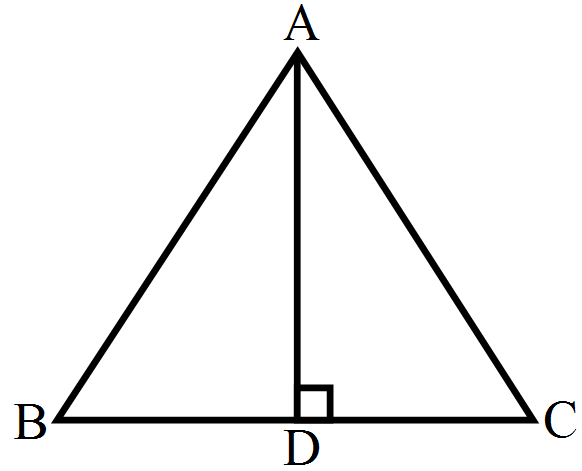
Let $\triangle\text{ABC}$ be an equilateral triangle with side a.
Then, AB = AC = BC = a.
Draw $\text{AD}\perp\text{BC}.$
In $\triangle\text{ADB}$ and $\triangle\text{A},$ we have
$\text{AB}=\text{AC}(\text{given}),\angle\text{B}=\angle\text{C}=60^\circ$
and $\angle\text{ADB}=\angle\text{ADC}=90^\circ$
$\therefore\triangle\text{ADB}\cong\triangle\text{ADC}$
$\therefore\text{BD}=\text{DC}=\frac{\text{a}}{2}$
From right $\triangle\text{ADB},$ we have
$\text{AB}^2=\text{AD}^2+\text{BD}^2$ ....(By Pythagoras theorem)
$\Rightarrow\text{AD}=\sqrt{\text{AB}^2-\text{AB}^2}$
$\Rightarrow\text{AD}=\sqrt{\text{a}^2-\Big(\frac{\text{a}}{2}\Big)^2}$
$\Rightarrow\text{AD}=\sqrt{\text{a}^2-\frac{\text{a}}{4}^2}$
$\Rightarrow\text{AD}=\sqrt{\frac{3\text{a}}{4}^2}$
$\Rightarrow\text{AD}=\frac{\sqrt{3}\text{a}}{2}$
So, the altitude is $\frac{\sqrt{3\text{a}}}{2},$
Area of $\triangle\text{ABC}=\frac{1}{2}\times\text{BC}\times\text{AD}$
$=\frac{1}{2}\times\text{a}\times\frac{\sqrt{3\text{a}}}{2}$
$=\frac{\sqrt{3}\text{a}^2}{4}$
Hence proved.

Need a full question paper?

Generate a complete, print-ready paper with questions like this in minutes — across 16+ boards, with answer keys.

Start Generating Free

Similar questions

Draw histogram and frequency polygon.

Image

In a class test, the sum of the marks obtained by P in Mathematics and science is $28$. Had he got $3$ marks more in mathematics and $4$ marks less in Science. The product of his marks would have been $180$. Find his marks in two subjects.
A farmer borrows ₹ 1000 and agrees to repay with a total interest of ₹ 140 in 12 installments, each installment being less than the preceding installment by ₹ 10 . What should be his first installment?
Explain why $3 \times 5 \times 7 + 7$ is a composite number.
Find the ratio in which the line segment joining the points A(3, -3) and B(-2, 7) is divided by x-axis. Also, find the point of division.
Using the determinants given below form two linear equations and solve them.
$D=\left|\begin{array}{cc}5 & 7 \\ 2 & -3\end{array}\right| \quad D y=\left|\begin{array}{cc}5 & 4 \\ 2 & -10\end{array}\right|$
Points $P, Q, R$ and $S$ divides the line segment joining $A(1, 2)$ and $B(6, 7)$ in $5$ equal parts. Find the coordinates of the points $P, Q$ and $R$.
The diagonals of quadrilateral ABCD intersect at O. Prove that $\frac{\text{ar}(\triangle\text{ACB})}{\text{ar}(\triangle\text{ACD})}=\frac{\text{BO}}{\text{DO}}.$
A tent of a circus is such that its lower part is cylindrical and upper part is conical. The diameter of the base of the tent is $48 \mathrm{~m}$ and the height of the cylindrical part is $15 \mathrm{~m}$. Total height of the tent is $33 \mathrm{~m}$. Find area of canvas required to make the tent. Also find volume of air in the tent.
Write a pair of linear equations which has the unique solution $x = -1, y = 3$. How many such pairs can you write?