Question 14 Marks
In the given figure, if $\angle\text{ADE}=\angle\text{B},$ show that $\triangle\text{ADE}\sim\triangle\text{ABC}.$ If AD = 3.8cm, AE = 3.6cm, BE = 2.1cm and BC = 4.2cm, find DE.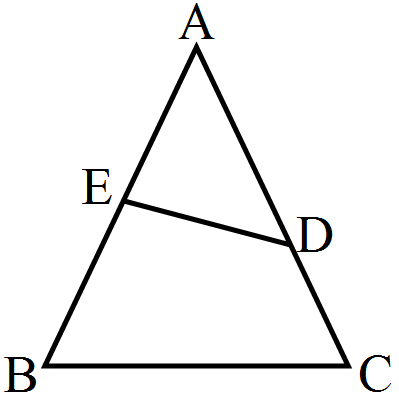
Answer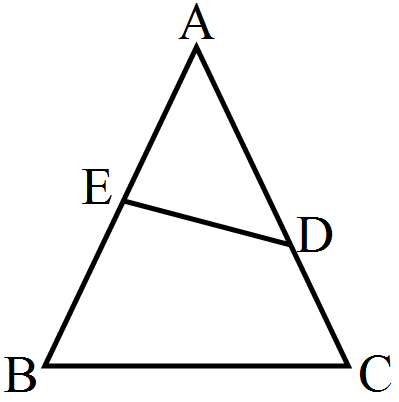
Given: $\angle\text{ADE}=\angle\text{B},$ AD = 3.8cm, AE = 3.6cm, BE = 2.1cm, BC = 4.2cm
Proof:
In $\triangle\text{ADE}$ and $\triangle\text{ABC},$
$\angle\text{A}=\angle\text{A}$ (common)
$\angle\text{ADE}=\angle\text{B}$ (given)
Therefore, $\triangle\text{ADE}\sim\triangle\text{ABC}$ (AA Criterion)
$\Rightarrow\frac{\text{AD}}{\text{AB}}=\frac{\text{DE}}{\text{BC}}$
$\Rightarrow\frac{3.8}{(3.6+2.1)}=\frac{\text{x}}{4.2 }(\text{DE}=\text{x})$
$\Rightarrow\frac{3.8}{5.7}=\frac{\text{x}}{4.2}$
$\text{x}=\frac{3.8\times4.2}{5.7}=2.8\text{cm}$
Hence, DE = 2.8cm View full question & answer→Question 24 Marks
State the AAA-similarity criterion.
AnswerIf is any two triangles, the corresponding angles are equal, then their corresponding sides are proportional and hence the triangles are similar.
View full question & answer→Question 34 Marks
$\triangle\text{ABC}$ is right-angled at A and $\text{AD}\perp\text{BC}.$ If BC = 13cm and AC =5cm, find the ratio of the areas of $\triangle\text{ABC}$ and $$$\triangle\text{ADC}.$
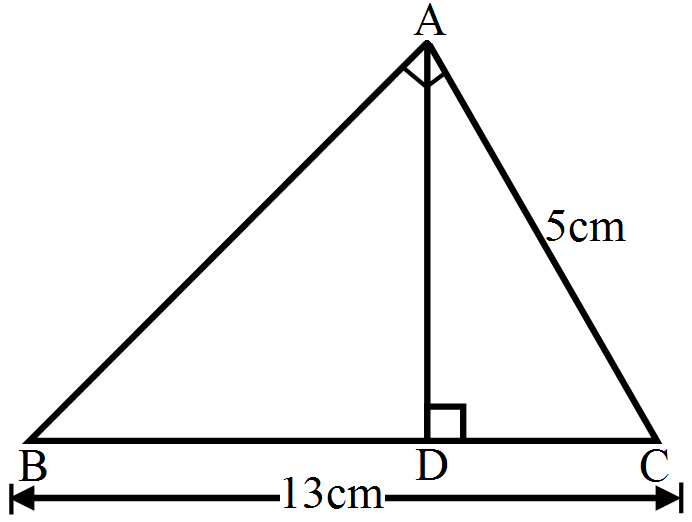
AnswerIn $\triangle\text{ABC}$ and $\triangle\text{ADC},$ we have:
$\angle\text{BAC}=\angle\text{ADC}=90^\circ$
$\angle\text{ACB}=\angle\text{ACD}$ (common)
By AA similarity, we can conclude that $\triangle\text{BAC}\sim\triangle\text{ADC}.$
Hence, the ratio of the areas of these triangles is equal to the ratio of squares of their corresponding sides.
$\therefore\frac{\text{ar}(\triangle\text{BAC})}{\text{ar}(\triangle\text{ADC})}=\frac{\text{BC}^2}{\text{AC}^2}$
$\Rightarrow\frac{\text{ar}(\triangle\text{BAC})}{\text{ar}(\triangle\text{ADC})}=\frac{\text{13}^2}{\text{5}^2}$
$=\frac{169}{25}$
Hence, the ratio of both the triangles is 169 : 25
View full question & answer→Question 44 Marks
A ladder is placed in such a way that its foot is at a distance of 15m from a wall and its top reaches a window 20m above the ground. Find the length of the ladder.
AnswerLet AB be the well where window is at B, CB be the ladder and AC be the distance between the foot of the ladder and wall. Then, $\text{AB}=20\text{m},\text{AC}=15\text {m},$ and $\angle\text{CAB}=90^\circ$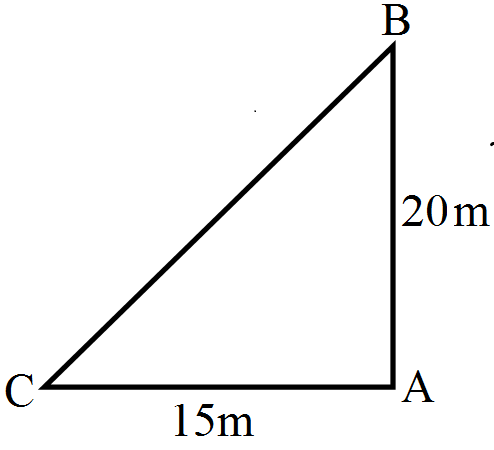
By Pythagoras theorem, we have $\text{CB}^2=\text{AB}^2+\text{AC}^2$ $=\Big[(20)^2+(15)^2\Big]\text{m}^2$ $=(400+225)\text{m}^2$ $=625\text{m}^2$ $\text{CB}=\sqrt{625}\text{m}=25\text{m}$ Hence, the length of ladder is 25 m. View full question & answer→Question 54 Marks
For the following statments state whether true (T) or false(F):
Two circles with different radii are similar.
AnswerTrue.
Solution:
Similar figures have the same shape but need not have the same size.
Since all circles irrespective of the radii will have the same shape, all be similar.
View full question & answer→Question 64 Marks
$\triangle\text{ABC}\sim\triangle\text{DEF}$ and their areas are respectively $100\ cm^2 $ and $49\ cm^2.$ If the altitude of $\triangle\text{ABC}$ is $5\ cm$, the corresponding altitude of $\triangle\text{DEF}.$
Answer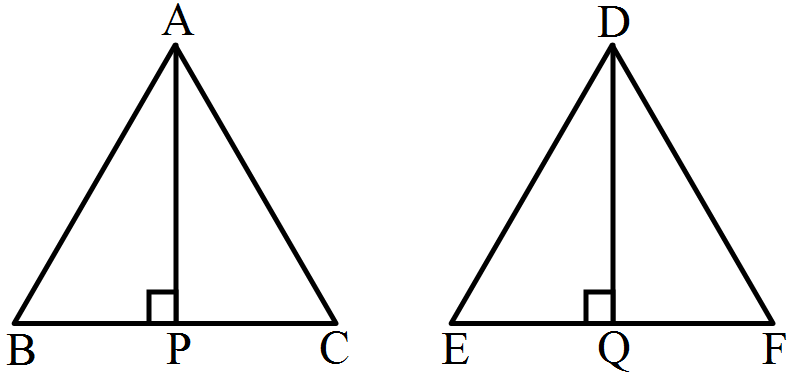
It is given that $\triangle\text{ABC}\sim\triangle\text{DEF}.$
Therefore, the ratio of the areas of these triangles will be equal to the ratio of squares of their corresponding sides.
Also, the ratio of areas of two similar triangles is equal to the ratio of squares of their corresponding altitudes.
Let the altitude of $\triangle\text{ABC}$ be $AP,$ drawn from $A$ to $BC$ to meet $BC$ at $P$ and the altitude of $\triangle\text{DEF}$ be $DQ,$ drawn from $D$ to meet EF at $Q$
Then,
$\frac{\text{ar}(\triangle\text{ACB})}{\text{ar}(\triangle\text{DEF})}=\frac{\text{AP}^2}{\text{DQ}^2}$
$\Rightarrow\frac{100}{49}=\frac{\text{5}^2}{\text{DQ}^2}$
$\Rightarrow\frac{100}{49}=\frac{\text{25}}{\text{DQ}^2}$
$\Rightarrow\text{DQ}^2=\frac{49\times25}{100}$
$\Rightarrow\text{DQ}=\sqrt{\frac{49\times25}{100}}$
$\Rightarrow\text{DQ}=3.5\text{cm}$
Hence, the altitude of $\triangle\text{DEF}$ is $3.5\ cm$ View full question & answer→Question 74 Marks
State the converse of Thales' theorem.
AnswerIf a line divides any two sides of a triangle in the same ratio then the line must be parallel to the third side.
View full question & answer→Question 84 Marks
In the given figure, $\triangle\text{ABC}$ is an obtuse triangle, obtuse-angled at $B$. If $\text{AD}\perp\text{CB}$ (produced) prove that $AC^2 = AB^2+ BC^2 +2BC.BD.$
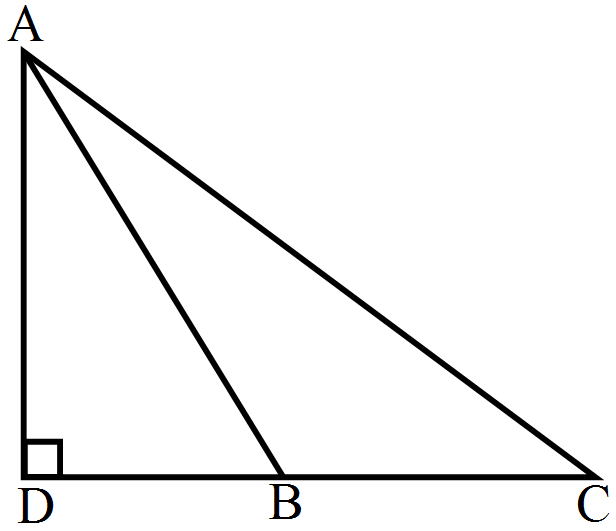
Answer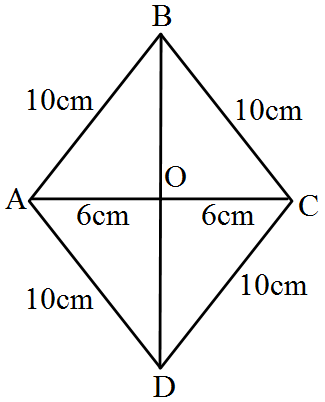
Applying Pythagoras theorem in right-angled triangle $ADC$, we get:
$AC^2= AD^2 + DC^2$
$\Rightarrow AC^2 - DC^2 = AD^2$
$\Rightarrow AD^2 = AC^2- DC^2 .....(1)$
Applying Oythagoras theorem in right-triangle $ADB,$ we get:
$AB^2 = AD^2 + DB^2$
$\Rightarrow AB^2 - DB^2= AD^2$
$\Rightarrow AD^2 = AB^2 - DB^2 .....(2)$
From equation $(1)$ and $(2)$, we have:
$AC^2 - DC^2 = AB^2 - DB^2$
$\Rightarrow AC^2 = AB^2 + DC^2 - DB^2$
$\Rightarrow AC^2 = AB^2 + (DB + BC)^2- DB^2$ $(\therefore\text{DB}+\text{BC}=\text{DC})$
$\Rightarrow AC^2 = AB^2 + DB^2 + BC^2 + 2DB.BC - DB^2$
$\Rightarrow AC^2 = AB^2 + BC^2 + 2BC.BD$
This completes the proof. View full question & answer→Question 94 Marks
In the given figure, $\angle\text{ACB}=90^\circ$ and $\text{CD}\perp\text{AB}.$
Prove that $\frac{\text{BC}^2}{\text{AC}^2}=\frac{\text{BD}}{\text{AD}}.$
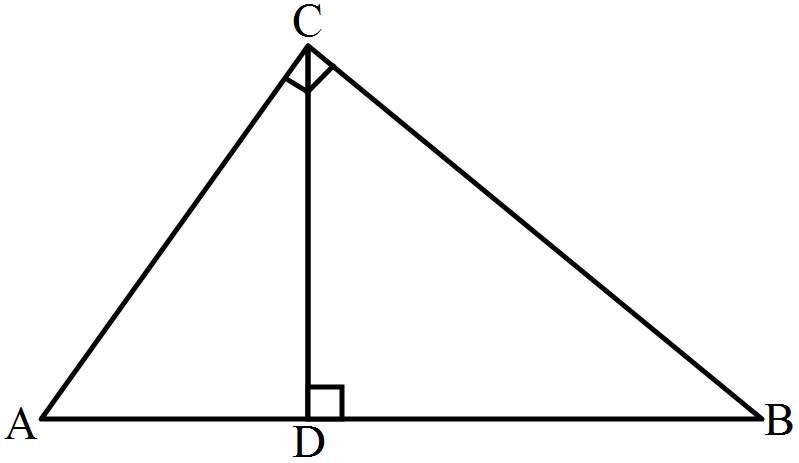
AnswerGiven: $\angle\text{ACB}=90^\circ$ and $\text{CD}\perp\text{AB}$
To Prove: $\frac{\text{BC}^2}{\text{AC}^2}=\frac{\text{BD}}{\text{AD}}$
Proof:
In $\triangle\text{ACB}$ and $\triangle\text{CDB}$
$\angle\text{ACB}=\angle\text{CDB}=90^\circ$ (Given)
$\angle\text{ABC}=\angle\text{CBD}$ (common)
By AA similarity-criterion $\triangle\text{ACB}\sim\triangle\text{CDB}$
When two triangles are similar, the ratios of the lengths of their corresponding sides are proportional.
$\therefore\frac{\text{BC}}{\text{BD}}=\frac{\text{AB}}{\text{BC}}$
$\Rightarrow\text{BC}^2=\text{BD}.\text{AB}\ .....(1)$
In $\triangle\text{ACB}$ and $\triangle\text{ADC}$
$\angle\text{ACB}=\angle\text{ADC}=90^\circ$ (Given)
$\angle\text{CAB}=\angle\text{DAC}$ (common)
By AA similarity-criterion $\triangle\text{ACB}\sim\triangle\text{ADC}$
When two triangles are similar, then the ratios of the lengths of their corresponding sides are proportional.
$\therefore\frac{\text{AC}}{\text{AD}}=\frac{\text{AB}}{\text{AC}}$
$\Rightarrow\text{AC}^2=\text{AD}.\text{AB}\ .....(2)$
Divinding (2) by (1), we get
$\frac{\text{BC}^2}{\text{AC}^2}=\frac{\text{BD}}{\text{AD}}$
View full question & answer→Question 104 Marks
In an equilateral triangle with side a, prove that area $=\frac{\sqrt{3}}{4}\text{a}^2.$
Answer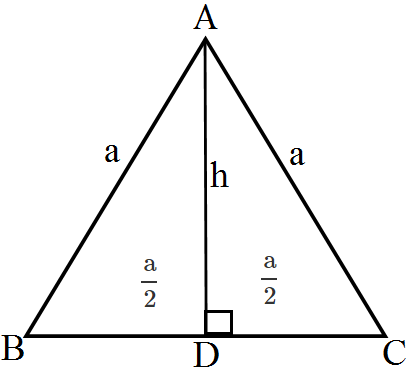
Let ABC be the equilateral triangle with each side equal to a.
Let AD be the altitude from A, meeting BC at D.
Therefore, D is the midpoint of BC.
Let AD be h.
Applying Pythagoras theorem in right-angled triangle ABD, we have:
$AB^2 = AD^2 + BD^2$
$\Rightarrow\text{a}^2=\text{h}^2+\big(\frac{\text{a}}{2}\big)^2$
$\Rightarrow\text{h}^2=\text{a}^2-\frac{\text{a}}{4}=\frac{3}{4}\text{a}^2$
$\Rightarrow\text{h}=\frac{\sqrt{3}}{2}\text{a}$
Therefore,
Area of triangle $\text{ABC}=\frac{1}{2}\times\text{base}\times\text{height}=\frac{1}{2}\times\text{a}\times\frac{\sqrt{3}}{2}\text{a}$
$=\frac{\sqrt{3}}{4}\text{a}^2$
This completes the proof. View full question & answer→Question 114 Marks
State the AA-similarity criterion.
AnswerIf two angles of one triangle are respectively equal to two angles of another triangle then the two triangles are similar.
View full question & answer→Question 124 Marks
$\triangle\text{ABC}\sim\triangle\text{DEF}$ such that $\text{ar}(\triangle\text{ABC})=64\text{cm}^2$ and $\text{ar}(\triangle\text{DEF})=169\text{cm}^2.$ If BC = 4cm, find EF.
Answer$\triangle\text{ABC}\sim\triangle\text{DEF}$
$\Rightarrow\frac{\text{ar}(\triangle\text{ABC})}{\text{ar}(\triangle\text{DEF})}=\frac{\text{BC}^2}{\text{EF}^2}$
$\Rightarrow\frac{64}{169}=\frac{4^2}{\text{EF}^2}$
$\Rightarrow\text{EF}^2=\frac{16\times169}{64}$
$\Rightarrow\text{EF}=\sqrt{\frac{16\times169}{64}}$
$\Rightarrow\text{EF}=\frac{4\times13}{8}$
$\Rightarrow\text{EF}=6.5\text{cm}$
View full question & answer→Question 134 Marks
In the adjoining figure, ABCD is a trapezium in which CD || AB and its digonals intersect at O. If AO = (2x + 1)cm, OC = (5x - 7)cm, DO = (7x - 5)cm and OB = (7x + 1)cm, find the value of x.
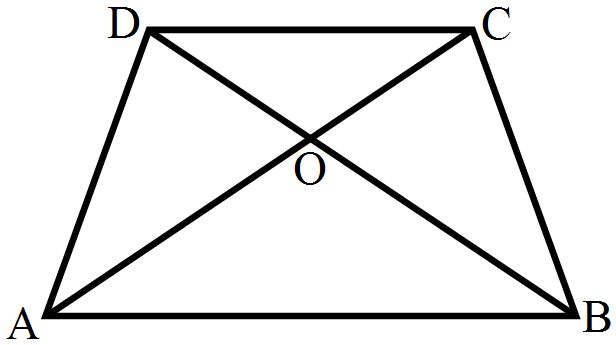
AnswerIn trapezium ABCD, AB || CD and the diagonals AC and BD intersect O.
Therefore,
$\frac{\text{AO}}{\text{OC}}=\frac{\text{BO}}{\text{OD}}$
$\Rightarrow\frac{5\text{x}-7}{2\text{x}+1}=\frac{7\text{x}-5}{7\text{x}+1}$
$\Rightarrow(5\text{x}-7)(7\text{x}+1)=(7\text{x}-5)(2\text{x}+1)$
$\Rightarrow35\text{x}^2+5\text{x}-49\text{x}-7=14\text{x}^2-10\text{x}+7\text{x}-5$
$\Rightarrow21\text{x}^2-41\text{x}-2=0$
$\Rightarrow21\text{x}^2-42\text{x}+\text{x}-2=0$
$\Rightarrow21\text{x}(\text{x}-2)+1(\text{x}-2)=0$
$\Rightarrow(\text{x}-2)+(21\text{x}+1)=0$
$\Rightarrow\text{x}=2,-\frac{1}{21}$
$\therefore\text{x}\not=-\frac{1}{21}$
$\therefore\text{x}=2$
View full question & answer→Question 144 Marks
D and E are points on the sides AB and AC respectively of a $\triangle\text{ABC}.$ In the following cases, determine whether DE || BC or not. AB = 11.7cm, AC = 11.2cm, BD = 6.5cm and AE = 4.2cm.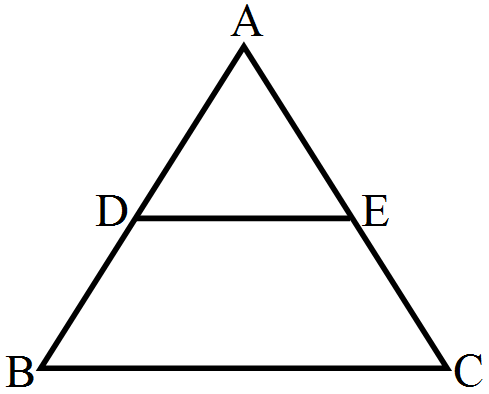
AnswerWe have:
AB = 11.7cm, DB = 6.5cm
Therefore,
AD = 11.7 - 6.5 = 5.2cm
Similarly,
AC = 11.2cm, AE = 4.2cm
Therefore,
EC = 11.2 - 4.2 = 7cm
Now,
$\frac{\text{AD}}{\text{DB}}=\frac{5.2}{6.5}=\frac{4}{5}$
$\frac{\text{AE}}{\text{EC}}=\frac{4.2}{7}$
Thus, $\frac{\text{AD}}{\text{DB}}\not=\frac{\text{AE}}{\text{EC}}$
Applying the converse of Thalse' theorem, we conclude thet DE is not parallel to BC.
View full question & answer→Question 154 Marks
P and Q are points on the sides AB and AC respectively of a $\triangle\text{ABC}.$ If AP = 2cm, PB = 4cm, AQ = 3cm and QC = 6cm, show that BC = 3PQ.
Answer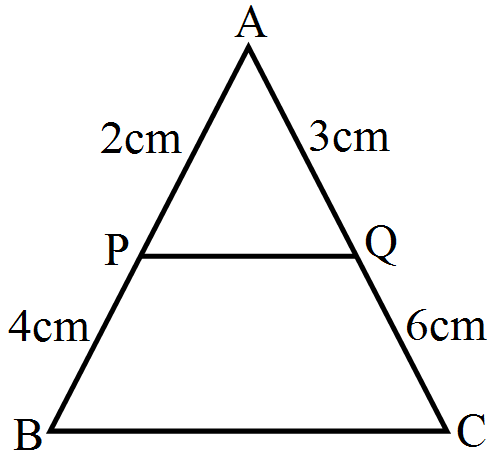
Given: P is a point on AB.
Then, AB = AP + PB = (2 + 4)cm = 6cm
Also Q is a point on AC.
Then, AC = AQ + QC = (3 + 6)cm = 9cm
$\therefore\frac{\text{AP}}{\text{AB}}=\frac{2}{6}=\frac{1}{3}$
and $\frac{\text{AQ}}{\text{AC}}=\frac{3}{9}=\frac{1}{3}$
$\therefore\frac{\text{AP}}{\text{AB}}=\frac{\text{AQ}}{\text{AC}}$
Thus, in $\triangle\text{APQ}$ and $\triangle\text{ABC}$
$\angle\text{A}=\angle\text{A}$ (common)
And $\frac{\text{AP}}{\text{AB}}=\frac{\text{AQ}}{\text{AC}}$
$\therefore\triangle\text{APQ}\sim\triangle\text{ABC}$ (by SAS similarity)
$\Rightarrow\frac{\text{AP}}{\text{AB}}=\frac{\text{PQ}}{\text{BC}}=\frac{\text{AQ}}{\text{AC}}$
$\therefore\frac{\text{PQ}}{\text{BC}}=\frac{\text{AQ}}{\text{AC}}\Rightarrow\frac{\text{PQ}}{\text{BC}}=\frac{3}{9}=\frac{1}{3}$
$\therefore\text{BC}=3\text{PQ}$
Hence proved. View full question & answer→Question 164 Marks
In the given figure, D is the midpoint of side BC and $\text{AE}\perp\text{BC}.$ If BC = a, AC = b, AB = c, ED = x, AD = p and AE = h, prove that.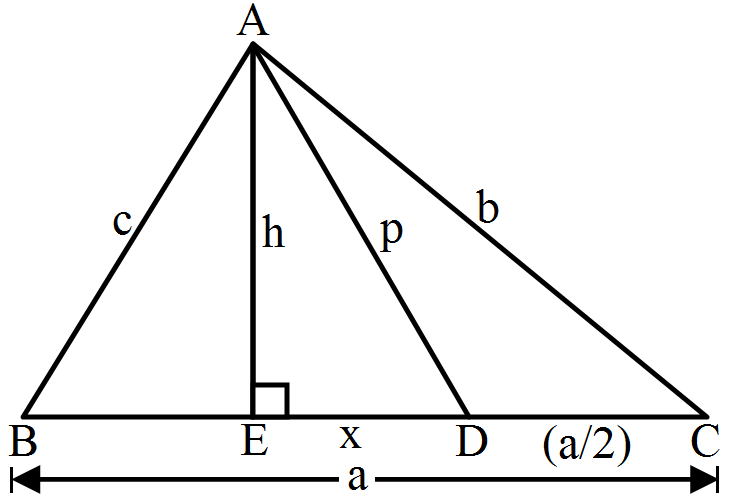
$\text{c}^2=\text{p}^2-\text{ax}+\frac{\text{a}^2}{4}$ AnswerGiven: D is the midpoint of side $\text{BC},\text{AE}\perp\text{BC},\text{BC}=\text{a},\text{AC}=\text{b},\text{AB}=\text{c},\text{ED}=\text{x},\text{AD}=\text{p}$ and $\text{AE}=\text{h}$
In $\triangle\text{AEC},\angle\text{AEC}=90^\circ$
$\text{AD}^2=\text{AE}^2+\text{ED}^2$ (by pythagoras theorem)
$\Rightarrow\text{p}^2=\text{h}^2+\text{x}^2$
In $\triangle\text{ABE},\angle\text{ABE}=90^\circ$
$\text{AB}^2=\text{AE}^2+\text{BE}^2$ (by pythagoras theorem)
$\Rightarrow\text{c}^2=\text{h}^2+\Big(\frac{\text{a}}{2}-\text{x}\Big)^2\dots(2)$
$=\big(\text{h}^2+\text{x}^2\big)-\text{ax}+\frac{\text{a}^2}{4}$
$=\text{p}^2-\text{ax}+\frac{\text{a}^2}{4}$
Hence, $\text{c}^2=\text{p}^2-\text{ax}+\frac{\text{a}^2}{4}$
View full question & answer→Question 174 Marks
In an equilateral triangle with side a, prove that area $=\frac{\sqrt{3}}{4}\text{a}^2.$
Answer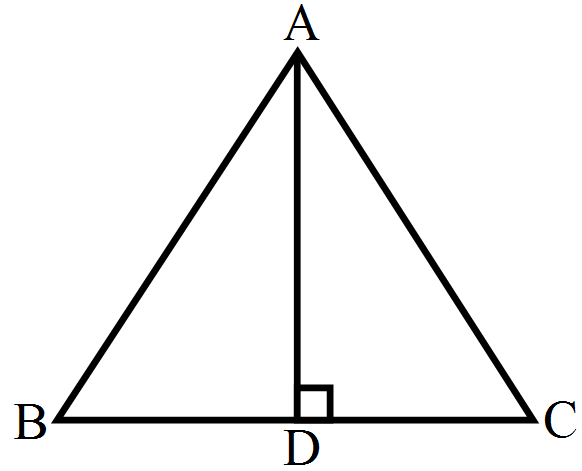
Let $\triangle\text{ABC}$ be an equilateral triangle with side a.
Then, AB = AC = BC = a.
Draw $\text{AD}\perp\text{BC}.$
In $\triangle\text{ADB}$ and $\triangle\text{A},$ we have
$\text{AB}=\text{AC}(\text{given}),\angle\text{B}=\angle\text{C}=60^\circ$
and $\angle\text{ADB}=\angle\text{ADC}=90^\circ$
$\therefore\triangle\text{ADB}\cong\triangle\text{ADC}$
$\therefore\text{BD}=\text{DC}=\frac{\text{a}}{2}$
From right $\triangle\text{ADB},$ we have
$\text{AB}^2=\text{AD}^2+\text{BD}^2$ ....(By Pythagoras theorem)
$\Rightarrow\text{AD}=\sqrt{\text{AB}^2-\text{AB}^2}$
$\Rightarrow\text{AD}=\sqrt{\text{a}^2-\Big(\frac{\text{a}}{2}\Big)^2}$
$\Rightarrow\text{AD}=\sqrt{\text{a}^2-\frac{\text{a}}{4}^2}$
$\Rightarrow\text{AD}=\sqrt{\frac{3\text{a}}{4}^2}$
$\Rightarrow\text{AD}=\frac{\sqrt{3}\text{a}}{2}$
So, the altitude is $\frac{\sqrt{3\text{a}}}{2},$
Area of $\triangle\text{ABC}=\frac{1}{2}\times\text{BC}\times\text{AD}$
$=\frac{1}{2}\times\text{a}\times\frac{\sqrt{3\text{a}}}{2}$
$=\frac{\sqrt{3}\text{a}^2}{4}$
Hence proved. View full question & answer→Question 184 Marks
Find the lenght of the altitude of an equilateral triangle of side $2a\ cm.$
Answer
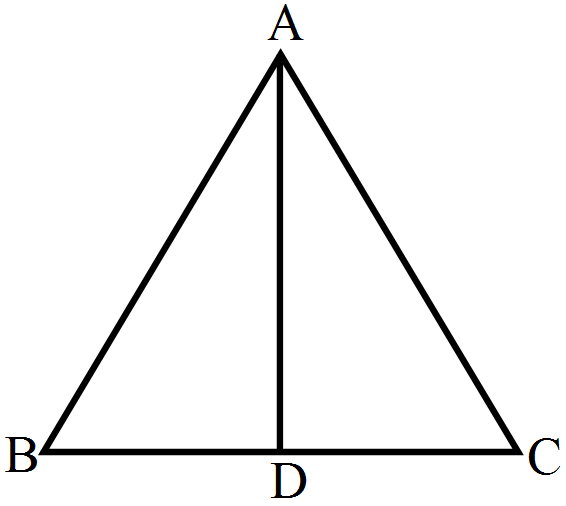
Let $\triangle\text{ABC}$ be an equilateral triangle.
We know that,
in an equilateral triangle the altitube is same as the median.
So, $BD = DC = a\ cm$
By Pythagoras theorem,
$AC^2 = AD^2 + DC^2$
$\Rightarrow AD^2 = AC^2- DC^2$
$\Rightarrow AD^2 = (2a)^2 - a^2$
$\Rightarrow AD^2 = 4a^2 - a^2$
$\Rightarrow AD^2 = 3a^2$
$\Rightarrow\text{AD}=\sqrt{3}\text{a cm}$
So, lendth of the altitude is $\sqrt{3}\text{a cm}.$ View full question & answer→Question 194 Marks
The lengths of the diagonals of a rhobbus are 40cm and 42cm. find the length of each side of the rhombus.
Answer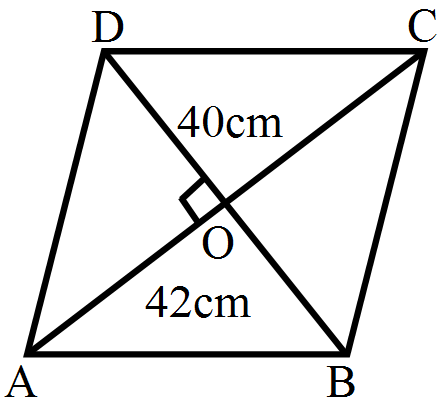
In an rhombus, the diagonals are perpendicular bisectors of each other, and sides are equal to eachother.
So, $\text{AO}=\frac{1}{2}\text{AC}=21\text{cm}$
$\text{OD}=\frac{1}{2}\text{BD}=20\text{cm}$
In right-angled $\triangle\text{AOD},$
$\text{AD}^2=\text{AO}^2+\text{OD}^2$
$\Rightarrow\text{AD}^2=21^2+20^2$
$\Rightarrow\text{AD}^2=441+400$
$\Rightarrow\text{AD}^2=841$
$\Rightarrow\text{AD}=29\text{cm}$
So, the length of the each side of the rhombus is 29cm. View full question & answer→Question 204 Marks
In an isosceles $\triangle\text{ABC},$ the base $AB$ is produced both ways in $P$ and $Q$ such that $AP \times BQ = AC^2.$
Prove that $\triangle\text{ACP}\sim\triangle\text{BCQ}.$
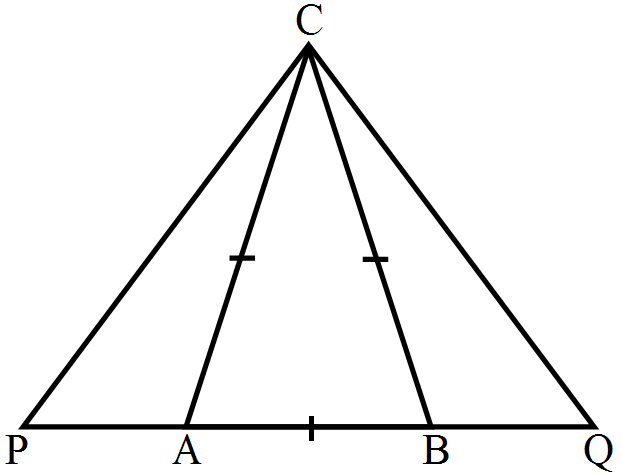
Answer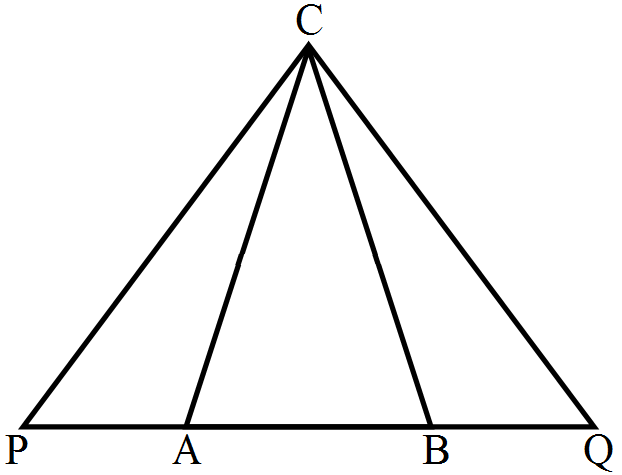
In $\triangle\text{ACP}$ and $\triangle\text{BCQ}$
$CA = CB$
$\Rightarrow\angle\text{CAB}=\angle\text{CBA}$
$\Rightarrow180^\circ-\angle\text{CAB}=180^\circ-\angle\text{CAB}$
$\Rightarrow\angle\text{CAP}=\angle\text{CBQ}$
Now, $AP \times BQ = AC^2$
$\Rightarrow\frac{\text{AP}}{\text{AC}}=\frac{\text{AC}}{\text{BQ}}$
$\Rightarrow\frac{\text{AP}}{\text{AC}}=\frac{\text{BC}}{\text{BQ}}$
Thus, $\angle\text{CAP}=\angle\text{CBQ}$ and $\frac{\text{AP}}{\text{AC}}=\frac{\text{BC}}{\text{BQ}}$
$\therefore\triangle\text{ACP}\sim\triangle\text{BCQ}$ View full question & answer→Question 214 Marks
A ladder $10\ m $ long reaches the window of a house 8m above the ground. Find the distance of the foot of the ladder from the base of the wall.
Answer
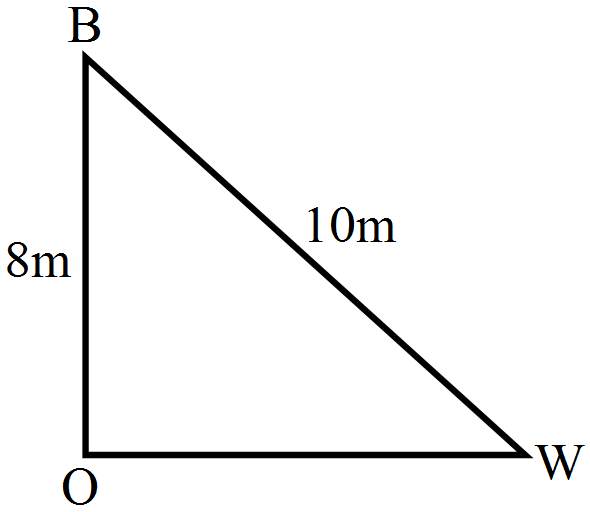
Let $BW$ be the ladder and $OB$ be the house.
$\triangle\text{BOW}$ forms a right-angled triangle.
By Pythagoras theorem,
$BW^2 = OW^2 + OB^2$
$OW^2 = BW^2 - OB^2$
$OW^2 = 10^2 - 8^2$
$OW^2 = 100 - 64$
$OW = 6m$
So the distance of the foot of the ladder from the house is 6m. View full question & answer→Question 224 Marks
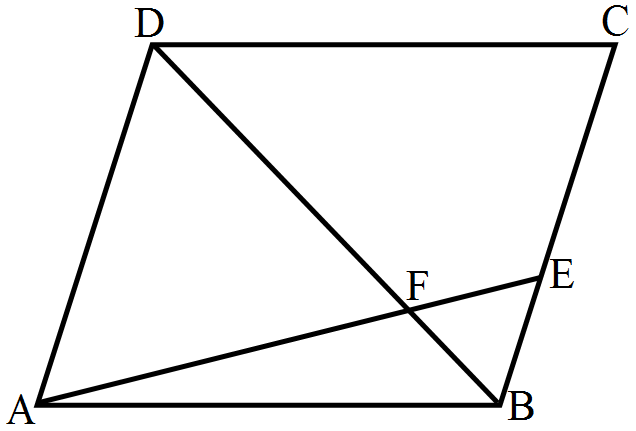
ABCD is a parallelogram and E is a point on BC. If the diagonal BD intersect AE at F, prove that AF × FB = EF × FD.
Answer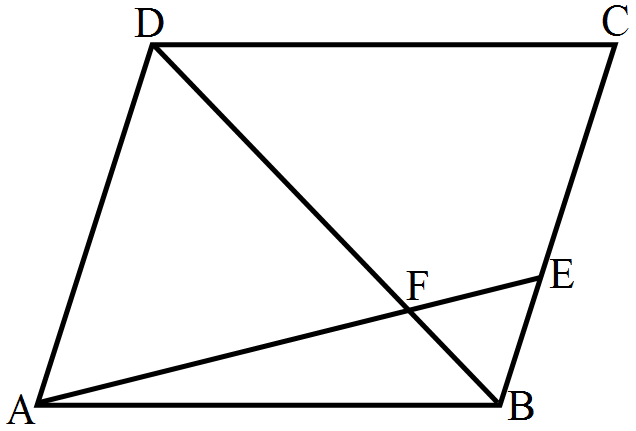
Given: ABCD is a parallelogram and E is point on BC. Diagonals DB intersects AE at F.
To Prove: AF × FB = EF × FD
Proof: In $\triangle\text{AFD}$ and $\triangle\text{EFD}$
$\angle\text{AFD}=\angle\text{EFB}$ $($vertically opposite $\angle\text{s})$
$\angle\text{DAF}=\angle\text{BEF}$ $($ Alternate $\angle\text{s})$
$\therefore\triangle\text{AFD}\approx\triangle\text{EFD}$ [By AAA similarity]
$\therefore\frac{\text{AF}}{\text{EF}}=\frac{\text{FD}}{\text{FB}}$
$\text{AF}\times\text{FB}=\text{EF}\times\text{FD}$
Hence proved. View full question & answer→Question 234 Marks
In the given figure, $\angle\text{ABC}=90^\circ$ and $\text{BD}\perp\text{AC}.$ If AB = 5.7cm, BD = 3.8cm, and CD = 5.4cm find BC.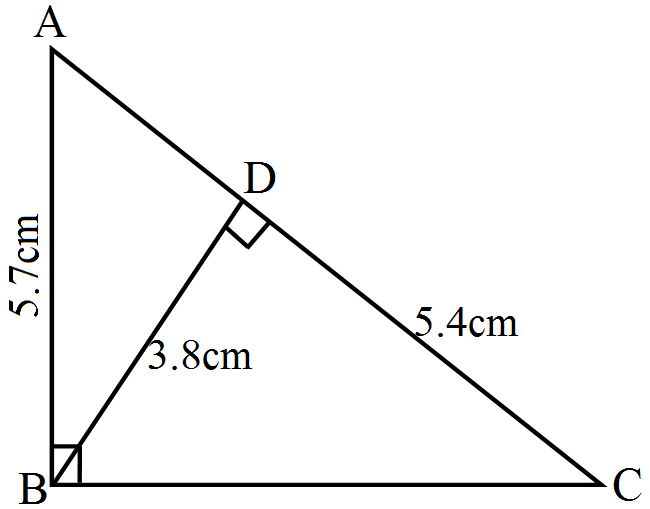
Answer
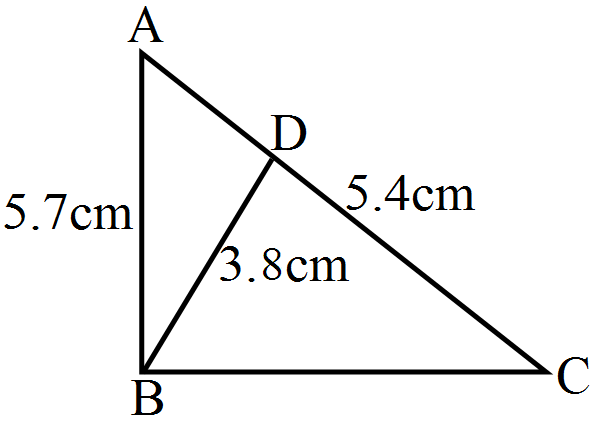 Given that AB = 5.7cm, BD = 3.8cm, and CD = 5.4cm
In $\triangle\text{CBA}$ and $\triangle\text{CDB}$
$\angle\text{CBA}=\angle\text{CDB}=90^\circ$
$\angle\text{C}=\angle\text{C}$ (common)
Therefore, $\triangle\text{CBA}\sim\triangle\text{CDB}$ (by AA similarities)
$\Rightarrow\frac{\text{BC}}{\text{CD}}=\frac{\text{BA}}{\text{BD}}$
$\Rightarrow\frac{\text{BC}}{\text{5.4}}=\frac{\text{5.7}}{\text{3.8}}$
$\Rightarrow\text{BC}=\frac{\text{5.7}\times5.4}{\text{3.8}}$
$\therefore\text{BC}=8.1\text{cm}$
Hence, BC= 8.1cm View full question & answer→Question 244 Marks
In the given pairs of triangles, find which pair of triangles are similar. State the similarity criterior and write the similarity relation in symbolic from.
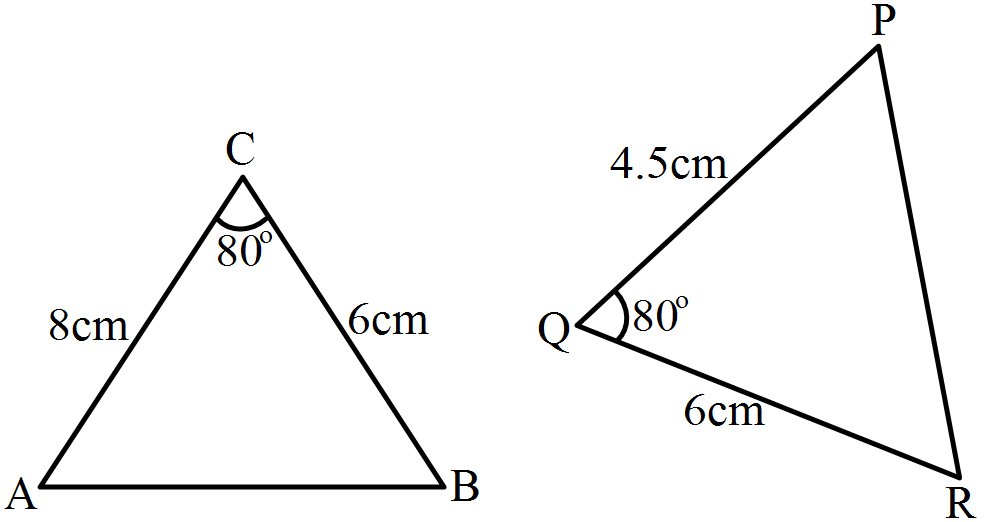
Answer$\triangle\text{CAB}\sim\triangle\text{QRP}$ (SAS Similarity)
as $\frac{\text{CA}}{\text{QR}}=\frac{\text{CB}}{\text{QP}}$ and $\angle\text{C}=\angle\text{Q}$
View full question & answer→Question 254 Marks
The sides of certain triangles are given below. Determine them are right triangles:
7cm, 24cm, 25cm.
AnswerFor a given triangle to be a right angled, the sum of the squares of the two sides must be equal to the square of the largest side.
Let a = 7cm, b = 24cm and c = 25cm, Then
$\big(\text{a}^2+\text{b}^2\big)=\big[7^2+(24)^2\big]\text{cm}^2$
$=(49+576)\text{cm}^2$
$=625\text{cm}^2$
$\text{c}^2=(25\text{cm})^2=625\text{cm}^2$
$\therefore\big(\text{a}^2+\text{b}^2\big)-\text{c}^2$
Hence, the given triangle is a right triangle.
View full question & answer→Question 264 Marks
The areas of two similar triangles are $169\ cm^2$ and $121\ cm^2$ respectively. If the longest side of the larger triangle is $26\ cm,$ find the longest side of the smaller triangle.
AnswerIt is given that the triangle are similar.
Therefore, the ratio of the areas of these triangle will be equal to the ratio of squares of their corresponding sides.
Let the longest side of smaller triangle be $x\ cm.$
$\frac{\text{ar(Larger triangle)}}{\text{ar(Smalles triangle)}}=\frac{(\text{Longest side of larger triangle})^2}{(\text{Longest side of smaller triangle})^2}$
$\Rightarrow\frac{169}{121}=\frac{26^2}{\text{x}^2}$
$\Rightarrow\text{x}=\sqrt{\frac{26\times26\times121}{169}}$
$=22$
Hence, the longest side of the smaller triangle is $22\ cm$.
View full question & answer→Question 274 Marks
State the converse of Pythagpras' theorem.
AnswerIn a triangle, if the square of one side is equal to the sum of the squeares of the other two sides then the angle opposite to the first side is a right angle.
View full question & answer→Question 284 Marks
In the given figure, $\triangle\text{OAB}\sim\triangle\text{OCD}.$ If AB = 8cm, BO = 6.4cm, OC = 3.5cm and CD = 5cm, find.
- OA
- DO
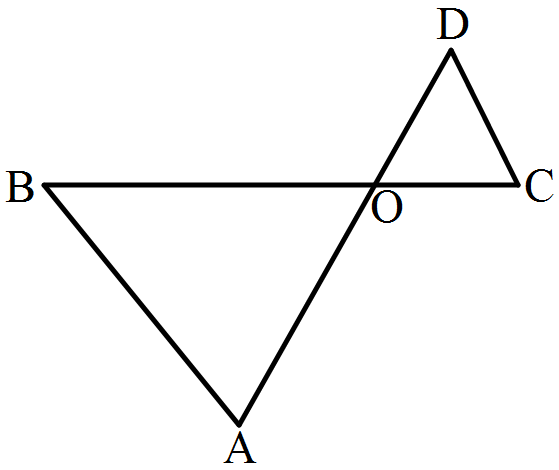
Answer
- Let OA be x cm.
$\therefore\triangle\text{OAB}\sim\triangle\text{OCD}$
$\therefore\frac{\text{OA}}{\text{OC}}=\frac{\text{AB}}{\text{CD}}$
$\Rightarrow\frac{\text{x}}{\text{3.5}}=\frac{\text{8}}{\text{5}}$ and
$\Rightarrow\text{x}=\frac{8\times3.5}{5}=5.6$
hence, OA = 5.6cm
- Let OD be y cm
$\therefore\triangle\text{OAB}\sim\triangle\text{OCD}$
$\therefore\frac{\text{AB}}{\text{CD}}=\frac{\text{OB}}{\text{OD}}$
$\Rightarrow\frac{\text{8}}{\text{5}}=\frac{\text{6.4}}{\text{y}}$
$\Rightarrow\text{y}=\frac{6.4\times5}{8}=4$ View full question & answer→Question 294 Marks
In a circle, two chords AB and CD intersect a point P inside the circle. Prove that
- $\triangle\text{PAC}\sim\triangle\text{PDB}$
- $\text{PA}.\text{PB}=\text{PC}.\text{PD}$
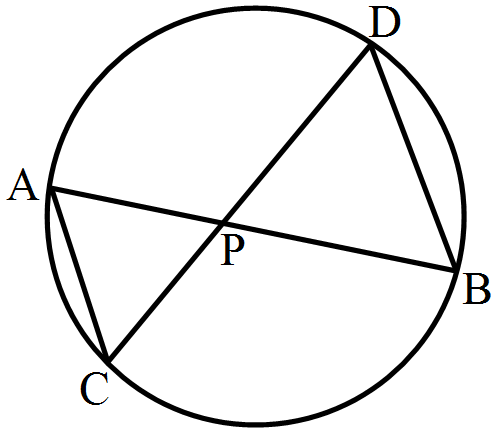
AnswerIn $\triangle\text{PAC}$ and $\triangle\text{BPD},$
$\angle\text{APC}=\angle\text{BPD}$ .....(Vertically opposite angles)
$\angle\text{CAP}=\angle\text{BDP}$ ......(Angels inscribed in the same are equal)
$\therefore\triangle\text{PAC}\sim\triangle\text{PDB}$ .....(AA similarity criterion)
$\Rightarrow\frac{\text{PA}}{\text{PD}}=\frac{\text{PC}}{\text{PB}}$
$\Rightarrow\text{PA}.\text{PB}=\text{PC}.\text{PD}$
View full question & answer→Question 304 Marks
Naman is diing fly-fishing in a stream. The tip of his fishing rod is $1.8m$ above the surface of the water and the fly at the eand of the string rests on the water $3.6m$ away from him and $2.4m$ from the point directly under the tip of the rod Assuming that the string (from tip of his rod to the fly) is taut, how much string does he have out (see the adjoining figure)? If he pulls in the string at the rate of $5\ cm$ per second, what will be the horizontal distance of the fly from him after $12$ seconds?
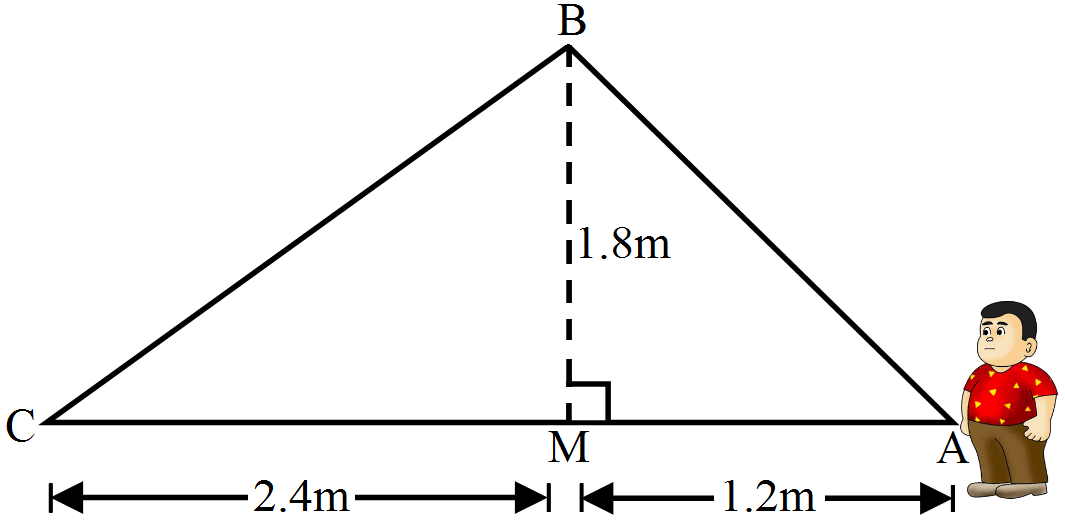
Answer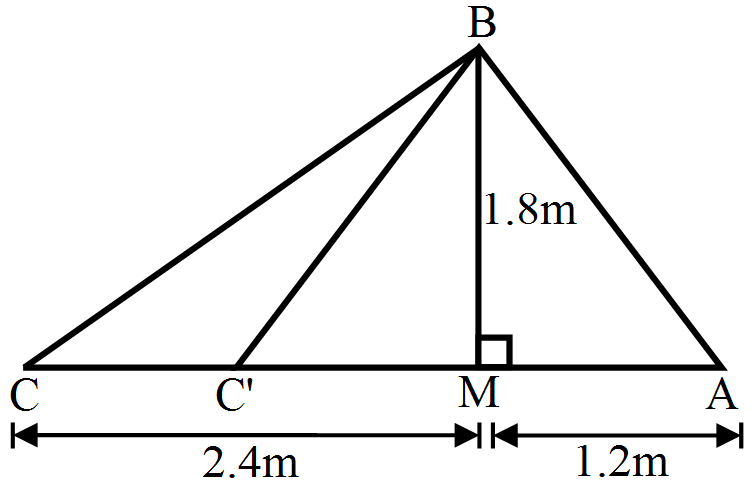
Given that Naman pulls is the string at the rate of 5cm per second.
Hence, after 12 second the lenght of the string he pulls$ = 12 \times 5 = 60cm = 0.6m$
In right $\triangle\text{BMC},$ By Pythagoras theorem,
$BC^2 = CM^2 + MB^2 $
$\Rightarrow BC^2 = (2.4)^2 + (1.8)^2 $
$\Rightarrow BC^2 = 5.76 + 3.24 $
$\Rightarrow BC^2= 9 $
$\Rightarrow BC^2 = 3m$
So, $BC' = BC -$ lenght of the string he pulled after 12 seconds
$\Rightarrow BC' = BC - 0.6$
$ \Rightarrow BC' = 3 - 0.6 $
$\Rightarrow BC' = 2.4m$ In right
$\triangle\text{ABC}'\text{M},$
By Pythagoras theorem,
$C'M^2 = BC'^2- MB^{2}$
$ \Rightarrow C'M^2 = (2.4)^2 - (1.8)^2 $
$\Rightarrow C'M^2 = 5.76 - 3.24$
$\Rightarrow C'M^2 = 2.52 $
$\Rightarrow C'M^2 = 1.59m .....($approximately$)$
The horizontal distance of the fly from him after $12$ second $= C' A = C' M + MA = 1.59 + 1.2 = 2.79m$
approximately $= 2.8m$ approximately View full question & answer→Question 314 Marks
In triangles BMP and CNR it is given that PB = 5cm, MP = 6cm, BM = 9cm and NR = 9cm. If $\triangle\text{BMP}\sim\triangle\text{CNR}$ then find the perimeter of $\triangle\text{CNR}.$
Answer$\triangle\text{BMP}\sim\triangle\text{CNR}$
$\Rightarrow\frac{\text{Perimeters of }\triangle\text{BMP}}{\text{Perimeters of }\triangle\text{CNR}}=\frac{\text{PB}}{\text{RC}}=\frac{\text{MP}}{\text{NR}}=\frac{\text{MB}}{\text{NC}}$
$\Rightarrow\frac{\text{BM+MP+PB }}{\text{Perimeters of }\triangle\text{CNR}}=\frac{\text{PB}}{\text{RC}}=\frac{\text{MP}}{\text{NR}}=\frac{\text{MB}}{\text{NC}}$
$\Rightarrow\frac{\text{9+6+5 }}{\text{Perimeters of }\triangle\text{CNR}}=\frac{\text{5}}{\text{RC}}=\frac{\text{6}}{\text{9}}=\frac{\text{9}}{\text{NC}}$
$\Rightarrow\frac{\text{20}}{\text{Perimeters of }\triangle\text{CNR}}=\frac{\text{6}}{9}$
$\Rightarrow\text{Perimeters of }\triangle\text{CNR}=\frac{\text{20}\times9}{9}$
$\Rightarrow\text{Perimeters of }\triangle\text{CNR}=30\text{cm}$
View full question & answer→Question 324 Marks
If D, E and F are respectively the midpoint of sides AB, BC and CA of $\triangle\text{ABC}$ then what is the ratio of the areas of $\triangle\text{DEF}$ and $\triangle\text{ABC}?$
Answer
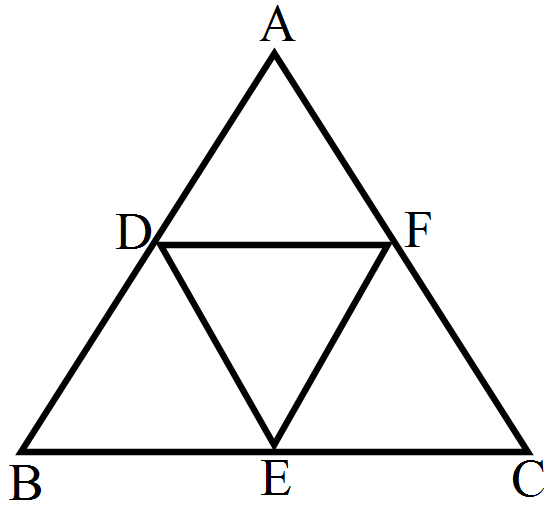 Given: A $\triangle\text{ABC}$ in which D, E and F are respectively the midpoints of sides AB, BC and CA
To find: $\text{ar}(\triangle\text{DEF}):\text{ar}(\triangle\text{ABC})$
Since E and F are the mid-points of BC and CA respectively,
so EF || AB and $\text{EF}=\frac{1}{2}\text{AB}$
...(By the converse of Basic Proportionality theorem)
In particular, EF || BD.
$\therefore$ BDFE is a || gm.
Similarly, EDAF is a || gm.
Now, in $\triangle\text{DEF}$ and $\triangle\text{ABC},$
$\angle\text{E}=\angle\text{A}$ ...(opposite angles of a || gm are equal)
$\angle\text{F}=\angle\text{B}$ ...(opposite angles of a || gm are equal)
$\therefore\triangle\text{DEF}\sim\triangle\text{CAB}$ ...(AA criterion for similarity)
We know that, the ratio of the areas of two similar triangles is equal to the ratio of the squares of their corresponding sides.
$\therefore\frac{\text{ar}(\triangle\text{DEF})}{\text{ar}(\triangle\text{CAB})}=\frac{\text{EF}^2}{\text{AB}^2}=\frac{\Big(\frac{1}{2}\text{AB}\Big)^2}{\text{AB}^2}=\frac{1}{4}$
Hence, $\text{ar}(\triangle\text{DEF}):\text{ar}(\triangle\text{ABC})\text{ is }1:4.$ View full question & answer→Question 334 Marks
A man goes 80m due east and then 150m due north. How far is he from the starting point?
Answerstarting from A, let the man goas from A to B and from B to C, as shows in the figure. Then, $\text{AB}=80\text{m,}\text { BC}=150\text{m}$ and $\angle\text{ABC}=90^\circ$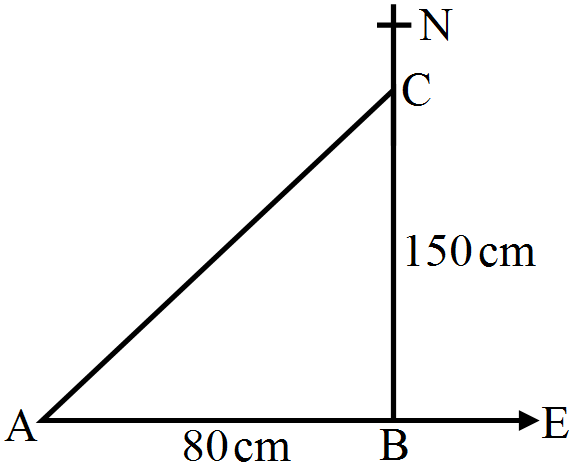
From right $\triangle\text{ABC},$ we have $\text{AC}^2=\big(\text{AB}^2+\text{BC}^2\big)\text{m}^2$ $=\big[(80)^2+(150)^2\big]\text{m}^2$ $=(6400+22500)\text{m}^2$ $=28900\text{m}^2$ $\therefore\text{AC}=\sqrt{28900}\text{m}=170\text{m}$ Hence, the man is 170m north-east from the starting point. View full question & answer→Question 344 Marks
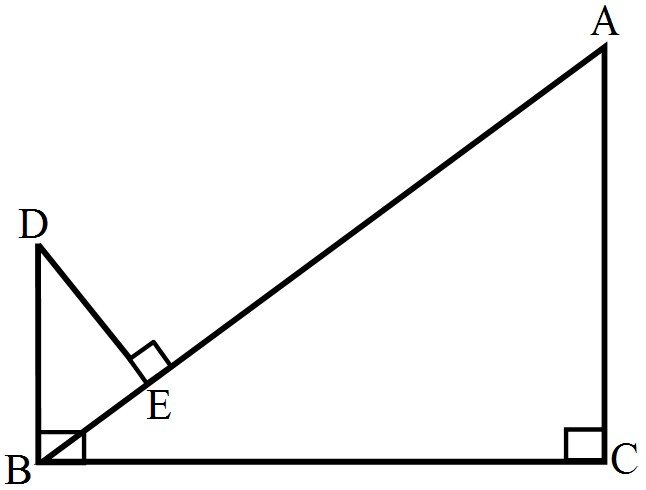
In the given figure, $\text{DB}\perp\text{BC},\text{DE}\perp\text{AB}$ and $\text{AC}\perp\text{BC}.$
Prove that $\frac{\text{BE}}{\text{DE}}=\frac{\text{AC}}{\text{BC}}.$
Answer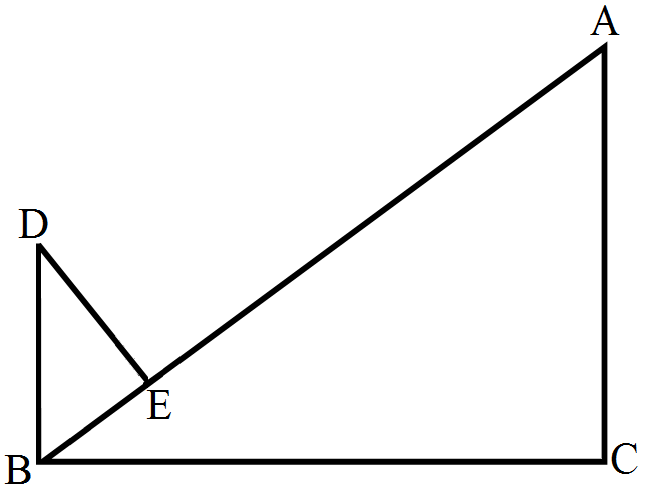
In the given figure : $\text{DB}\perp\text{AB},\text{AC}\perp\text{BC}$ and DB || AC
$\therefore\angle\text{DBC}=\angle\text{ACB}$
AB is the transversal
$\therefore\angle\text{DBE}=\angle\text{BAC}$ $\big[\text{Alternate }\angle\text{s}\big]$
In $\triangle\text{DBE}$ and $\triangle\text{ABC}$
$\angle\text{DEB}=\angle\text{ACB}=90^\circ$
$\angle\text{DBE}=\angle\text{BAC}$
$\triangle\text{DBE}\sim\triangle\text{ABC}$ [By AA similarity]
$\Rightarrow\frac{\text{BE}}{\text{DE}}=\frac{\text{AC}}{\text{BC}}$
Hence proved. View full question & answer→Question 354 Marks
For the following statments state whether true $(T)$ or false$(F):$
The sum of the squares on the sides of a rhombus is equal to the sum of the squares on its diagonals.
AnswerTrue.Solution:
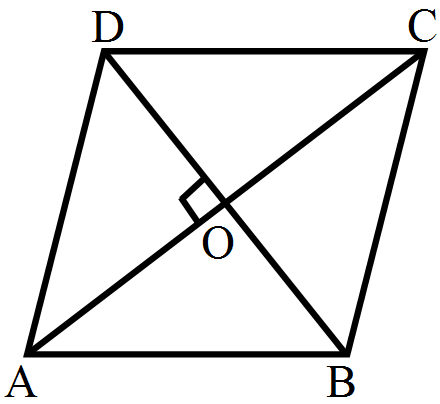
Given: $A$ rhombus $ABCD$ whose diagonals $AC$ and $BD$ intersect at $O.$
To prove: $(AB^2 + BC^2 + CD^2 + AD^2) = (AC^2 + BD^2)$
Proof:
We know that the diagonals of a rhombus are perpendicular bisectors of each other,
$\therefore\angle\text{AOB}=\angle\text{BOC}=\angle\text{COD}=\angle\text{DOA}=90^\circ$
$\text{OA}=\frac{1}{2}\text{AC}$ and $\text{OB}=\frac{1}{2}\text{BD}$
From right $\triangle\text{AOB},$
$\text{AB}^2=\text{OA}^2+\text{OB}^2$
$\Rightarrow\text{AB}^2=\Big(\frac{1}{2}\text{AC}\Big)^2+\Big(\frac{1}{2}\text{BD}\Big)^2$
$\Rightarrow\text{AB}^2=\frac{1}{4}(\text{AC}^2+\text{BD}^2)$
$\Rightarrow4\text{AB}^2=\text{AC}^2+\text{BD}^2\dots(\text{i})$
Similarly, we have
$4\text{BC}^2-\text{AC}^2+\text{BD}^2\dots(\text{ii})$
$4\text{CD}^2=\text{AC}^2+\text{BD}^2\dots(\text{iii})$
$4\text{DA}^2=\text{AC}^2+\text{BD}^2\dots(\text{iv})$
Addind (i), (ii), (iii) and (iv), we get
$\text{AB}^2+\text{BC}^2+\text{CD}^2+\text{DA}^2=\text{AC}^2+\text{BD}^2$ View full question & answer→Question 364 Marks
D and E are points on the sides AB and AC respectively of a $\triangle\text{ABC}$ such that DE || BC:
If $\frac{\text{AD}}{\text{DB}}=\frac{4}{7}$ and AC = 6.6cm, find AE.
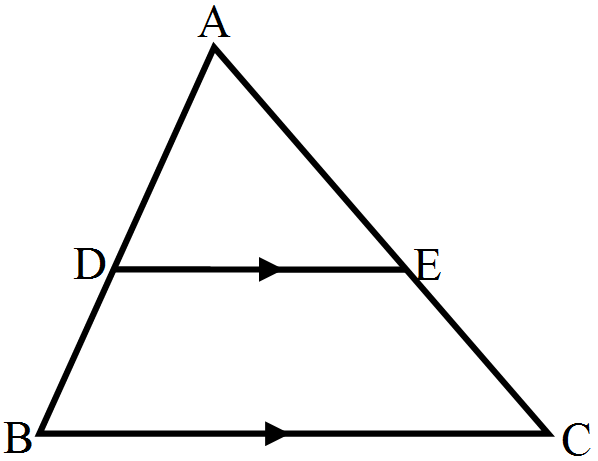
AnswerIn $\triangle\text{ABC},$ it is given that DE || BC.
Applying Thales' theorem, we get:
$\frac{\text{AD}}{\text{DB}}=\frac{\text{AE}}{\text{EC}}$
$\Rightarrow\frac{\text{4}}{\text{7}}=\frac{\text{AE}}{\text{EC}}$
Adding 1 to both sides, we get:
$\Rightarrow\frac{\text{11}}{\text{7}}=\frac{\text{AE}}{\text{EC}}$
$\text{EC}=\frac{6.6\times7}{11}=4.2\text{cm}$
Therefore, $\text{AE}=\text{AC}-\text{EC}=6.6-4.2=2.4\text{cm}$
View full question & answer→Question 374 Marks
State the basic proportionality theorem.
AnswerIf a line is drawn parallel to one side of a triangle to intersect the other two sides in distinct point, then the other sides are divided in the same ratio.
View full question & answer→Question 384 Marks
For the following statments state whether true (T) or false(F):
The ratio of the perimeters of two similar triangles is the same as the ratio of their corresponding medians.
AnswerTrue. Solution: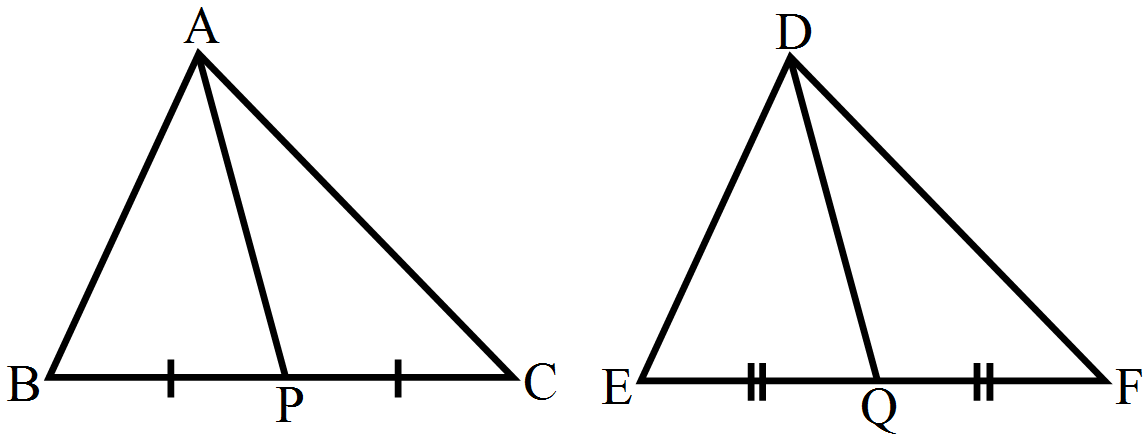
Given $\triangle\text{ABC}\sim\triangle\text{DEF}$ $\Rightarrow\frac{\text{AB}}{\text{DE}}=\frac{\text{BC}}{\text{EF}}=\frac{\text{AC}}{\text{DF}}$ $\Rightarrow\frac{\text{AB}}{\text{DE}}=\frac{2\text{BP}}{2\text{EQ}}=\frac{\text{BP}}{\text{EQ}}$ and $\angle\text{B}=\angle\text{E}$ Now, in $\triangle\text{APB}$ and $\triangle\text{DQE},$ $\angle\text{B}=\angle\text{E}$ $\frac{\text{AB}}{\text{DE}}=\frac{\text{BP}}{\text{EQ}}$ $\Rightarrow\triangle\text{APB}\sim\triangle\text{DQE}$ .....(SAS criterion for similarity) $\therefore\frac{\text{AB}}{\text{DE}}=\frac{\text{AP}}{\text{DQ}}$ So, $\frac{\text{AB}}{\text{DE}}=\frac{\text{BC}}{\text{EF}}=\frac{\text{AC}}{\text{DF}}=\frac{\text{AP}}{\text{DQ}}$ We now that, The ratio of the perimeters of two similar triangles is the same as the ratio of their corresponding sides. That is, $\frac{\text{AB}+\text{BC}+\text{AC}}{\text{DE+EF+DF}}=\frac{\text{AP}}{\text{DQ}}$ View full question & answer→Question 394 Marks
In the given figure, each one of PA , QB and RC is perpendicular to AC. If AP = x, QB = z, RC = y, AB = a and BC = b, show that $\frac{1}{\text{x}}+\frac{1}{\text{y}}=\frac{1}{\text{z}}.$
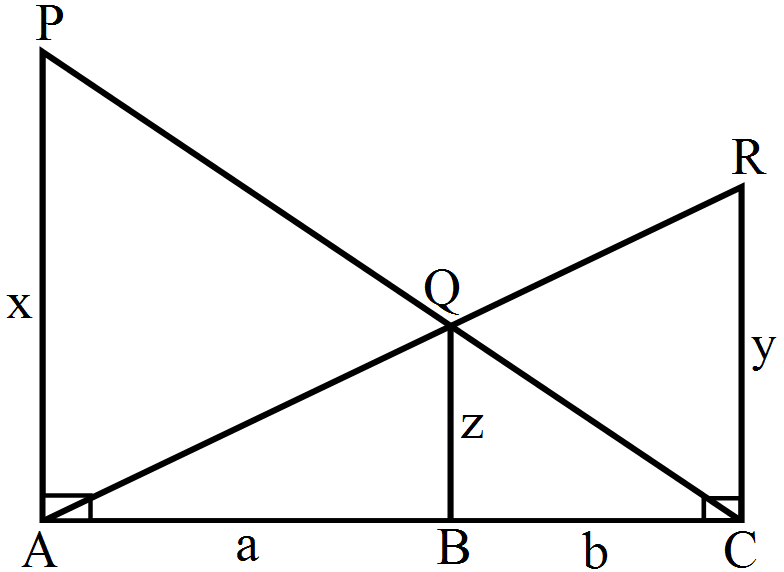
AnswerIn $\triangle\text{PAC}$ and $\triangle\text{QBC},$ we have:
$\angle\text{A}=\angle\text{B}$ (Both angles are 90º)
$\angle\text{P}=\angle\text{Q}$ (Corresponding angle)
and
Therefore, $\triangle\text{PAC}\sim\triangle\text{QBC}$
$\frac{\text{AP}}{\text{BQ}}=\frac{\text{AC}}{\text{BC}}$
$\Rightarrow\frac{\text{x}}{\text{z}}=\frac{\text{a+b}}{\text{b}}$
$\Rightarrow\text{a}+\text{b}=\frac{\text{bx}}{\text{z}}\dots(1)$
In $\triangle\text{RCA}$ and $\triangle\text{QBA},$ we have:
$\angle\text{C}=\angle\text{B}$ (Both angles are 90º)
$\angle\text{R}=\angle\text{Q}$ (Corresponding angles)
and
$\angle\text{A}=\angle\text{A}$ (common angles)
Therefore, $\triangle\text{RCA}\sim\triangle\text{QBA}$
$\frac{\text{RC}}{\text{BQ}}=\frac{\text{AC}}{\text{AB}}$
$\Rightarrow\frac{\text{y}}{\text{z}}=\frac{\text{a+b}}{\text{a}}$
$\Rightarrow\text{a}+\text{b}=\frac{\text{ay}}{\text{z}}\dots(2)$
From equation (1) and (2), we have:
$\frac{\text{bx}}{\text{z}}=\frac{\text{ay}}{\text{z}}$
$\Rightarrow\text{bx}=\text{ay}$
$\frac{\text{a}}{\text{b}}=\frac{\text{x}}{\text{y}}\dots(3)$
Also,
$\Rightarrow\frac{\text{x}}{\text{z}}=\frac{\text{a+b}}{\text{b}}$
$\Rightarrow\frac{\text{x}}{\text{z}}=\frac{\text{a}}{\text{b}}+1$
Using the value of $\frac{\text{a}}{\text{b}}$ from equation (3), we have:
$\Rightarrow\frac{\text{x}}{\text{z}}=\frac{\text{x}}{\text{y}}+1$
Dividing both side by x, we get:
$\frac{\text{1}}{\text{z}}=\frac{\text{1}}{\text{y}}+\frac{\text{1}}{\text{z}}$
$\therefore\frac{\text{1}}{\text{x}}+\frac{\text{1}}{\text{y}}=\frac{\text{1}}{\text{z}}$
This completes the proof.
View full question & answer→Question 404 Marks
Find the lenght of a diagonal of a rectangle whose adjacent side are 30cm and 16cm.
AnswerLet ABCD is the given rectangle let BD is a diagonal making a $\triangle\text{ADB}.$ $\Rightarrow\angle\text{BAD}=90^\circ$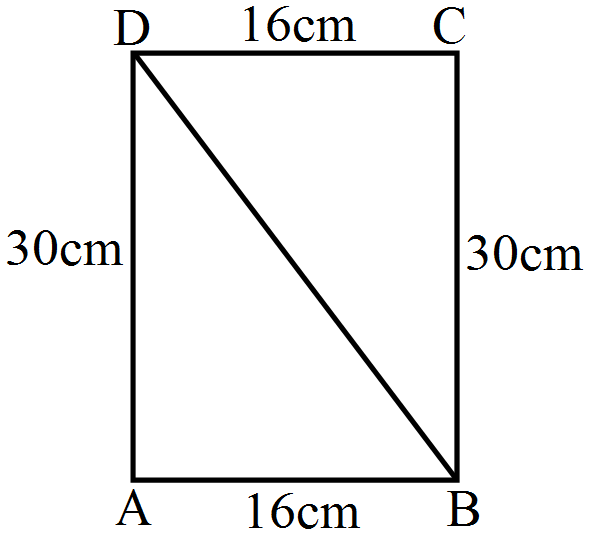
Using Pythagoras theorem: $(\text{DB})^2=\text{AB}^2+\text{AD}^2$ $\text{DB}^2=\big(16^2+30^2\big)\text{cm}^2$ $\text{DB}=\sqrt{16^2+30^2}\text{cm}$ $=\sqrt{256+900}$ $=34\text{cm}$ Hence, lenght of diagonal DB is 34cm. View full question & answer→Question 414 Marks
$\triangle\text{ABC}$ is an equilateral triangle of side 2a units. Find each of its altitudes.
AnswerIn an equilateral triangle all sides are equal. Then, AB = BC = AC = 2a uints Const: Draw an altitude $\text{AD}\perp\text{BC}$ Given BC = 2a Then, BD = a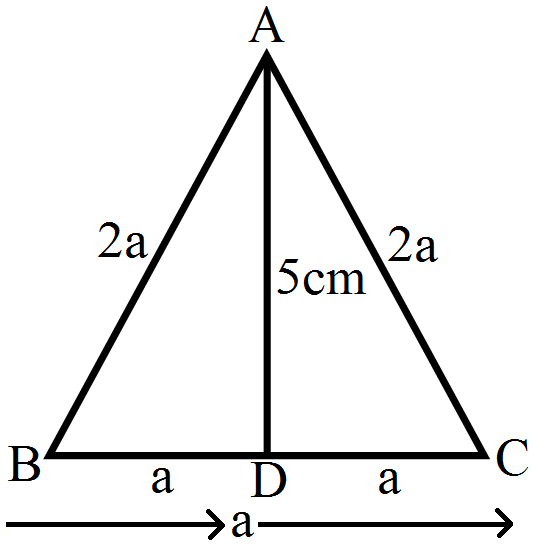
In $\triangle\text{ABD},$ $\angle\text{ADB}=90^\circ$ $(\text{AB})^2=\text{(AD)}^2+\text{(BD})^2$ (by pythagoras theorem) $\text{(AD})^2=\big(\text{AB}^2-\text{BD}^2\big)$ $=\Big[(2\text{a})^2-(\text{a})^2\Big]\text{sq}.\text{units}$ $=\big(4\text{a}^2-\text{a}^2\big)\text{sq}.\text{unit}=3\text{a}^2\text{sq}.\text{unit}$ $\text{AD}=\sqrt{3\text{a}^2}\text{unit}=\text{a}\sqrt{3}\text{ unit}$ Hence, lenght of each altitude is $\text{a}\sqrt{3}\text{ units}$ View full question & answer→Question 424 Marks
The areas of two similar triangles are $81\ cm^2$ and $49\ cm^2$ respectively. If the altitudes of the first triangle is $6.3\ cm,$ find the corresponding altitude of the other.
AnswerIt is given that the triangles are similar.
Therefore, the ratio of the areas of these triangles is will be equal to the ratio of squares of their corresponding sides.
Also, the ratio of areas of two similar triangles is equal to the ratio of square of their correspondind altitudes.
Let the two triangles be $ABC$ and $DEF$ with altitudes $AP$ and $DQ$, respectively.
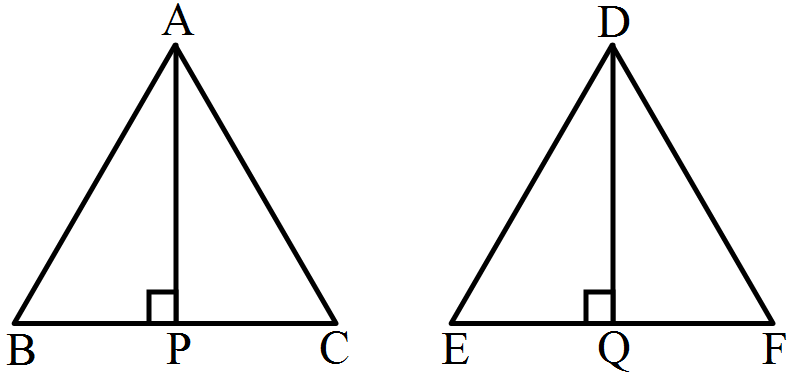
$\frac{\text{ar}(\triangle\text{ABC})}{\text{ar}(\triangle\text{PQR})}=\frac{\text{AP}^2}{\text{DQ}^2}$
$\Rightarrow\frac{81}{49}=\frac{\text{6.3}^2}{\text{DQ}^2}$
$\Rightarrow\text{DQ}^2=\frac{49}{81}\times6.3^2$
$\Rightarrow\text{DQ}^2=\sqrt{\frac{49}{81}\times6.3\times6.3}$
$=4.9\text{cm}$
Hence, the altitude of the other triangle is $4.9\ cm.$ View full question & answer→Question 434 Marks
The areas of two similar triangles are $100\ cm^2$ and $64\ cm^2$ respectively. If a median of the smaller triangle is $5.6\ cm$, find the correspondin median of the other.
AnswerLet the two triangles be $ABC$ and $PQR$ with median $AM$ and $PN$, respectively.
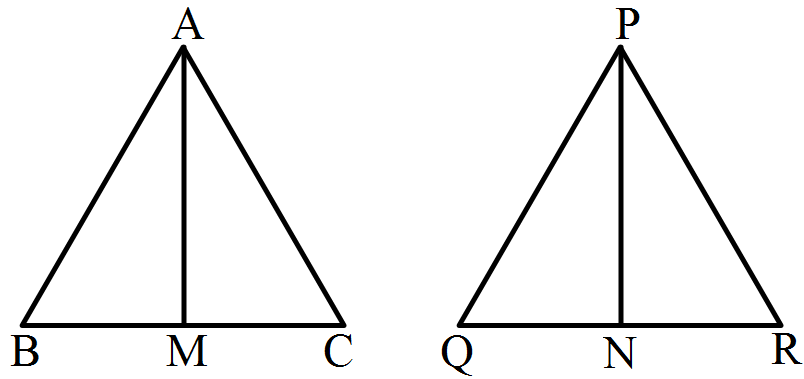
Therefore, the ratio of areas of two similar triangles will be equal to the ratio of squares of their corrrsponding medians.
$\therefore\frac{\text{ar}(\triangle\text{ABC})}{\text{ar}(\triangle\text{PQR})}=\frac{\text{AM}^2}{\text{PN}^2}$
$\Rightarrow\frac{64}{100}=\frac{\text{5.6}^2}{\text{PN}^2}$
$\Rightarrow\text{PN}^2=\frac{64}{100}\times5.6^2$
$\Rightarrow\text{PN}^2=\sqrt{\frac{100}{64}\times5.6\times5.6}$
$=7\text{cm}$
Hence, the median of the larger triangle is $7\ cm$. View full question & answer→Question 444 Marks
Prove that the internal bisector of an angle of a triangle divides the opposite side internally in the ratio of the sides containing the angle.
AnswerLet the triangle be ABC with AD as the bisector of $\angle\text{A}$ which meets BC at D.
We have to prove:
$\frac{\text{BD}}{\text{DC}}=\frac{\text{AB}}{\text{AC}}$
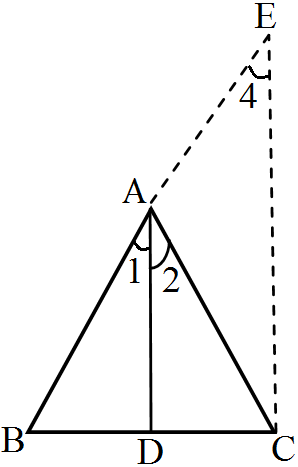
Draw CE || DA, meeting BA produced at E
CE || DA
Therefore,
$\angle2=\angle3$ (Alternate angles)
and $\angle1=\angle4$ (Corresponding angles)
But,
$\angle1=\angle2$
Therefore,
$\angle3=\angle4$
$\Rightarrow\text{AE}=\text{AC}$
In $\triangle\text{BCE},\text{DA }||\text{ CE}.$
Applying Thales' theorem, we have:
$\frac{\text{BD}}{\text{DC}}=\frac{\text{AB}}{\text{AE}}$
$\Rightarrow\frac{\text{BD}}{\text{DC}}=\frac{\text{AB}}{\text{AC}}$
This completes the proof. View full question & answer→Question 454 Marks
State the SAS-similarity criterion.
AnswerIf one angle of a triangle is equal to one angle of the other triangle and the sides including these angles are proportional then the two triangles are similar.
View full question & answer→Question 464 Marks
Two chords AB and CD of a circle intersect at a point P outside the ciecle. Prove that.
- $\triangle\text{PAC}\sim\triangle\text{PDB}$
- $\text{PA}.\text{PB}=\text{PC}.\text{PD}$
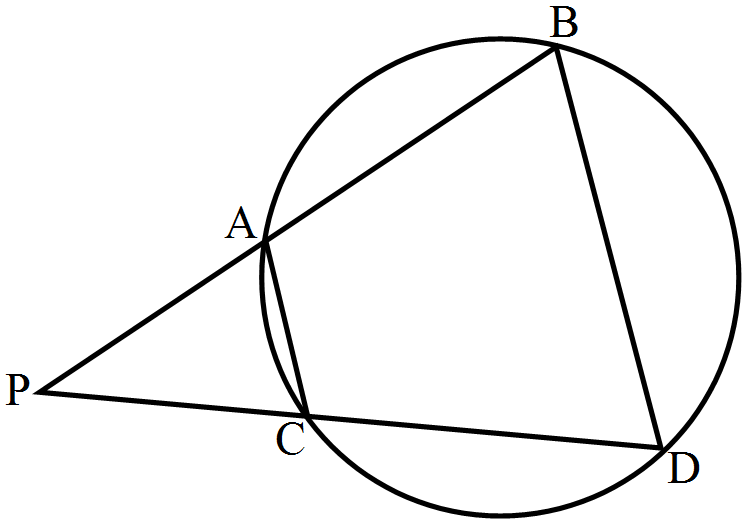
AnswerIn $\triangle\text{PAC}$ and $\triangle\text{PDB},$
$\angle\text{APC}=\angle\text{BPD}$ .....(common angle)
Since ABCD is a cyclic quadrilateral,
$\angle\text{PAC}=\angle\text{BDP}$
$\therefore\triangle\text{PAC}\sim\triangle\text{PDB}$ .....(AA similarity criterion)
$\Rightarrow\frac{\text{PA}}{\text{PD}}=\frac{\text{PC}}{\text{PB}}$
$\Rightarrow\text{PA}.\text{PB}=\text{PC}.\text{PD}$
View full question & answer→Question 474 Marks
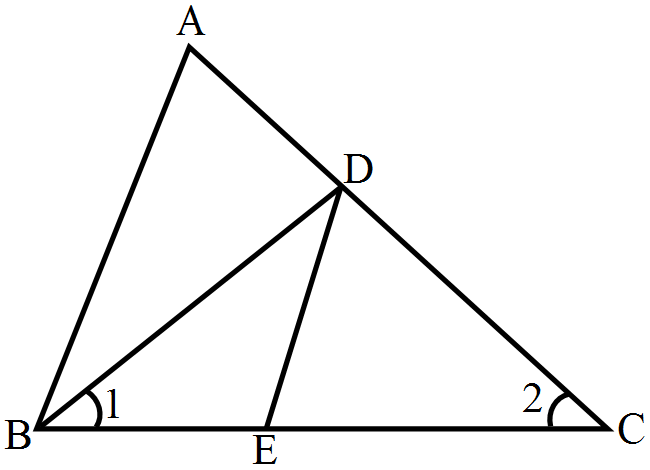
In the given figure, $\angle1=\angle2$ and $\frac{\text{AC}}{\text{BD}}=\frac{\text{CB}}{\text{CE}}$
Prove that $\triangle\text{ACB}\sim\triangle\text{DCE}.$
Answer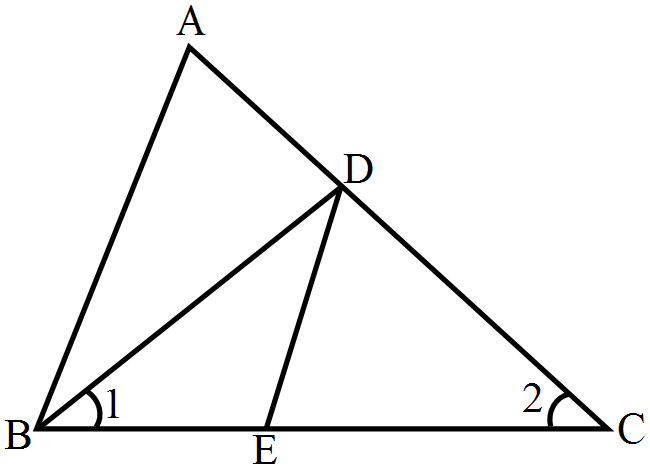
$\angle1=\angle2$ (given)
$\frac{\text{AC}}{\text{BD}}=\frac{\text{CB}}{\text{CE}}\Rightarrow\frac{\text{AC}}{\text{CB}}=\frac{\text{BD}}{\text{CE}}$ (given)
Also, $\angle2=\angle1$ $\big[\therefore\text{BD}=\text{DC}\big]$
Thus, $\frac{\text{AC}}{\text{CB}}=\frac{\text{BD}}{\text{CE}}$
and $\angle2=\angle1$
Therefore, by SAS similarity criterion $\triangle\text{ACB}\sim\triangle\text{DCE}$ View full question & answer→Question 484 Marks
A man goes $12\ m$ due south and then $35\ m$ due west. How far is he from the starting point?
Answer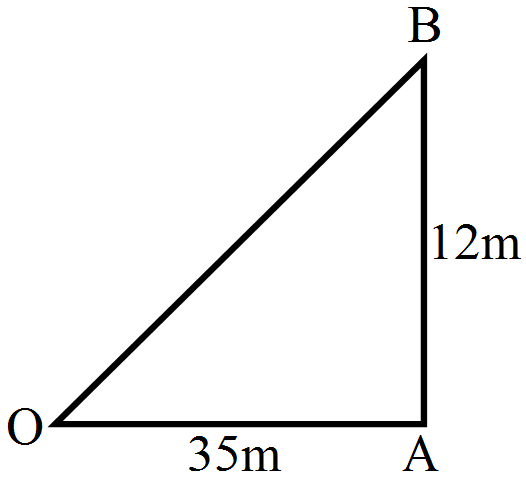
Let the starting point be $B$.
Since $\triangle\text{OAB}$ forms a right-angled triangle,
By Pythagoras theorem,
$OB^2 = OA^2 + AB^2$
$\Rightarrow OB^2 = 35^2 + 12^2$
$\Rightarrow OB^2 = 1225 + 144$
$\Rightarrow OB^2 = 1369$
$\Rightarrow OB = 37m$
So, he is $37m$ away from the starting point. View full question & answer→Question 494 Marks
In the given figure, D is the midpoint of side BC and $\text{AE}\perp\text{BC}.$ If BC = a, AC = b, AB = c, ED = x, AD = p and AE = h, prove that.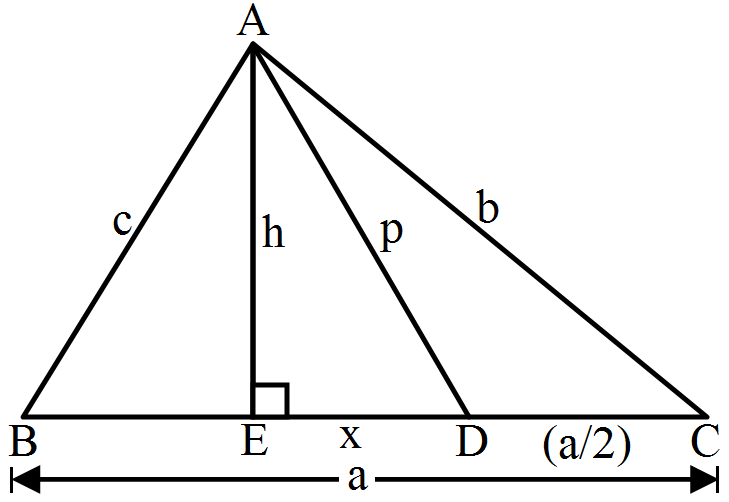
$(\text{b}^2+\text{c}^2)=2\text{p}^2+\frac{1}{2}\text{a}^2$ AnswerGiven: D is the midpoint of side $\text{BC},\text{AE}\perp\text{BC}$
$\text{BC}=\text{a},\text{AC}=\text{b},\text{AB}=\text{c},\text{ED}=\text{x},\text{AD}=\text{p}$ and $\text{AE}=\text{h}$
In $\triangle\text{AEC},\angle\text{AEC}=90^\circ$
$\text{AD}^2=\text{AE}^2+\text{ED}^2$ (by pythagoras theorem)
$\Rightarrow\text{p}^2=\text{h}^2+\text{x}^2$
Adding (1) and (2), we get
$\text{b}^2+\text{c} ^2=\text{p}^2+\text{ax}+\frac{\text{a}^2}{4}+\text{p}^2-\text{ax}+\frac{\text{a}^2}{4}$
$\big(\text{b}^2+\text{c}^2\big)=2\text{p}^2+\frac{1}{2}\text{a}^2$
View full question & answer→Question 504 Marks
For the following statments state whether true (T) or false(F):
The polygon formed by joining the midpoit of the sides of a quadrilateral is a rhombus.
AnswerFalse.
Solution: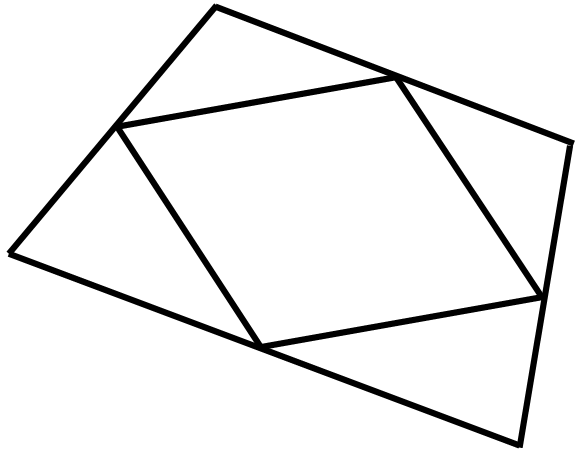
The line segments joining the midpoint of the adjacent sides of a quadrilateral form a parallelogram as shown. It may or may not be a rhombus.
View full question & answer→Question 514 Marks
In $\triangle\text{ABC},\text{D}$ and $\text{E}$ are the midpoint of AB and AC respectively. Find the ratio of the areas of $\triangle\text{ADE}$ and $\triangle\text{ABC}.$
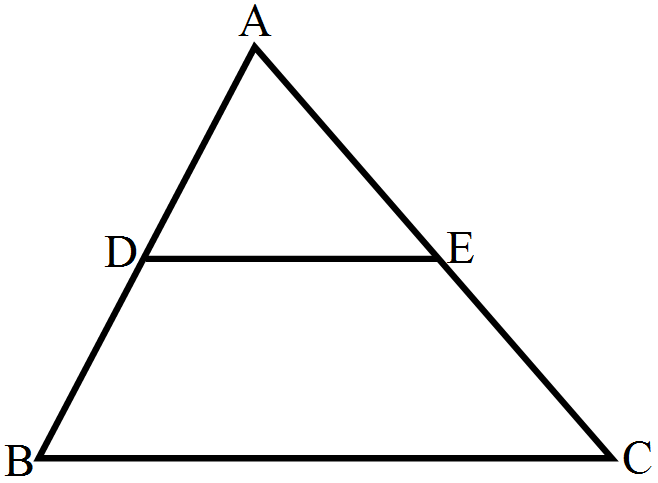
AnswerIt is given that D and E are midpoint of AB and AC.
Applying midpoint theorem, we can conclude that DE || BC.
Hence, by B.P.T we get:
$\frac{\text{AD}}{\text{AB}}=\frac{\text{AE}}{\text{AC}}$
Also, $\angle\text{A}=\angle\text{A}$
Applying SAS similarity theorem, we can conclude that $\triangle\text{ADE}\sim\triangle\text{ABC}.$
Therefore, the ratio of the areas of these triangles will be equal to the ratio of squares of their corresponding sides.
$\therefore\frac{\text{ar}(\triangle\text{ADE})}{\text{ar}(\triangle\text{ABC})}=\frac{\text{DE}^2}{\text{BC}^2}$
$=\frac{\big(\frac{1}{2}\text{BC}\big)^2}{\text{BC}^2}$
$=\frac{1}{4}$
View full question & answer→Question 524 Marks
Two triangles ABC and PQR are such that AB = 3cm, AC = 6cm, $\angle\text{A}=70^\circ,\text{PR}=9\text{cm},\angle\text{P}=70^\circ$ and $\text{PQ}=4.5\text{cm}.$ show that $\triangle\text{ABC}\sim\triangle\text{PQR}$ and state the similarity criterion.
Answer
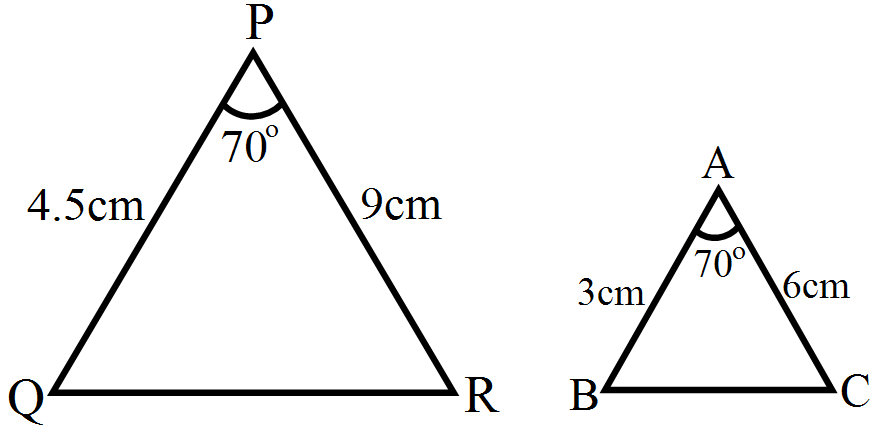 In $\triangle\text{ABC}$ and $\triangle\text{PQR},$
$\angle\text{A}=\angle\text{P}=70^\circ\ ...\ \text{(Given)}$
$\frac{\text{AB}}{\text{PQ}}=\frac{3}{4.5}=\frac{2}{3}$
$\frac{\text{AC}}{\text{PR}}=\frac{6}{9}=\frac{2}{3}$
$\Rightarrow\frac{\text{AB}}{\text{PQ}}=\frac{\text{AC}}{\text{PR}}$
so, $\triangle\text{ABC}\sim\triangle\text{PQR}$ ...(SAS criterion for similarity) View full question & answer→Question 534 Marks
Find the length of each side of a rhombus whose diagonals are $24\ cm$ and $10\ cm$ long.
Answer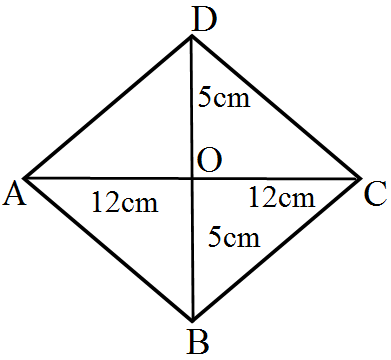
Let $ABCD$ be the rhobbus with diagonals $AC$ and $BD$ intersecting each other at $O$.
We know that the diagonals of a rhombus bisect each other at right angles.
$\therefore$ if $AC = 24\ cm$ and $BD = 10\ cm$, $AO = 12\ cm$ and $BO = 5\ cm$
Applying Pythagoras theorem in right- angled triangle AOB, we get:
$AB^2 = AO^2 + BO^2 = 12^2 + 5^2 = 144 + 25 = 169$
$AB = 13\ cm$
Hence, the lenght of each side of the given rhombus is $13\ cm$ View full question & answer→Question 544 Marks
For the following statments state whether true $(T)$ or false$(F):$If $O$ is any point inside a rectangle $ABCD$ then $OA^2 + OC^2 = OB^2 + OD^2$
AnswerTrue.
Solution:
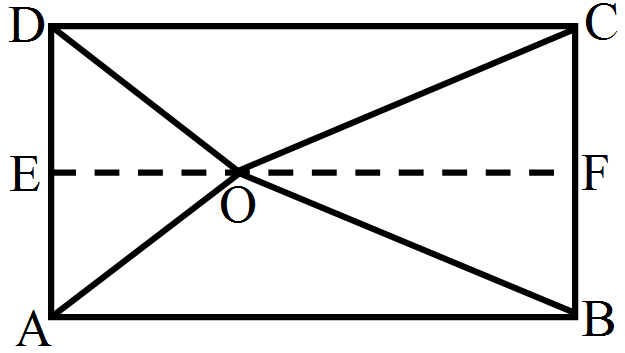
Construction: Draw $EF || AB$ through $O.$
In $\triangle\text{OEA}$ and $\triangle\text{OFC},$ by pythagoras theorem,
$OA^2 = OE^2 + AE^2$ and $OC^2= OF^2 + CF^2$
Adding the two equations, we get
$OA^2 + OC^2 = OE^2 + AE^2 + OF^2 + CF^2 .....(i)$
$\triangle \text{OFB}$ and $\triangle \text{ODE},$ by pythagoras theorem,
$OB^2 = OF^2 + FB^2 $ and $OD^2 = OE^2 + DE^2$
Adding the two equation, we get
$OB^2 + OD^2 = OF^2 + FB^2 + OE^2 + DE^2 .....(ii)$
By Construction since $EF || CD,$
$DE = CF$ and $AE = FB$
So, from (i) and (ii), we have
$OA^2 + OC^2 = OB^2 + OD^2$ View full question & answer→Question 554 Marks
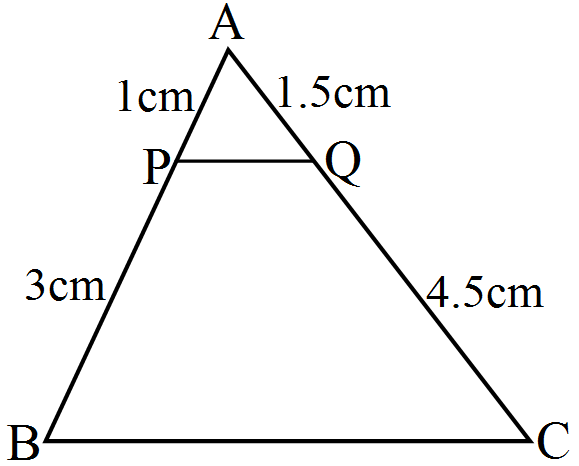
In the given figure, ABC is a triangle and PQ is a straight line meeting AB in P and AC in Q. If AP = 1cm. PB = 3cm, AQ = 1.5cm, QC = 4.5cm, Prove that area of $\triangle\text{APQ}$ is $\frac{1}{16}$ of the area of $\triangle\text{ABC}.$
AnswerWe have:
$\frac{\text{AP}}{\text{AB}}=\frac{1}{1+3}=\frac{1}{4}$ and $\frac{\text{AQ}}{\text{AC}}=\frac{1.5}{1.5+4.5}=\frac{1.5}{6}=\frac{1}{4}$
$\Rightarrow\frac{\text{AP}}{\text{AB}}=\frac{\text{AQ}}{\text{AC}}$
Also,
$\angle\text{A}=\angle\text{A}$
By SAS similarity, we can conclude that $\triangle\text{APQ}\sim\triangle\text{ABC}$
$\frac{\text{ar}(\triangle\text{APQ})}{\text{ar}(\triangle\text{ABC})}=\frac{\text{AP}^2}{\text{AB}^2}=\frac{1^2}{4^2}=\frac{1}{16}$
$\Rightarrow\frac{\text{ar}(\triangle\text{APQ})}{\text{ar}(\triangle\text{ABC})}=\frac{1}{16}$
$\Rightarrow\text{ar}(\triangle\text{APQ})=\frac{1}{16}\times\text{ar}(\triangle\text{ABC})$
Hence proved.
View full question & answer→Question 564 Marks
Two vertical poles of height 9m and 14m stand on a plane ground. If the distance between their feet is 12m, find the distance between their tops.
AnswerLet AB and CD be the given vertical poles. Then, AB = 9m, CD = 14m and AC = 12m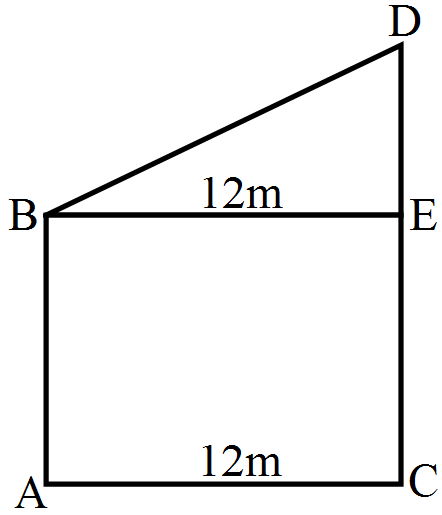
Const Draw, BE || AC. Then, CE = AB = 9m and BE = AC = 12m $\therefore\text{ DE} = \text{(CD} -\text{ CE)}$ $= (14 - 9)$ $= 5\text{m}$ In right $\triangle\text{BED},$ we have $\text{BD}^2=\text{BE}^2+\text{DE}^2$ $=\Big[(12)^2+(5)^2\Big]\text{m}^2$ $=(144+25)\text{m}^2$ $=169\text{m}^2$ $\Rightarrow\text{BD}=\sqrt{169}=13\text{m}$ Hence, the distance between their tops is 13m. View full question & answer→Question 574 Marks
In the given figure, DE || BC and DE : BC = 3 : 5. Calculate the ratio of the areas of $\triangle\text{ADE}$ and the trapezium BCED.
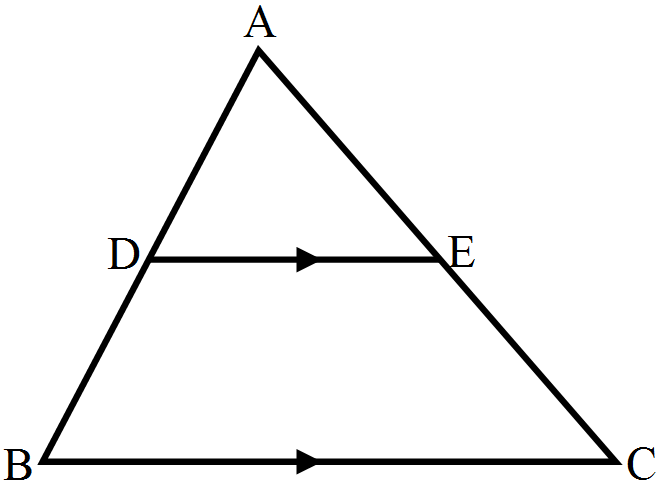
AnswerIt is given that DE || BC.
$\therefore\angle\text{ADE}=\angle\text{ABC}$ (Corresponding angles)
$\angle\text{AED}=\angle\text{ACB}$ (Corresponding angles)
Applying AA similarity theorem, we can conclude that $\triangle\text{ADE}\sim\triangle\text{ABC}.$
$\therefore\frac{\text{ar}(\triangle\text{ABC})}{\text{ar}(\triangle\text{ADE})}=\frac{\text{BC}^2}{\text{DE}^2}$
Subtracting 1 from both sides, we get:
$\frac{\text{ar}(\triangle\text{ABC})}{\text{ar}(\triangle\text{ADE})}-1=\frac{5^2}{3^2}-1$
$\Rightarrow\frac{\text{ar}(\triangle\text{ABC})-\text{ar}(\triangle\text{ADE})}{\text{ar}(\triangle\text{ADE})}=\frac{25-9}{9}$
$\Rightarrow\frac{\text{ar}(\triangle\text{BCED})}{\text{ar}(\triangle\text{ADE})}=\frac{16}{9}$
or, $\frac{\text{ar}(\triangle\text{ADE})}{\text{ar}(\triangle\text{BCED})}=\frac{9}{16}$
View full question & answer→Question 584 Marks
For the following statments state whether true (T) or false(F):
The length of the line segment joining the midpoint of any two sides of a triangle is equal to half the length of the third side.
AnswerTrue. Solution: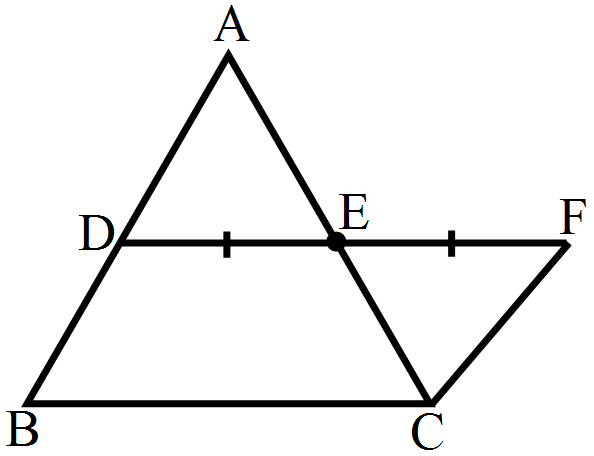
Construction: Produce DE to F that DE = EF. By the Basic proportinality theorem, DE || BC That is, DF || BC ....(i) In $\triangle\text{ADE}$ and $\triangle\text{CEF},$ $\angle\text{AED}=\angle\text{CEF}$ ....(Vertically opposite angles) $\text{DE}=\text{EF}$ ....(Costruction) $\text{AE}=\text{EC}$ ....(E is mid-point of AC) $\Rightarrow\triangle\text{ADE}\cong\triangle\text{CEF}$....(SAS congruence criterion) $\angle\text{ADE}=\angle\text{CFE}$ ....(cpct) $\Rightarrow\text{AD }||\text{ CF}$ that is, $\text{AD }||\text{ CF}\Rightarrow\text{BD }||\text{ CF}\dots(\text{ii})$ So, from (i) and (ii) BDFC is a parallelogram. ⇒ DF = BC So, $\text{DE}=\frac{1}{2}\text{DF}=\frac{1}{2}\text{BC}$ View full question & answer→Question 594 Marks
Show that the line segment which joins the midpoint of the oblique sides of a trapezium is parallel to the parallel sides.
AnswerLet the trapezium be ABCD with E and F as the points of AD and BC, respectively. Produce AD and BC to meet at P.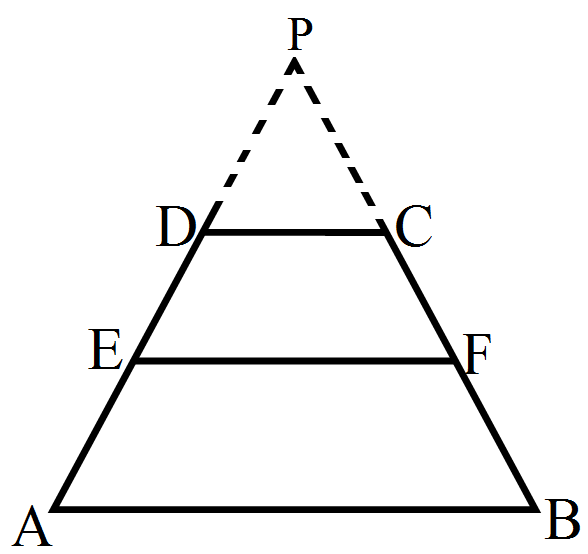
In $\triangle\text{PAB},\text{ DC }|| \text{ AB}.$ Applying Thales' theorem, we get: $\frac{\text{PD}}{\text{DA}}=\frac{\text{PC}}{\text{CB}}$ Now, E and F are the midpoint of AD and BC, respectively. $\Rightarrow\frac{\text{PD}}{2\text{DE}}=\frac{\text{PC}}{2\text{CF}}$ $\Rightarrow\frac{\text{PD}}{\text{DE}}=\frac{\text{PC}}{\text{CF}}$ Applying the converse of Thales' theorem in $\triangle\text{PEF},$ we get that DC || EF. Hence, EF || AB. Thus. EF is parallel to both AB and DC. This completes the proof. View full question & answer→Question 604 Marks
For the following statments state whether true (T) or false(F):
If two triangles are similar then their corresponding angles are equal and their corresponding sides are equal.
AnswerFalse.
Solution:
Two triangles are said to be similar to each other if:
- Their corresponding angles are equal.
- Their corresponding sides are proportional.
View full question & answer→Question 614 Marks
The perimeters of two similar triangles ABC and PQR are 32cm and 24cm respectively. If PQ = 12cm, find AB.
Answer$\triangle\text{ABC}$ and $\triangle\text{PQR}$ are similar triangles, therefore corresponding sides of both the triangle are proportional.
So, $\frac{\text{Perimeter of }\triangle\text{ABC}}{\text{Perimeter of }\triangle\text{PQR}}=\frac{\text{AB}}{\text{PQ}}$
Let, AB = x cm
Then, $\frac{\text{x}}{12}=\frac{32}{24}$
$\text{x}=\frac{32\times12}{24}=16\text{cm}$
Hence, AB = 16cm
View full question & answer→Question 624 Marks
In the given figure, $\angle\text{ABC}=90^\circ$ and $\text{BD}\perp\text{AC}.$ If BD = 8cm, AD = 4cm, find CD.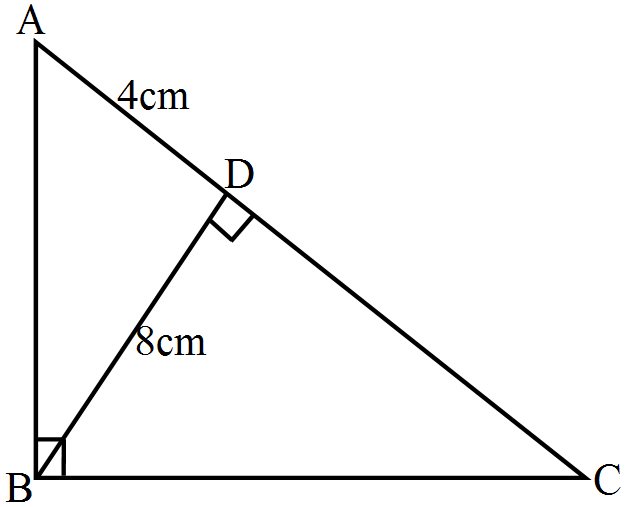
Answer
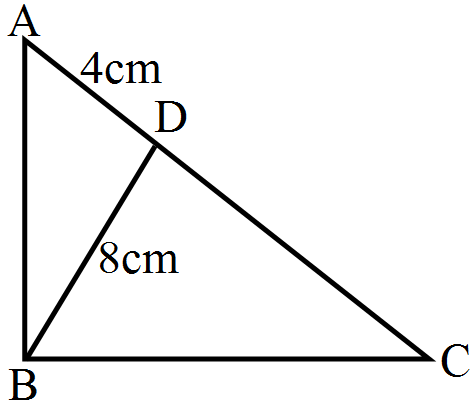 Given that BD = 8cm, AD = 4cm
In $\triangle\text{DBA}$ and $\triangle\text{DCB},$ we have
$\angle\text{BDA}=\angle\text{CDB}=90^\circ$
$\angle\text{DBA}=\angle\text{DCB}$ $\big[\text{each}=90^\circ-\angle\text{A}\big]$
$\therefore\triangle\text{DBA}\sim\triangle\text{DCB}$ (by AAA similaritiy)
$\therefore\frac{\text{BD}}{\text{CD}}=\frac{\text{AD}}{\text{BD}}$
$\Rightarrow\text{CD}=\frac{\text{BD}^2}{\text{AD}}$
$\Rightarrow\text{CD}=\frac{(\text{8)}^2}{\text{4}}=\frac{64}{4}=16\text{cm}$
Hence, CD= 16cm View full question & answer→Question 634 Marks
Each of the equal sides of an isosceles triangle is $25\ cm.$ Find the length of its altitude if the $14\ cm.$
Answer
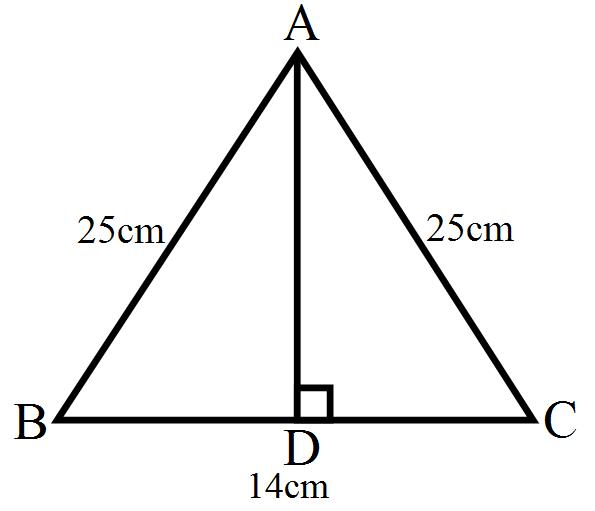
Let $\triangle\text{ABC}$ be the isosceles triangle and $AD$ be the altitude.
The height of an isosceles triangles is the same as its median.
So, $BD = DC = 7cm$
$\triangle\text{ADB}$ is a right.angled triangle.
By Pythagoras theorem,
$AB^2 = AD^2 + BD^2$
$\Rightarrow AD^2 = AB^2- BD^2$
$\Rightarrow AD^2= 25^2 - 7^2$
$\Rightarrow AD^2 = 625 - 49$
$\Rightarrow AD^2 = 576$
$\Rightarrow AD = 24cm$
Hence, the length of the altitude is $24cm.$ View full question & answer→Question 644 Marks
In the given figure, XY || AC and XY divides $\triangle\text{ABC}$ into two regions, equal in area. Show that $\frac{\text{AX}}{\text{AB}}=\frac{(2-\sqrt{2})}{2}.$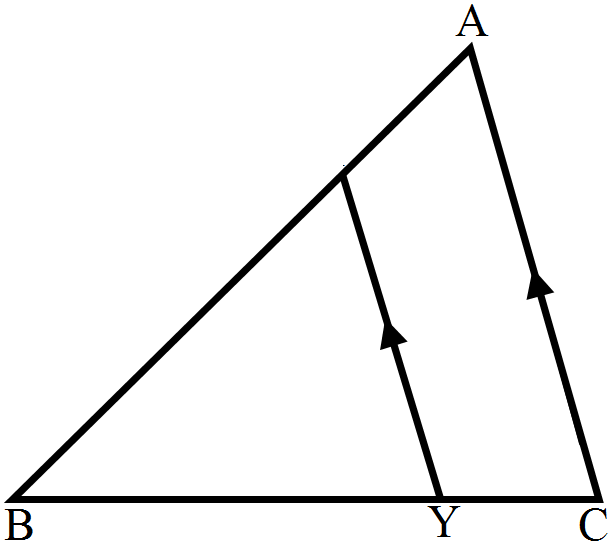
AnswerIn $\triangle\text{ABC}$ and $\triangle\text{BXY},$ we have:
$\angle\text{B}=\angle\text{B}$
$\angle\text{BXY}=\angle\text{BAC}$ (Corresponding angles)
Thus, $\triangle\text{ABC}\sim\triangle\text{BXY}$ (AA criterion)
$\therefore\frac{\text{ar}(\triangle\text{ABC})}{\text{ar}(\triangle\text{BXY})}=\frac{\text{AB}^2}{\text{BX}^2}=\frac{\text{AB}^2}{\text{(AB}-\text{AX})^2}\dots(\text{i})$
Also, $\frac{\text{ar}(\triangle\text{ABC})}{\text{ar}(\triangle\text{BXY})}=\frac{2}{1}$ $\{\therefore(\triangle\text{BXY})=\text{ar}(\text{trapezium AXYC})\}\dots(\text{ii})$
From (i) and (ii), we have:
$\Rightarrow\frac{\text{AB}^2}{(\text{AB}-\text{AX})^2}=\sqrt{2}$
$\Rightarrow\frac{(\text{AB}-\text{AX})}{\text{AB}}=\frac{1}{\sqrt{2}}$
$\Rightarrow1-\frac{\text{AX}}{\text{AB}}=\frac{1}{\sqrt{2}}$
$\Rightarrow\frac{\text{AX}}{\text{AB}}=1-\frac{1}{\sqrt{2}}$
$=\frac{\sqrt{2}-1}{\sqrt{2}}=\frac{(2-\sqrt{2})}{\sqrt{2}}$
View full question & answer→Question 654 Marks
The sides of certain triangles are given below. Determine them are right triangles:
$(\text{a} - 1)\text{cm},2\sqrt{\text{a}}\text{ cm},(\text{a} + 1)\text{cm}.$
AnswerFor a given triangle to be a right angled, the sum of the squares of the two sides must be equal to the square of the largest side.
Let $\text{p}=(\text{a} - 1)\text{cm},\text{q}=2\sqrt{\text{a}}\text{ cm}$ and $\text{r}=(\text{a}+1)\text{cm}^2$
$\text{p}^2+\text{q}^2=\Big[(\text{a}-1)^2+\big(2\sqrt{\text{a}}\big)^2\Big]\text{cm}^2$
$=\big(\text{a}^2+1-2\text{a}+4\text{a}\big)\text{cm}^2$
$=\big(\text{a}^2+1+2\text{a}\big)\text{cm}^2=(\text{a}+1)^2\text{cm}^2$
$\text{r}^2=(\text{a}+1)^2\text{cm}^2$
$\therefore\text{p}^2+\text{q}^2=\text{r}^2$
Hence, the given triangle is a right triangle.
View full question & answer→Question 664 Marks
If $\triangle\text{ABC}\sim\triangle\text{DEF}$ such that 2AB = DE and BC = 6cm, find EF.
Answer$\therefore\triangle\text{ABC}\sim\triangle\text{DEF}$
$\therefore\frac{\text{AB}}{\text{DE}}=\frac{\text{BC}}{\text{EF}}$
$\Rightarrow\frac{1}{2}=\frac{6}{\text{EF}}$
$\Rightarrow\text{EF}=12\text{cm}$
View full question & answer→Question 674 Marks
In the given figure, $\triangle\text{ABC}$ and $\triangle\text{DBC}$ have the same base BC. If AD and BC intersect at O, prove that $\frac{\text{ar}(\triangle\text{ABC})}{\text{ar}(\triangle\text{DBC})}=\frac{\text{AO}}{\text{DO}}.$
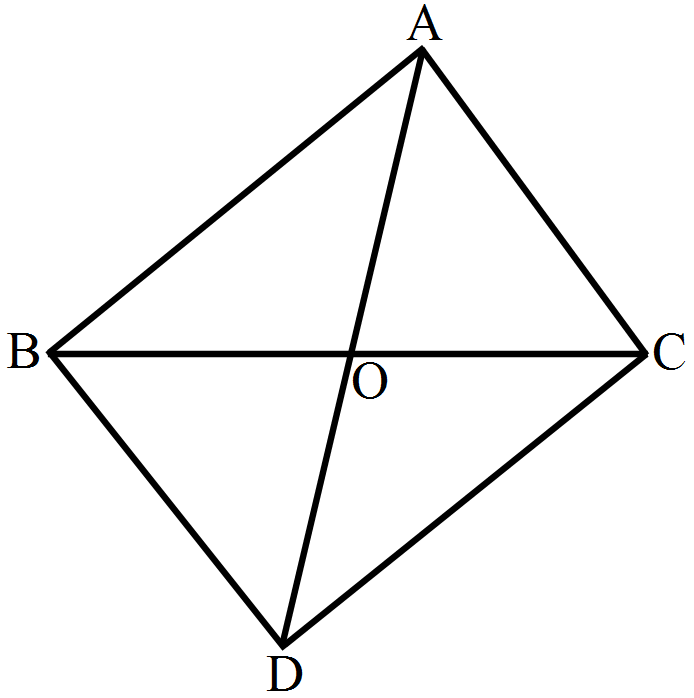
Answer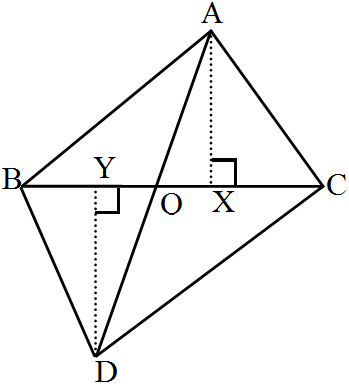
Construction: Draw $\text{AX}\perp\text{CO}$ and $\text{DY}\perp\text{BO}.$
As,
$\frac{\text{ar}(\triangle\text{ABC})}{\text{ar}(\triangle\text{DBC})}=\frac{\frac{1}{2}\times\text{AX}\times\text{BC}}{\frac{1}{2}\times\text{DY}\times\text{BC}}$
$\Rightarrow\frac{\text{ar}(\triangle\text{ABC})}{\text{ar}(\triangle\text{DBC})}=\frac{\text{AX}}{\text{DY}}\dots(\text{i})$
In $\triangle\text{ABC}$ and $\triangle\text{DBC},\angle\text{AXY}=\angle\text{DYO}=90^\circ(\text{By construction})$
$\angle\text{AOX}=\angle\text{DOY}(\text{Vertically opposite angles})$$\therefore\triangle\text{AXY}\sim\triangle\text{DYO }(\text{By AA criterion})$
This completes the proof. View full question & answer→Question 684 Marks
In a $\triangle\text{ABC},\text{AD}$ is the bisector of $\angle\text{A}.$
If AB = 10cm, AC = 14cm and BC = 6cm, find BD and DC.
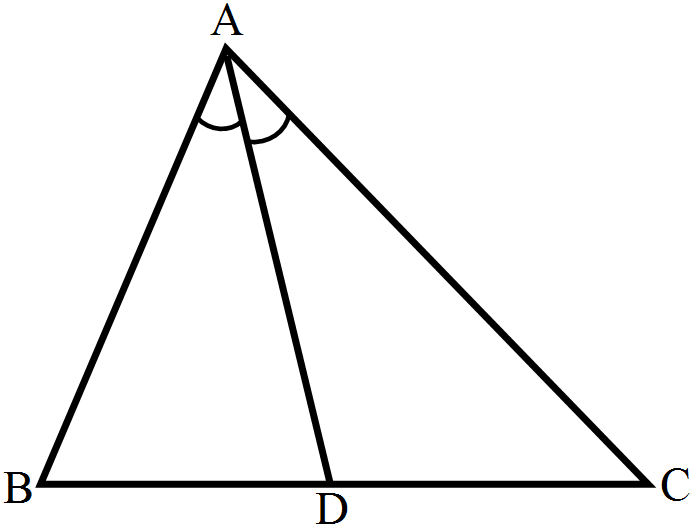
AnswerIt is given that AD bisects $\angle\text{A}.$
Applying angle-bisector theorem in $\triangle\text{ABC},$ we get:
$\frac{\text{BD}}{\text{DC}}=\frac{\text{AB}}{\text{AC}}$
Let BD be x cm.
Therefore, DC = (6 - x)cm
$\Rightarrow\frac{\text{x}}{6-\text{x}}=\frac{10}{14}$
$\Rightarrow14\text{x}=60-10\text{x}$
$\Rightarrow24\text{x}=60$
$\Rightarrow\text{x}=2.5\text{cm}$
Thus, BD = 2.5cm
DC = 6 - 2.5 = 3.5cm
View full question & answer→Question 694 Marks
In the adjoining figure, ABC is a triangle in which AB = AC. If D and E are points on AB and AC respectively such that AD = AE, show that the points B, C, E and D are concyclic.
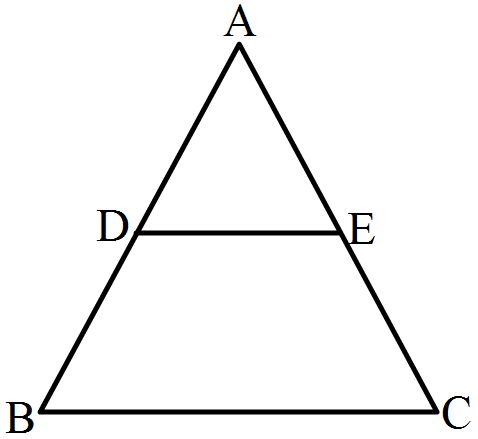
AnswerGiven:
AD = AE ...(i)
AB = AC ...(ii)
Subtracting AD from both sides, we get:
⇒ AB - AD = AC - AD
⇒ AB - AD = AC - AE (Since, AD = AE)
⇒ BD = EC ...(iii)
Dividing equation (i) by equation (iii), we get:
$\frac{\text{AD}}{\text{DB}}=\frac{\text{AE}}{\text{EC}}$
Dividing the converse pf Thales' theorem, DE || BC
$\Rightarrow\angle\text{DEC}+\angle\text{ECB}=180^\circ$ (Sum of interior angles on the same side of a transversal line is 180º)
$\Rightarrow\angle\text{DEC}+\angle\text{CBD}=180^\circ$ $($Since, AB = AC ⇒ $\angle\text{B}=\angle\text{C})$
Hence, quadrilateral BDED is cyclic.
Therefore, B, C, E and D are concyclic points.
View full question & answer→Question 704 Marks
In the given figure, MN || BC and AM : MB = 1 : 2
Find $\frac{\text{area}(\triangle\text{AMN})}{\text{area}(\triangle\text{ABC})}.$
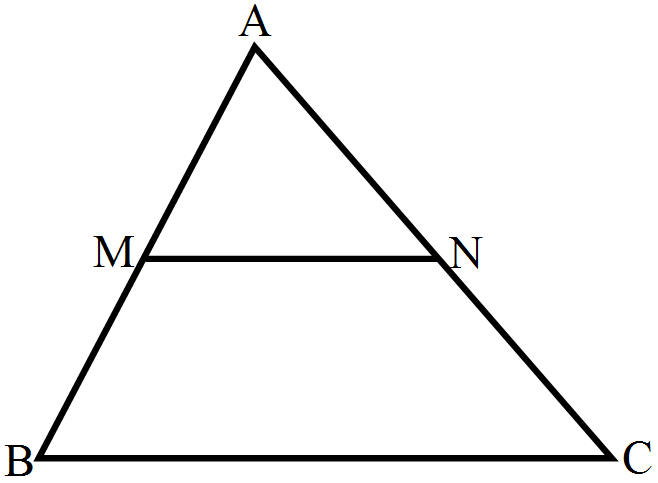
AnswerIn $\triangle\text{ABC}$ and $\triangle\text{AMN},$
So, $\angle\text{M}=\angle\text{B}$ and $\angle\text{N}=\angle\text{C}$ ....(corresponding angles)
$\Rightarrow\triangle\text{ABC}\sim\triangle\text{AMN}$ ....(AA criterion for similarity)
$\Rightarrow\frac{\text{area}(\triangle\text{AMN})}{\text{area}(\triangle\text{ABC})}=\frac{\text{AM}^2}{\text{AB}^2}$
Now, $\frac{\text{AM}}{\text{MB}}=\frac{1}{2}$
$\Rightarrow\frac{\text{MB}}{\text{AM}}=2$
By Componendo,
$\Rightarrow\frac{\text{MB}+\text{AM}}{\text{AM}}=2+1$
$\Rightarrow\frac{\text{AB}}{\text{AM}}=3$
$\Rightarrow\frac{\text{AM}}{\text{AB}}=\frac{1}{3}$
So, $\Rightarrow\frac{\text{area}(\triangle\text{AMN})}{\text{area}(\triangle\text{ABC})}=\bigg(\frac{\text{AM}^2}{\text{AB}^2}\bigg)^2=\bigg(\frac{1}{3}\bigg)=\frac{1}{9}.$
View full question & answer→