Question
In an experiment on determining the density of a rectangular block, the dimensions of the block are measured with a Venier Caliper (with a least count of 0.01cm) and its mass is measured with a beam balance of least count of 0.1gm. How do we report our result for the density of the block?
Answer

Let the measured values be:
Mass the block (m) = 39.3g
length (l) = 5.12cm
breadth (b) = 2.56cm
thickness (t) = 0.37cm
The density of the block is given by:
$\text{d}=\frac{\text{mass}}{\text{volume}}=\frac{\text{m}}{\text{l}\text{ ,b}\text{ ,h}}$
$=\frac{39.3}{5.12'2.56'0.37}=8.1037\text{gram}/\text{ cm}^3$
Now the uncertain value are:
$\text{l}=\pm0.01\text{cm}$
$\text{b}=\pm0.01\text{cm}$
$\text{t}=\pm0.01\text{cm}$
Maximum relative error, in the density, value is given by:
$\frac{\text{Dd}}{\text{d}}=\frac{\text{Dl}}{\text{l}}+\frac{\text{Db}}{\text{b}}+\frac{\text{Dt}}{\text{t}}+\frac{\text{Dm}}{\text{m}}$
$=\frac{0.01}{5.12}+\frac{0.01}{2.56}+\frac{0.01}{0.37}+\frac{0.7}{39.3}$
$=0.0019+0.0039+0.027+0.0024=0.0358$
$\therefore\Delta\text{d}=0.358\times8.1037=0.3\text{g}/\text{cm}^3\text{approx}$

Need a full question paper?

Generate a complete, print-ready paper with questions like this in minutes — across 16+ boards, with answer keys.

Start Generating Free

Similar questions

A particle P starts its motion at t = 0 and moves along a circle as shown in figure with period of 4s. Write down the equation representing S.H.M. of the particle P.
A capacitance C, a resistance R and an emf $\in$ are connected in series at t = 0. What is the maximum value of (a) the potential difference across the resistor (b) the current in the circuit (c) the potential difference across the capacitor (d) the energy stored in the capacitor (e) the power delivered by the battery and (f) the power converted into heat?
A solid sphere rolls down two different inclined planes of the same heights but different angles of inclination.
  1. Will it reach the bottom with the same speed in each case?
  2. Will it take longer to roll down one plane than the other?
  3. If so, which one and why?
Two trains each having a speed of 30km/ hr are headed at each other on the same track. A bird that can fly at 60km/ hr flies off from one train, when they are 60km apart, and heads directly for the other train. On reaching the other train, it flies directly back to the first, and so forth.
  1. How many trips can the bird make from one train to the other before they crash?
  2. What is the total distance the bird travels?
A ball of mass 50g moving at a speed of 2.0m/s strikes a plane surface at an angle of incidence 45°. The ball is reflected by the plane at equal angle of reflection with the same speed. Calculate
  1. The magnitude of the change in momentum of the ball.
  2. The change in the magnitude of the momentum of the ball.
Find the charge required to flow through an electrolyte to liberate one atom of.
  1. A monovalent material.
  2. A divalent material.
A current of 1.0A exists in a copper wire of cross-section 1.0mm2. Assuming one free electron per atom, calculate the drift speed of the free electrons in the wire. The density of copper is 9000kg/m-3.
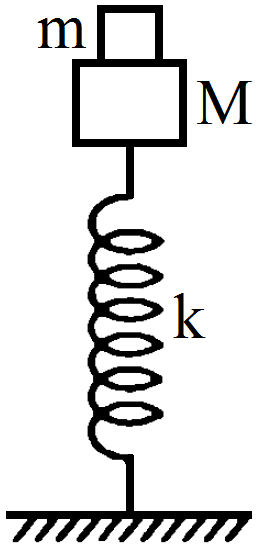
A small block of mass m is kept on a bigger block of mass M which is attached to a vertical spring of spring constant k as shown in the figure. The system oscillates vertically.
  1. Find the resultant force on the smaller block when it is displaced through a distance x above its equilibrium position.
  2. Find the normal force on the smaller block at this position. When is this force smallest in magnitude?
  3. What can be the maximum amplitude with which the two blocks may oscillate together?

Estimate the amount of energy released in the nuclear fusion reaction.
$_1\text{H}^2+_1\text{H}^2\rightarrow _2\text{He}^3+_0\text{n}^1$
Given: $\text{M}(_1\text{H}^2)=2.0141\text{u},$
$\text{M}(_2\text{He}^3)=3.0160\text{u}.$
$\text{M}(_2\text{n}^1)=1.0087\text{u},$
$1\text{amu}=1\text{u}$
$=1.661\times10^{-27}\text{ kg}$
$=931\text{Mev}$
A voltmeter coil has resistance $50.0\Omega$ and a resistor of $1.15\text{k}\Omega$ is connected in series. It can read potential differences up to 12 volts. If this same coil is used to construct an ammeter that can measure currents up to 2.0A, what should be the resistance of the shunt used?