Question
A solid sphere rolls down two different inclined planes of the same heights but different angles of inclination.
  1. Will it reach the bottom with the same speed in each case?
  2. Will it take longer to roll down one plane than the other?
  3. If so, which one and why?

Answer

  1. Mass of the sphere = m

Height of the plane = h

Velocity of the sphere at the bottom of the plane = v

At the top of the plane, the total energy of the sphere = Potential energy = mgh

At the bottom of the plane, the sphere has both translational and rotational kinetic energies.

Hence, total energy $=\Big(\frac{1}{2}\Big)\text{mv}^2+\bigg(\frac{\frac{1}{2}}{\omega^2}\bigg)$

Using the law of conservation of energy, we can write,

$\Big(\frac{1}{2}\Big)\text{mv}^2+\bigg(\frac{\frac{1}{2}}{\omega^2}\bigg)=\text{mgh}$

For a solid sphere, the moment of inertia about its centre, $\text{I}=\Big(\frac{2}{5}\Big)\text{mr}^2$

Hence, equation (i) becomes,

$\Big(\frac{1}{2}\Big)\text{mv}^2+\Big(\frac{1}{2}\Big)\Big[\Big(\frac{2}{5}\Big)\text{mr}^2\Big]\omega^2=\text{mgh}$

$\Big(\frac{1}{2}\Big)\text{v}^2+\Big(\frac{1}{5}\Big)\text{r}^2\omega^2=\text{gh}$

But we have the relation, $\text{v}=\text{r}\omega$

$\therefore\Big(\frac{1}{2}\Big)\text{v}^2+\Big(\frac{1}{5}\Big)\text{v}^2=\text{gh}$

$\text{v}^2\Big(\frac{7}{10}\Big)=\text{gh}$

$\text{v}=\sqrt{\Big(\frac{10}{7}\Big)}\text{gh}$

Hence, the velocity of the sphere at the bottom depends only on height (h) and acceleration due to gravity (g). Both these values are constants. Therefore, the velocity at the bottom remains the same from whichever inclined plane the sphere is rolled.

  1. Consider two inclined planes with inclinations $\theta_1$ and $\theta_2$ related as,

$\theta_1<\theta_2$

The acceleration produced in the sphere when it rolls down the plane inclined at $\theta_1$ is,

$\text{g}\sin\theta_1$

The various forces acting on the sphere are shown in the following figure:
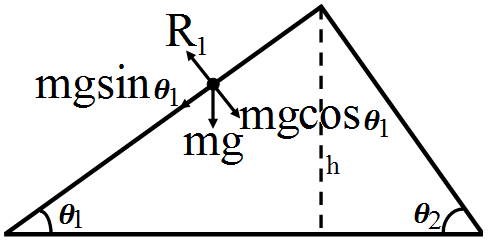
R1 is the normal reaction to the sphere.

Similarly, the acceleration produced in the sphere when it rolls down the plane inclined at $\theta_2$ is,

$\text{g}\sin\theta_2$

  1. The various forces acting on the sphere are shown in the following figure:
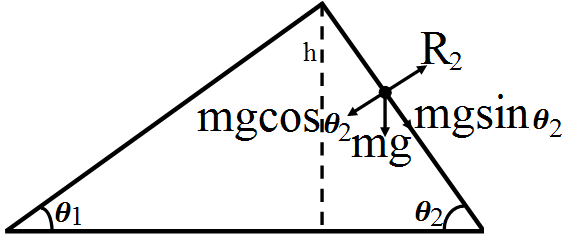
R2 is the normal reaction to the sphere.

$\theta_2>\theta_1,\sin\theta_2>\sin\theta_1\ ...(\text{i})$

$\therefore\text{ a}_2>\text{a}_1\ ...(\text{ii})$

Initial velocity, u = 0

Final velocity, v = Constant

Using the first equation of motion, we can obtain the time of roll as,

$\text{v}=\text{u}+\text{at}$

$\therefore\ \text{t}\propto\Big(\frac{1}{\alpha}\Big)$

For inclination $\theta_1: \text{t}\propto\Big(\frac{1}{\alpha_1}\Big)$

For inclination $\theta_2: \text{t}\propto\Big(\frac{1}{\alpha_2}\Big)$

From above equations, we get,

t< t1

Hence, the sphere will take a longer time to reach the bottom of the inclined plane having the smaller inclination.
Need a full question paper?

Generate a complete, print-ready paper with questions like this in minutes — across 16+ boards, with answer keys.

Start Generating Free

Similar questions

A pitcher with 1mm thick porous walls contains 10kg of water. Water comes to its outer surface and evaporates at the rate of 0.1gs-1. The surface area of the pitcher (one side)= 200cm2. The room temperature = 42°C, latent heat of vaporization $ =2.27\times10^6\text{Jkg}^{-1},$ and the thermal conductivity of the porous walls $=0.80\text{Js}^{-1}\text{m}^{-1}{^{\circ}}\text{C}^{-1}.$ Calculate the temperature of water in the pitcher when it attains a constant value.
A 50kg girl wearing high heel shoes balances on a single heel. The heel is circular with a diameter 1.0cm. What is the pressure exerted by the heel on the horizontal floor?
The escape speed of a projectile on the earth’s surface is 11.2km s-1. A body is projected out with thrice this speed. What is the speed of the body far away from the earth? Ignore the presence of the sun and other planets.
Find the potential difference between the points A and B and between the points B and C of the figure. in steady state.

Find the increase in surface energy when a large drop of water is sprayed into small droplets.
For the wave described in Exercise 15.8, plot the displacement (y) versus (t) graphs for x = 0, 2 and 4cm. What are the shapes of these graphs? In which aspects does the oscillatory motion in travelling wave differ from one point to another: amplitude, frequency or phase?
Mean solar day is the time interval between two successive noon when sun passes through zenith point (meridian). Sidereal day is the time interval between two successive transit of a distant star through the zenith point (meridian). By drawing appropriate diagram showing earth’s spin and orbital motion, show that mean solar day is four minutes longer than the sidereal day. In other words, distant stars would rise 4 minutes early every successive day.
Seven homogeneous bricks, each of length L, are arranged as shown in figure. Each brick is displaced with respect to the one in contact by $\frac{\text{L}}{10}.$ Find the x-coordinate of the centre of mass relative to the origin shown.

A metre scale made of steel reads accurately at 20°C. In a sensitive experiment, distances accurate up to 0.055mm in 1m are required. Find the range of temperature in which the experiment can be performed with this metre scale. Coefficient of linear expansion of steel = 11 × 10-6 °C-1.
Calculate the total torque acting on the body shown in figure about the point O.