Question
In an experiment on the specific heat of a metal, a 0.20 kg block of the metal at $150^{\circ} \mathrm{C}$ is dropped in a copper calorimeter (of water equivalent 0.025 kg ) containing $150 \mathrm{~cm}^3$ of water at $27^{\circ} \mathrm{C}$. The final temperature is $40^{\circ} \mathrm{C}$. Compute the specific heat of the metal. If heat losses to the surroundings are not negligible, is your answer greater or smaller than the actual value for specific heat of the metal?
Answer

Mass of the metal, $m = 0.20kg = 200g$
Initial temperature of the metal, $T_1 = 150^\circ C$
Final temperature of the metal, $T_2 = 40^\circ C$
Calorimeter has water equivalent of mass, m’ = 0.025kg = 25g
Volume of water, $V = 150cm^3$
Mass (M) of water at temperature $T = 27^\circ C: 150 \times 1 = 150g$
Fall in the temperature of the metal:
$\triangle\text{T}=(\text{T}_1-\text{T}_2)=(150-40)=110^\circ\text{C}$
Specific heat of water, $\text{C}_\text{w}=\frac{4.186\text{J}}{\frac{\text{g}}{^\circ\text{K}}}$
Specific heat of the metal = C
Heat lost by the metal, $\theta=\text{m}\text{C}\triangle\text{T}\ ...(1)$
Rise in the temperature of the water and calorimeter system:
$\triangle\text{T}=(40-27)=13^\circ\text{C}$
Heat gained by the water and calorimeter system:
$\triangle\theta=\text{m}_1\text{C}_\text{w}\triangle\text{T}$
$=(\text{M}+\text{m}')\text{C}_\text{w}\triangle\text{T}'$
$(200\times\text{C}\times110)=(1(50+25))\times4.186\times13)$
$\frac{(175\times4.186\times13)}{(110\times200)}=0.43\text{jg}^{-1}\text{K}^{-1}$
If some heat is lost to the surroundings, then the value of C will be smaller than the actual value.

Need a full question paper?

Generate a complete, print-ready paper with questions like this in minutes — across 16+ boards, with answer keys.

Start Generating Free

Similar questions

In a laboratory experiment (room temperature being $15°C$), the wavelength of a note of sound of frequency $500Hz$ is found to be $0.68m$. If the density of air at STP is $1.29kg m^{-3}$ calculate the ratio of the specific heat of air.
Consider $N=n_1 n_2$ identical cells, each of emf $\in$ and internal resistance $r$. Suppose $n_1$ cells are joined in series to form a line and $\mathrm{n}_2$ such lines are connected in parallel. The combination drives a current in an external resistance R.
(a) Find the current in the external resistance. (b) Assuming that $\mathrm{n}_1$ and $\mathrm{n}_2$ can be continuously varied, find the relation between $n_1, n_2, R$ and $r$ for which the current in $R$ is maximum.
  1. Derive expression for kinetic energy and potential energies of simple harmonic oscillator. Hence show that the total energy is conserved.
  2. What is the length of a simple pendulum which ticks in one second?
Prove that the distance covered by a uniformly accelerated body in $n ^{\text {th }}$ second
$
s_n=u+\frac{1}{2} a(2 n-1)
$
A body covers $12m$ in $2^{nd}$ second and $20m$ in $4^{th}$ second. Find what distance the body will cover in $4$ second after $5^{th}$ second.
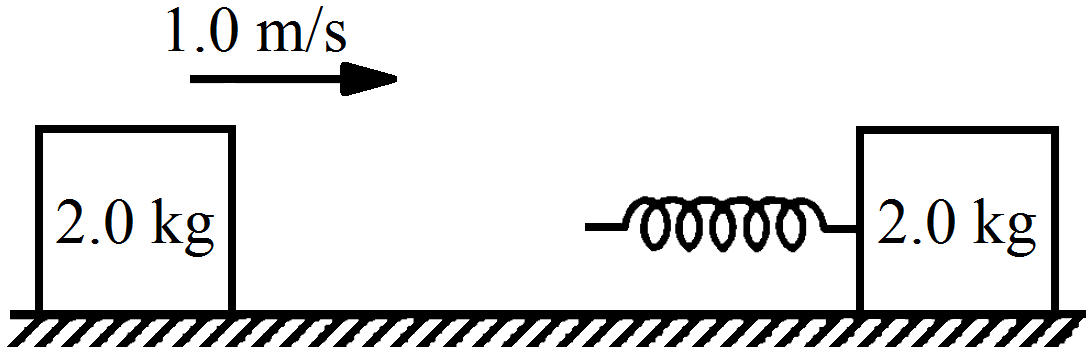
A block of mass 2.0kg is moving on a frictionless horizontal surface with a velocity of 1.0m/s towards another block of equal mass kept at rest. The spring constant of the spring fixed at one end is 100N/m. Find the maximum compression of the spring.
The current in an ideal, long solenoid is varied at a uniform rate of 0.01A/s. The solenoid has 2000 turns/m and its radius is 6.0cm.
  1. Consider a circle of radius 1.0cm inside the solenoid with its axis coinciding with the axis of the solenoid. Write the change in the magnetic flux through this circle in 2.0 seconds.
  2. Find the electric field induced at a point on the circumference of the circle.
  3. Find the electric field induced at a point outside the solenoid at a distance 8.0cm from its axis.
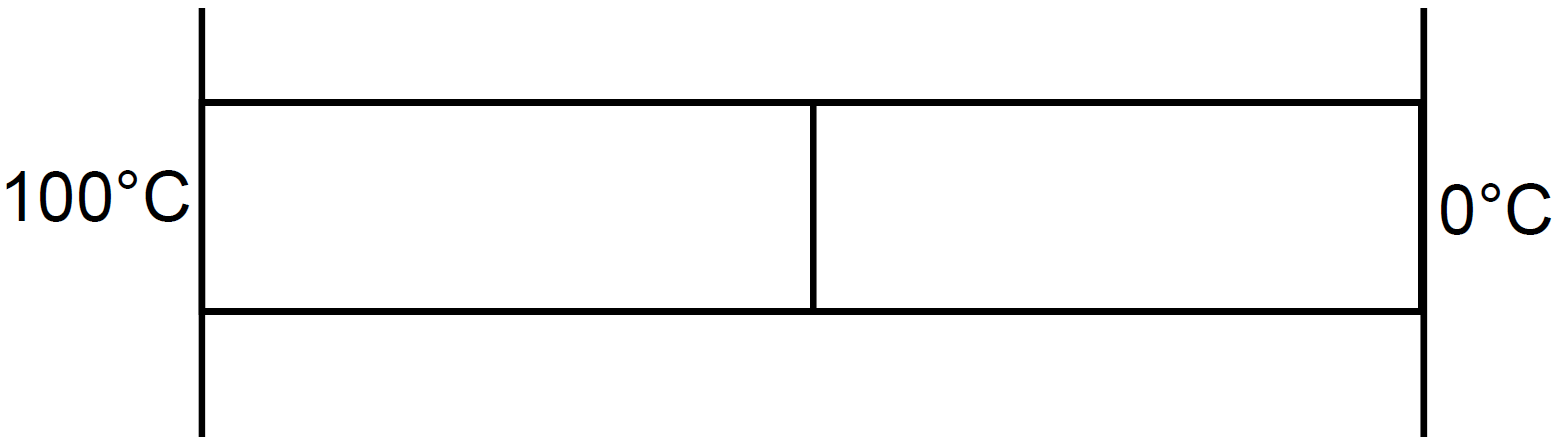
The two rods shown in figure, have identical geometrical dimensions. They are in contact with two heat baths at temperatures $100^{\circ} \mathrm{C}$ and $0^{\circ} \mathrm{C}$. The temperature of the junction is $70^{\circ} \mathrm{C}$. Find the temperature of the junction if the rods are interchanged.
A long, straight wire is fixed horizontally and carries a current of $50.0A$. A second wire having linear mass density $1.0 \times 10^{-4}kg/m$ is placed parallel to and directly above this wire at a separation of $5.0mm$. What current should this second wire carry such that the magnetic repulsion can balance its weight?
$\hat{\text{i}}$ and $\hat{\text{j}}$ are unit vectors along x- and y- axis respectively. What is the magnitude and direction of the vectors $\hat{\text{i}}+\hat{\text{j}},$ and $\hat{\text{i}}-\hat{\text{j}}$? What are the components of a vector $\text{A}=2\hat{\text{i}}+3\hat{\text{j}}$ along the directions of $\hat{\text{i}}+\hat{\text{j}}$ and $\hat{\text{i}}-\hat{\text{j}}$? [You may use graphical method]