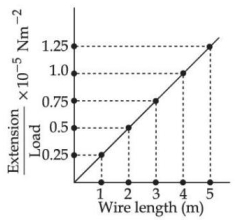
In an experiment to determine the Young's modulus, steel wires of five different lengths $(1,2,3,4$ and $5\,m )$ but of same cross section $\left(2\,mm ^{2}\right)$ were taken and curves between extension and load were obtained. The slope (extension/load) of the curves were plotted with the wire length and the following graph is obtained. If the Young's modulus of given steel wires is $x \times 10^{11}\,Nm ^{-2}$, then the value of $x$ is
JEE MAIN 2022, Medium


Download our appand get started for free
Experience the future of education. Simply download our apps or reach out to us for more information. Let's shape the future of learning together!No signup needed.*
Similar Questions
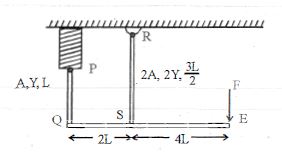
- 1A rigid massless rod of length $6\ L$ is suspended horizontally by means of two elasticrods $PQ$ and $RS$ as given figure. Their area of cross section, young's modulus and lengths are mentioned in figure. Find deflection of end $S$ in equilibrium state. Free end of rigid rod is pushed down by a constant force . $A$ is area of cross section, $Y$ is young's modulus of elasticityView Solution
- 2The pressure that has to be applied to the ends of a steel wire of length $10\ cm$ to keep its length constant when its temperature is raised by $100^o C$ is: (For steel Young's modulus is $2 \times 10^{11}$ $Nm^{-1}$ and coefficient of thermal expansion is $1.1 \times 10^{-5}$ $K^{-1}$ )View Solution
- 3A force $F$ is applied on a square area of side $L$. If the percentage error in the measurement of $L$ is $2 \%$ and that in $F$ is $4 \%$, what is the maximum percentage error in pressure?View Solution
- 4$Assertion :$ Solids are least compressible and gases are most compressible.View Solution
$Reason :$ solids have definite shape and volume but gases do not have either definite shape or definite volume. - 5View SolutionLiquids have no Poisson's ratio, because
- 6View SolutionThe isothermal bulk modulus of a gas at atmospheric pressure is
- 7Which of the following curve represents the correctly distribution of elongation $(y)$ along heavy rod under its own weight $L \rightarrow$ length of rod, $x \rightarrow$ distance of point from lower end?View Solution
- 8Stress required in a wire to produce $0.1\%$ strain is $4 \times10^8\, N/m^2$. Its yound modulus is $Y_1$. If stress required in other wire to produce $0.3\%$ strain is $6 \times 10^8\, N/m^2$. Its young modulus is $Y_2$. Which relation is correctView Solution
- 9View SolutionTo keep constant time, watches are fitted with balance wheel made of
- 10If one end of a wire is fixed with a rigid support and the other end is stretched by a force of $10 \,N,$ then the increase in length is $0.5\, mm$. The ratio of the energy of the wire and the work done in displacing it through $1.5\, mm$ by the weight isView Solution