In an experiment to measure the internal resistance of a cell by potentiometer, it is found that the balance point is at a length of $2\,m$ when the cell is shunted by a $5\,\Omega $ resistance; and is at a length of $3\,m$ when the cell is shunted by a $10\,\Omega $ resistance. The internal resistance of the cell is, then ................ $\Omega $
Medium
Download our app for free and get started
b
$r = \left( {\frac{{{l_1} - {l_2}}}{{{l_2}}}} \right) \times R'$$ = \left( {\frac{{{l_1} - 2}}{2}} \right) \times 5$ ... $(i)$
$r = \left( {\frac{{{l_1} - {l_2}}}{{{l_2}}}} \right) \times R'$$ = \left( {\frac{{{l_1} - 2}}{2}} \right) \times 5$ ... $(i)$
and $r = \left( {\frac{{{l_1} - 3}}{3}} \right) \times 10$ ... $(ii)$
On solving $(i)$ and $(ii)$
$r = 10 \,\Omega$

Download our appand get started for free
Experience the future of education. Simply download our apps or reach out to us for more information. Let's shape the future of learning together!No signup needed.*
Similar Questions
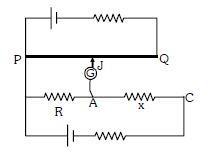
- 1Circuit for the measurement of resistance by potentiometer is shown. The galvanometer is first connected at point $A$ and zero deflection is observed at length $P J = 10\ cm$ . In second case it is connected at point $C$ and zero deflection is observed at a length $30\ cm$ from $P$ . Then the unknown resistance $X$ isView Solution
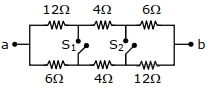
- 2In the given figure switches $S_{1}$ and $S_{2}$ are in open condition. The resistance across $a b$ when the switches $S_{1}$ and $S_{2}$ are closed is $...\,\Omega$View Solution
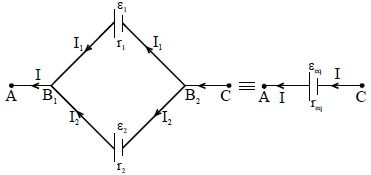
- 3Consider a parallel combination of the cellsshown in the figure.The potential difference in between $B_1$ and $B_2$ isView Solution
- 4View SolutionCorrect set up to verify Ohm's law is
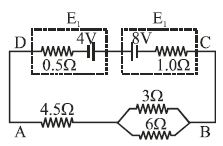
- 5In the given circuit, calculate the value of current in $4.5\,\Omega $ resistor .............. $\mathrm{A}$View Solution
- 6A rod of a certain metal is $1.0\, m$ long and $0.6\, cm$ in diameter. Its resistance is $3.0 × {10^{ - 3}}\, ohm$. Another disc made of the same metal is $2.0\, cm$ in diameter and $1.0\, mm$ thick. What is the resistance between the round faces of the discView Solution
- 7Which of the four resistances $P, Q, R$ and $S$ generate the greatest amount of heat when a current flows from $A$ to $B$ ?View Solution
- 8A $10\,m$ long potentiometer wire has a potential gradient of $0.0025\, V/cm$. Calculate the distance of null point when the wire is connected to a $1.025\,V$ standard cell ............... $\mathrm{m}$View Solution
- 9The $V-i$ graph for a conductor makes an angle $\theta $ with $V-$ axis. Here $ V$ denotes the voltage and $i$ denotes current. The resistance of conductor is given byView Solution
- 10The thermo $e.m.f.$ of a thermo-couple is $25\,\mu V{/^o}C$ at room temperature. A galvanometer of $40\, ohm$ resistance, capable of detecting current as low as ${10^{ - 5}}\,A,$ is connected with the thermocouple. The smallest temperature difference that can be detected by this system is ................ $^oC$View Solution