Question
In an ideal spring the length is 0.5 kg one of mass vertical oscillations are made by suspending the body. If the oscillation period is $\frac{\pi}{2}$ then what is the spring constant?

Answer

Given : $m=0.5 kg$ and $T=\frac{\pi}{2} sec$
$T=2 \pi \sqrt{\frac{m}{k}}$
$\frac{\pi}{2}=2 \pi \sqrt{\frac{m}{k}}$
$\frac{1}{4}=\sqrt{\frac{0.5}{k}}$
On squaring
$\frac{1}{16}=\frac{0.5}{k}$
$\begin{aligned} k & =16 \times 0.5 \\ & =8 N / m \end{aligned}$

Need a full question paper?

Generate a complete, print-ready paper with questions like this in minutes — across 16+ boards, with answer keys.
Start Generating Free

Similar questions

The density of atmosphere is $1.29 \mathrm{~kg} \mathrm{~m}^{-3}$ at sea level, where atmospheric pressure is $1.013 \times 10^5 \mathrm{~Pa}$. If we assume that atmospheric density does not change with altitude, then what should be the height of the atmosphere?
Two thermos flasks are of the same height and same capacity. One has a circular cross-section while the other has a square cross-section. Which of the two is better?
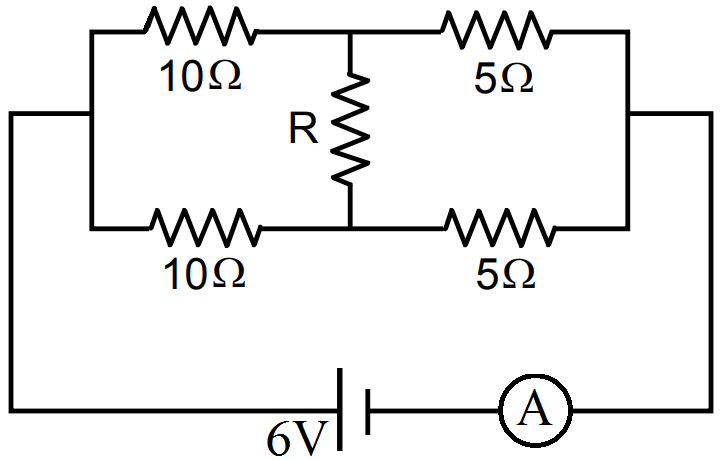
What should be the value of R in the figure. for which the current in it is zero?
A semicircular wire of radius 5.0cm carries a current of 5.0A. A magnetic field B of magnitude 0.50T exists along the perpendicular to the plane of the wire. Find the magnitude of the magnetic force acting on the wire.
If the mass of the sun is $2 \times 10^{30} kg$, the distance of the earth from the sun is $1.5 \times 10^{11} m$ and period of revolution of the earth around the sun is one year ( $=365.3$ days), calculate the value of gravitational constant.
A nucleus is at rest in the laboratory frame of reference. Show that if it disintegrates into two smaller nuclei, the products must be emitted in opposite directions.
At what time is the potential of a simple harmonic and kinetic energy oscillator equal?
A body hanging from a spring can oscillate in a horizontal plane with angular velocity $\omega$ without friction or damping when it is stretched to a distance and then released. It passes through the equilibrium center with a velocity at time $t=0$. Find the amplitude of the resultant oscillation in terms of parameter $\omega_0, x_0$ and $v_0$.
[Hint : The equation $x=a \cos (\omega t+\theta)$ is negative keep in mind that the initial]
Is the bulb of a thermometer made of diathermic or adiabatic wall?
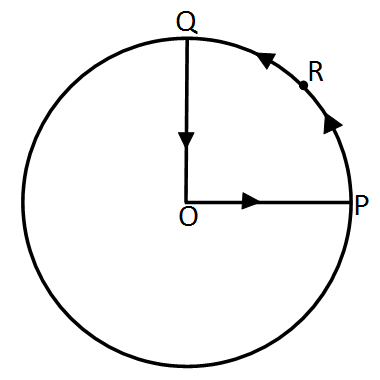
A cyclist starts from centre O of a circular park of radius 1km and moves along the path OPRQO as shown Fig. If he maintains constant speed of $10ms^{–1}$, what is his acceleration at point R in magnitude and direction?