MCQ
In an induction coil, the secondary $e.m.f.$ is
  • A
    Zero during break of the circuit
  • B
    Very high during make of the circuit
  • C
    Zero during make of the circuit
  • Very high during break of the circuit

Answer

Correct option: D.
Very high during break of the circuit
d
When the circuit break, current in circuit become zero in very small time. therefore $\frac{\text { di }}{\text { di }}$ will be high.Hence induce e.m.f. will be high.

Need a full question paper?

Generate a complete, print-ready paper with questions like this in minutes — across 16+ boards, with answer keys.
Start Generating Free

Similar questions

Which of the following logic gate is an universal gate
A straight wire carrying a current ${i_1}\,amp$ runs along the axis of a circular current ${i_2}\,amp$. Then the force of interaction between the two current carrying conductors is
To draw maximum current from a combination of cells, how should the cells be grouped
How will two parallel beams of electron behave while moving in the same direction?
In Young's double slit experiment, if the two slits are illuminated with separate sources, no interference pattern is observed because
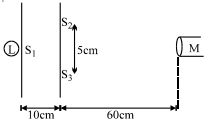
$A$ student is asked to measure the wavelength of monochromatic light. He sets up the apparatus sketched below. $S_1, S_2, S_3$ are narrow parallel slits, $L$ is a sodium lamp and $M$ is a microscope eyepiece. The student fails to observe interference fringes. Your first advice to him will be
Two particles $A$ and $B$ having equal charges $+6\,C$, after being accelerated through the same potential difference, enter in a region of uniform magnetic field and describe circular paths of radii $2\,cm$ and $3\,cm$ respectively. The ratio of mass of $A$ to that of $B$ is
Monochromatic light of frequency $5 \times {10^{14}}Hz$ travelling in vacuum enters a medium of refractive index $1.5.$ Its wavelength in the medium is.......$\mathop A\limits^o $
A coil has $L =\, 0.04\, H $and $R = 12\,\Omega $. When it is connected to $220\,V$, $50\,Hz$ supply the current flowing through the coil, in amperes is
A ray of light travelling in the direction $\frac{1}{2}(\hat{i}+\sqrt{3} \hat{j})$ is incident on a plane mirror. After reflection, it travels along the direction $\frac{1}{2}(\hat{i}-\sqrt{3 \hat{j}})$. The angle of incidence is: