MCQ
In an inelastic collision:
  • A
    The initial kinetic energy is equal to the final kinetic energy.
  • B
    The final kinetic energy is less than the initial kinetic energy.
  • C
    The kinetic energy remains constant.
  • D
    The kinetic energy first increases then decreases.
Answer

  1. The final kinetic energy is less than the initial kinetic energy.

Explanation:

As some energy is loss into heat in an inelastic collision, the final kinetic energy is less than the initial kinetic energy.

Need a full question paper?

Generate a complete, print-ready paper with questions like this in minutes — across 16+ boards, with answer keys.

Start Generating Free

Similar questions

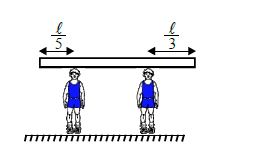
Two persons of equal height are carrying a long uniform wooden beam of length $\ell $. They are at distance  $\frac{\ell }{5}$ and $\frac{\ell }{3}$ . From nearest end of the rod. The ratio of normal reaction at their heads is
A body of mass $‘M’$ collides against a wall with a velocity $v$ and retraces its path with the same speed. The change in momentum is (take initial direction of velocity as positive)
Energy required to form a soap bubble of diameter $20 \,cm$ will be (Surface tension for soap solution is $30$ dynes/cm)
Two equal forces ($P$ each) act at a point inclined to each other at an angle of $120^°$. The magnitude of their resultant is
Two planets have the same average density but their radii are ${R_1}$ and ${R_2}$. If acceleration due to gravity on these planets be ${g_1}$ and ${g_2}$ respectively, then
Column $I$ Contains a list of processes involving expansion of an ideal gas. Match this with Column $II$ describing the thermodynamic change during this process. Indicate your answer by darkening the appropriate bubbles of the $4 \times 4$ matrix given in the $ORS$.
Column $I$ Column $II$
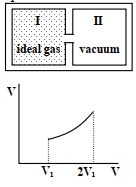
$(A)$ An insulated container has two chambers separated by a valve. Chamber $I$ contains an ideal gas and the Chamber $II$ has vacuum. The valve is opened. $(p)$ The temperature of the gas decreases
$(B)$ An ideal monoatomic gas expands to twice its original volume such that its pressure $\mathrm{P} \propto \frac{1}{\mathrm{~V}^2}$, where $\mathrm{V}$ is the volume of the gas $(q)$ The temperature of the gas increases or remains constant
$(C)$ An ideal monoatomic gas expands to twice its original volume such that its pressure $\mathrm{P} \propto \frac{1}{\mathrm{~V}^{4 / 3}}$, where $\mathrm{V}$ is its volume $(r)$ The gas loses heat
$(D)$ An ideal monoatomic gas expands such that its pressure $\mathrm{P}$ and volume $\mathrm{V}$ follows the behaviour shown in the graph $Image$ $(s)$ The gas gains heat

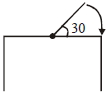
One end of a straight uniform $1\; \mathrm{m}$ long bar is pivoted on horizontal table. It is released from rest when it makes an angle $30^{\circ}$ from the horizontal (see figure). Its angular speed when it hits the table is given as $\sqrt{\mathrm{n}}\; \mathrm{s}^{-1},$ where $\mathrm{n}$ is an integer. The value of $n$ is
A uniform cubical block is subjected to volumetric compression, which decreases its each side by $2 \%$. The Bulk strain produced in it is ............
The quantities $A$ and $B$ are related by the relation, $m = A/B$, where $m$ is the linear density and $A$ is the force. The dimensions of $B$ are of
Three identical balls are projected with the same speed at angle $30^o, 45^o$ and $60^o$. Their ranges are $R_1 R_2$ and $R_3$ respectively. Then